
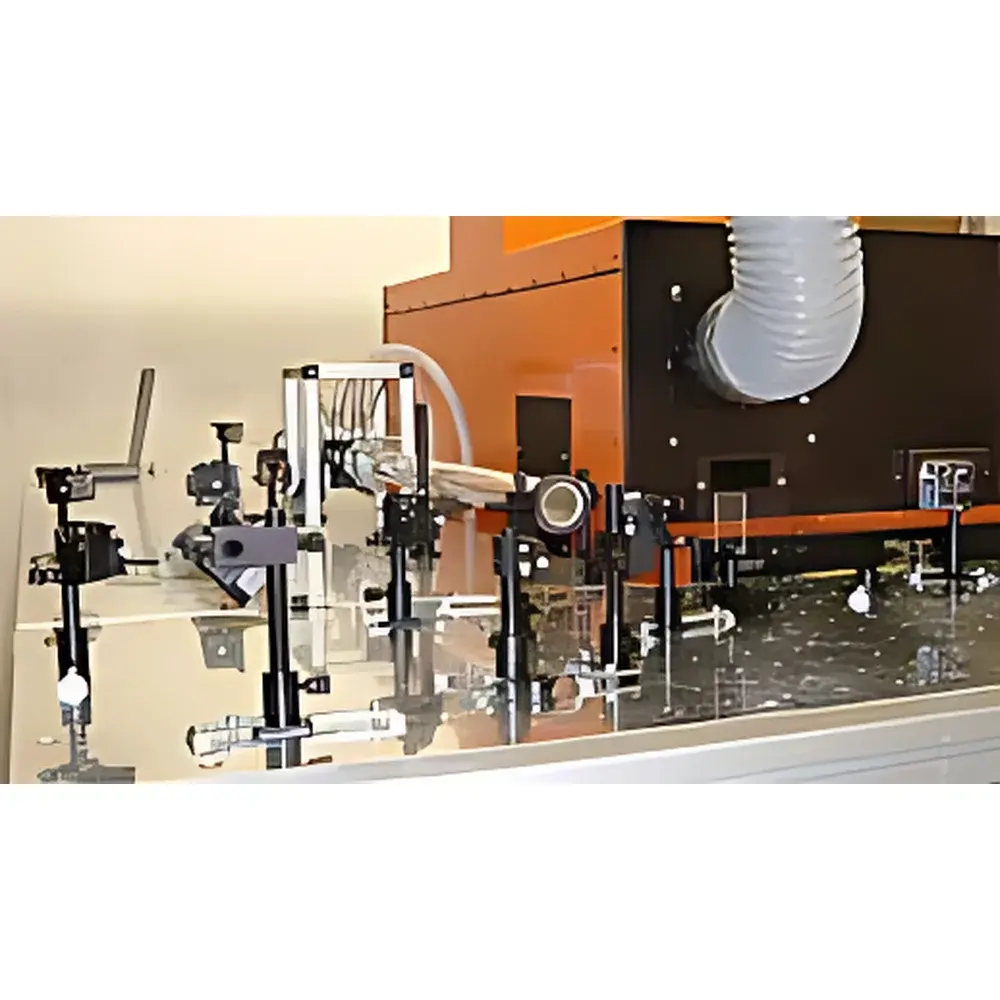
LLG100 UV Femtosecond Laser Amplifier
| Brand | Laser-Laboratorium Göttingen e.V. |
|---|---|
| Origin | Germany |
| Model | LLG100 |
| Wavelength | 248 nm |
| Single-Pulse Energy | 100 mJ (≥50 µJ seed pulse energy @ 248 nm) |
| Timing Jitter | ±2 ns (relative to trigger pulse) |
| Beam Size | 36 × 36 mm² |
| Beam Quality | 2× diffraction-limited (M² = 1 input) |
Overview
The LLG100 UV Femtosecond Laser Amplifier is a high-energy, narrow-bandwidth optical parametric amplifier system engineered for ultrafast science applications requiring precise temporal control and deep-UV photon delivery. Developed by Laser-Laboratorium Göttingen e.V., this amplifier operates at a fundamental wavelength of 248 nm—corresponding to the KrF excimer spectral line—and delivers up to 100 mJ per pulse with sub-100-fs temporal duration (pulse width specified at full-width half-maximum under standard compression conditions). Its core architecture employs interferometric pulse stacking: linearly polarized seed pulses are split into orthogonally polarized components that counter-propagate through the same gain medium, enabling coherent recombination and phase-locked amplification. This design ensures high spatial overlap, minimal wavefront distortion, and deterministic pulse-to-pulse phase stability—critical for pump-probe spectroscopy, attosecond pulse generation via high-harmonic generation (HHG), and time-resolved photoelectron imaging.
Key Features
- Interferometric pulse stacking architecture for coherent energy scaling without nonlinear temporal broadening
- Deep-UV output at 248 nm with >100 mJ single-pulse energy (conditioned on ≥50 µJ seed input)
- Timing jitter of ±2 ns relative to external TTL trigger—compatible with synchronized multi-laser experiments
- Uniform 36 × 36 mm² near-top-hat beam profile with controlled divergence (<0.3 mrad)
- Beam quality maintained at ≤2× diffraction limit (M² ≤ 2) when driven by M² = 1 seed source
- Gas-based amplification medium (KrF-excited gain medium) ensuring high thermal stability and long-term operational reproducibility
- Integrated vacuum-compatible beam transport interface for integration into UHV end-stations
Sample Compatibility & Compliance
The LLG100 is designed for use in research-grade ultrafast laboratories where stringent environmental and regulatory requirements apply. It complies with IEC 60825-1:2014 Class 4 laser safety standards and incorporates interlocked beam enclosures, redundant shutter systems, and real-time power monitoring with automatic shutdown protocols. All optical paths are sealed against ambient humidity to prevent ozone-induced degradation of UV-transmitting optics. The system meets CE marking requirements for electromagnetic compatibility (EMC Directive 2014/30/EU) and low-voltage operation (LVD Directive 2014/35/EU). While not certified for clinical or industrial production environments, its architecture supports GLP-aligned documentation workflows—including audit-trail-enabled logging of pulse energy, repetition rate, and trigger latency—for traceable data acquisition in peer-reviewed publications.
Software & Data Management
Control is implemented via a deterministic real-time Linux-based embedded controller interfaced through Ethernet (TCP/IP) and USB 2.0. The vendor-supplied LabVIEW-compatible API provides programmatic access to all operational parameters—including seed injection timing, cavity alignment feedback, and energy stabilization loop setpoints. Pulse energy measurements are logged with timestamp resolution of 100 ns and stored in HDF5 format for interoperability with Python (h5py), MATLAB, and OriginLab analysis pipelines. Optional firmware modules support 21 CFR Part 11–compliant electronic signatures and audit trails when deployed in regulated academic core facilities subject to NIH or DFG audit requirements.
Applications
- Pump-probe transient absorption spectroscopy of wide-bandgap semiconductors and insulators
- High-harmonic generation in noble gases for tabletop attosecond XUV sources
- Time-resolved photoemission electron microscopy (PEEM) of topological materials
- UV photolysis studies of prebiotic molecular dynamics under simulated space conditions
- Calibration reference source for synchrotron beamline diagnostics and FEL seeding validation
- Nonlinear frequency conversion experiments requiring high-peak-power, phase-stable UV drivers
FAQ
What is the minimum required seed pulse energy to achieve rated 100 mJ output?
A seed pulse energy of ≥50 µJ at 248 nm is required to reach full 100 mJ amplification; lower seed energies scale output linearly down to threshold operation.
Is the LLG100 compatible with commercial Ti:sapphire oscillator systems?
Yes—when coupled with a 248 nm harmonic generation stage (e.g., BBO-based fourth-harmonic generation from 992 nm), it accepts standard 1-kHz, 100-fs Ti:Sa oscillators as seed sources.
Does the system include pulse compression optics?
No—compression is performed externally using chirped-mirror pairs or grating compressors optimized for 248 nm; the amplifier outputs transform-limited or slightly chirped pulses depending on gain medium dispersion.
Can the LLG100 operate at variable repetition rates?
It is configured for fixed 1-Hz operation to ensure thermal equilibrium in the KrF gain medium; higher repetition rates require custom thermal management upgrades and are not covered under standard warranty.
What maintenance intervals are recommended for gas replenishment and optic inspection?
KrF gas refill is required every 12 months under continuous operation; fused silica and MgF₂ optics should be inspected quarterly for UV-induced solarization and surface contamination.




