
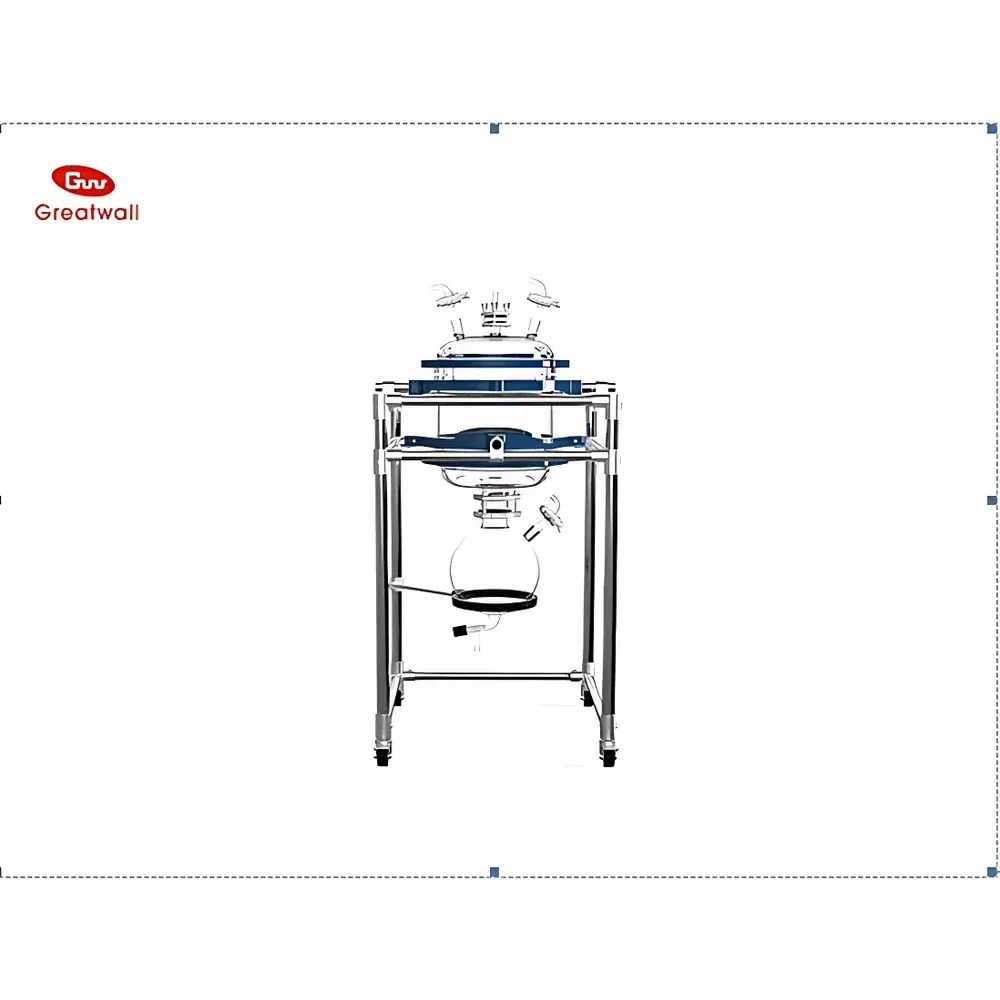
Great Wall CLZZ-30 Vacuum Filtration Apparatus
| Brand | Great Wall |
|---|---|
| Origin | Henan, China |
| Manufacturer Type | Direct Manufacturer |
| Country of Origin | China |
| Model | CLZZ-30 |
| Instrument Category | Other Reactors |
| Usable Volume | Medium-Scale |
| Construction Material | Borosilicate Glass 3.3 (Body), SUS304 Stainless Steel + Anodized 6061-F Aluminum (Frame) |
| Operating Pressure Range | Vacuum to Atmospheric |
| Capacity | 30 L (Filtration Vessel), 20 L (Collection Flask) |
| Vacuum Level | ≤ −0.098 MPa (≤ 98 kPa absolute) |
| Filtration Area Diameter | Ø300 mm |
| Filter Disc Material | PTFE Sintered Frit |
| Pore Size | 20–30 µm |
| Temperature Range | −80 °C to +200 °C |
| Frame Dimensions (W×D×H) | Approx. 650 × 650 × 1600 mm |
| Port Standards | 40# Flange (Liquid Feed), 24/29# Standard Taper Ground Joints (Vacuum & Vent) |
Overview
The Great Wall CLZZ-30 Vacuum Filtration Apparatus is a medium-scale, bench-to-pilot plant filtration system engineered for reliable solid–liquid separation under controlled vacuum conditions. It operates on the principle of pressure-driven filtration, where differential pressure across a rigid, sintered PTFE frit generates convective flow through suspended particulates—enabling efficient cake formation and filtrate recovery. Designed for chemical synthesis, crystallization workups, catalyst recovery, and pharmaceutical intermediate isolation, the CLZZ-30 integrates process transparency with mechanical robustness. Its all-glass wetted path—fabricated from DIN/ISO-compliant borosilicate glass 3.3—ensures chemical inertness against strong acids, bases, and organic solvents across a wide thermal range (−80 °C to +200 °C). The apparatus maintains structural integrity under sustained vacuum down to ≤ −0.098 MPa (≤ 98 kPa absolute), supporting both batch and semi-continuous operation in GLP-compliant laboratories and pilot-scale reaction workflows.
Key Features
- Transparent filtration vessel (Ø300 mm) constructed entirely from high-purity borosilicate glass 3.3 per DIN ISO 3585, offering superior thermal shock resistance (ΔT ≥ 150 °C) and hydrolytic stability (Class HGB 1 per ISO 719)
- SUS304 stainless steel frame with anodized 6061-F aluminum panels and electrostatic powder coating—providing corrosion resistance, static rigidity, and compatibility with cleanroom-grade environments
- Interchangeable sintered PTFE filter discs (20–30 µm nominal pore size) mounted on a quick-release support plate; no tools required for removal or replacement
- Modular ground-glass port configuration: 40# flange for liquid feed, dual 24/29# standard taper joints for vacuum evacuation and venting—ensuring leak-tight sealing per ISO 3585 and ASTM E287
- Lockable swivel casters (two fixed, two braked) enabling stable repositioning within fume hoods or reactor suites without compromising alignment or vacuum integrity
- Integrated pressure relief valve and vacuum gauge port (not supplied) compatible with third-party digital manometers calibrated to NIST-traceable standards
Sample Compatibility & Compliance
The CLZZ-30 accommodates heterogeneous slurries containing crystalline APIs, metal oxides, polymer precipitates, and heterogeneous catalysts—provided particle size exceeds the frit’s retention threshold (≥ 30 µm recommended for optimal flow rate and cake release). Its non-metallic fluid path eliminates leaching risks, making it suitable for USP particulate matter testing preparation and ICH Q5A-compliant bioprocess clarification steps. All glass components conform to ISO 1042 (volumetric calibration) and ASTM E438 (Type I, Class A). The apparatus supports audit-ready documentation when operated under SOP-defined parameters aligned with FDA 21 CFR Part 11 (when paired with compliant data loggers) and meets mechanical safety requirements per EN 61000-6-2 (EMC immunity) and EN 61000-6-4 (EMC emission).
Software & Data Management
As a manually operated vacuum filtration platform, the CLZZ-30 does not include embedded firmware or proprietary software. However, its standardized vacuum interface (1/4″ NPT or M10 × 1 metric thread) allows seamless integration with external vacuum controllers (e.g., KNF NP series, Vacuubrand RC 6) equipped with analog 0–10 V or 4–20 mA output for real-time pressure logging. When connected to validated SCADA or LIMS systems via industrial PLC gateways, operational parameters—including vacuum ramp profiles, dwell times, and endpoint detection via filtrate conductivity monitoring—can be archived with full electronic audit trails meeting ALCOA+ principles.
Applications
- Isolation of crystalline active pharmaceutical ingredients (APIs) following antisolvent precipitation or cooling crystallization
- Recovery of heterogeneous catalysts (e.g., Pd/C, Raney Ni) in fine chemical hydrogenation processes
- Filtration of thermally sensitive biopolymers (e.g., alginate, chitosan) under ambient or chilled conditions
- Removal of desiccants (MgSO₄, Na₂SO₄) and insoluble reagents post-reaction quenching
- Preparative-scale purification of metal–organic frameworks (MOFs) and covalent organic frameworks (COFs)
- Slurry washing and displacement cycles using solvent gradients under inert atmosphere (via optional gas inlet adapter)
FAQ
What vacuum pumps are compatible with the CLZZ-30?
Diaphragm, scroll, or oil-lubricated rotary vane pumps delivering ≥ 10 m³/h at ≤ 1 mbar are recommended; KNF N840.3, Edwards RV8, or Agilent IDP-10 meet typical duty cycle requirements.
Can the CLZZ-30 be used under positive pressure?
No—it is rated exclusively for vacuum-to-atmospheric operation; pressurization may compromise glass joint integrity and void warranty.
Is autoclaving supported for sterilization?
Borosilicate glass 3.3 components tolerate steam sterilization (121 °C, 20 min), but PTFE frits degrade above 260 °C; dry heat (160 °C, 2 h) is preferred for full assembly.
How often should the PTFE frit be replaced?
Under routine use with non-abrasive slurries, service life exceeds 500 cycles; inspect visually for channeling or permanent pore deformation before critical batches.
Does Great Wall provide GMP documentation packages?
Yes—upon request, Factory Acceptance Test (FAT) reports, material certifications (EN 10204 3.1), and dimensional inspection records are available for IQ/OQ protocol development.



