
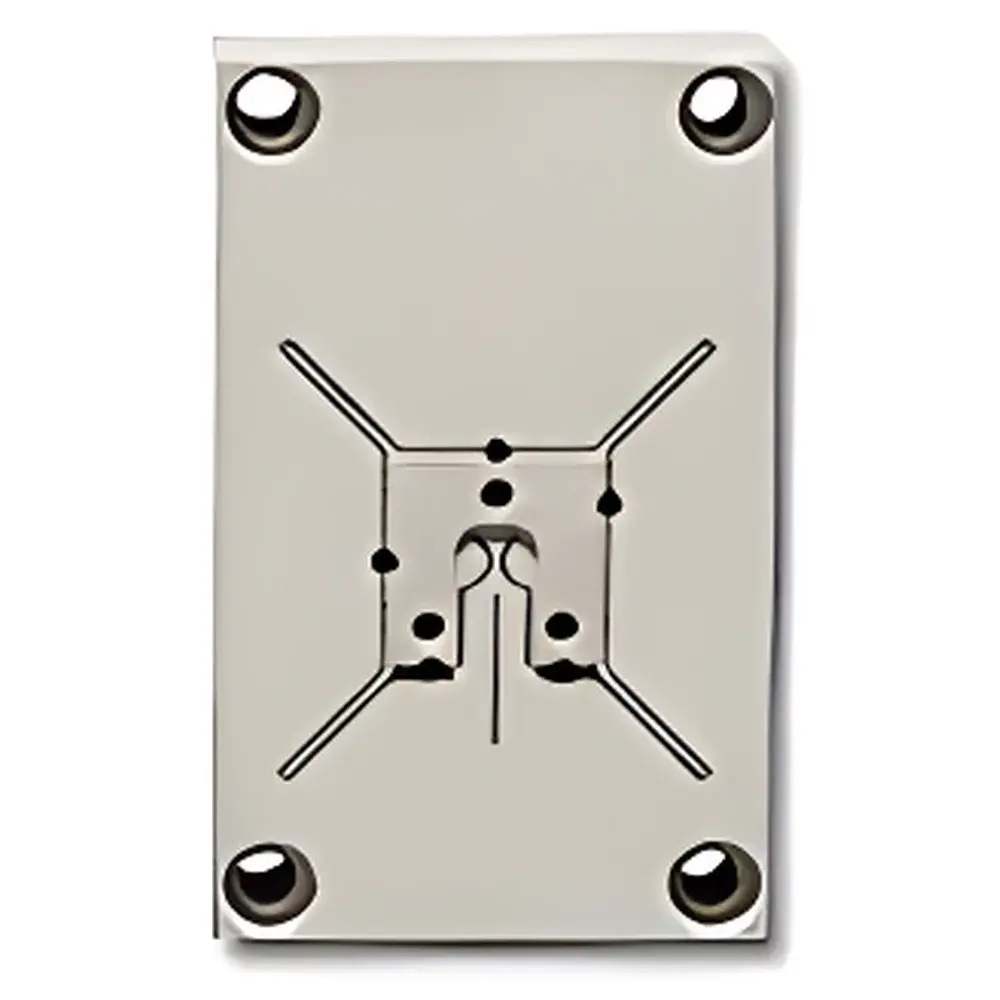
MCL Think Nano Nano-Theta Piezo-Actuated Precision Rotational Stage
| Brand | MCL Think Nano |
|---|---|
| Origin | USA |
| Model | Nano-Theta |
| Product Type | Motorized Rotational Translation Stage |
| Motion Range | 2.0 mrad |
| Resolution | 4 nrad |
| Resonant Frequency (unloaded) | 2.0 kHz ±20% |
| Body Material | Aluminum or Invar |
| Control Architecture | Closed-loop with integrated PicoQ® position sensing |
| Controller | Nano-Drive® |
Overview
The MCL Think Nano Nano-Theta is a high-precision, piezo-actuated rotational stage engineered for sub-microradian angular positioning in demanding optical and photonics applications. Unlike conventional goniometric stages relying on mechanical gears or stepper motors, the Nano-Theta employs direct piezoelectric actuation coupled with monolithic flexure mechanics to deliver frictionless, hysteresis-minimized rotation about a well-defined, physically accessible axis. Its core measurement principle is based on capacitive or strain-based displacement transduction—integrated via MCL’s proprietary PicoQ® sensing technology—which enables absolute, drift-free position feedback at nanoradian resolution. Designed specifically for alignment-critical workflows in cleanroom and ultra-stable optical benches, the Nano-Theta operates within a total angular range of ±1.0 mrad (2.0 mrad peak-to-peak), making it ideal for fine beam steering, interferometric cavity alignment, and dynamic wavefront correction where thermal stability and mechanical repeatability are non-negotiable.
Key Features
- Piezo-driven rotational actuation with zero backlash and no mechanical wear
- Well-defined, externally accessible rotation axis enabling co-planar mirror mounting—critical for minimizing beam walk-off during angular adjustment
- Closed-loop control architecture with integrated PicoQ® position sensors delivering 4 nrad resolution and sub-10 nrad long-term repeatability
- Monolithic aluminum or optional Invar construction for enhanced thermal stability and vibration damping
- Mounting flexibility: compatible with standard optical table kinematic bases and vacuum-compatible configurations (upon request)
- Resonant frequency of 2.0 kHz (±20%) under unloaded conditions, supporting high-bandwidth servo tracking up to ~200 Hz closed-loop bandwidth
- Compatible with MCL’s Nano-Drive® controller platform, supporting analog voltage input (±10 V), digital USB/Ethernet command interface, and real-time position streaming
Sample Compatibility & Compliance
The Nano-Theta is optimized for integration with reflective optics (e.g., dielectric mirrors, kinematic mirror mounts) and fiber collimators weighing up to 150 g—load capacity scaling inversely with required dynamic performance. It complies with RoHS 2011/65/EU directives and meets CE marking requirements for electromagnetic compatibility (EMC Directive 2014/30/EU) and low-voltage safety (LVD Directive 2014/35/EU). While not certified for medical or aerospace-grade qualification out-of-the-box, its design adheres to principles aligned with ISO 9001 manufacturing controls and supports traceable calibration protocols required under GLP and ISO/IEC 17025 laboratory accreditation frameworks. All firmware and controller software are developed in accordance with IEC 62443-4-1 security development lifecycle guidelines.
Software & Data Management
The Nano-Theta is fully supported by MCL’s Nano-Drive® software suite, which provides cross-platform (Windows/macOS/Linux) GUI and API access via Python, MATLAB, LabVIEW, and C/C++. The system logs position data with timestamped metadata—including sensor readout, commanded setpoint, error signal, and thermal compensation offset—at user-selectable rates up to 10 kHz. Audit trails are enabled by default, satisfying FDA 21 CFR Part 11 requirements for electronic records and signatures when deployed in regulated QC environments. Raw sensor output is provided in SI units (radians), with optional conversion to degrees, arcseconds, or µm lateral displacement at a defined working distance. Firmware updates are delivered through signed, version-controlled packages with SHA-256 integrity verification.
Applications
- Laser beam scanning and active stabilization in adaptive optics testbeds
- Fiber Bragg grating (FBG) inscription systems requiring precise angular dithering of phase masks
- Interferometric alignment of Fabry–Pérot cavities and gravitational-wave detector prototypes
- Near-field optical lithography tool path correction and mask alignment
- Optical disk mastering and servo track writing calibration
- Ultra-low-noise angular modulation in quantum optics experiments (e.g., polarization state manipulation, cavity ring-down spectroscopy)
FAQ
What is the maximum recommended payload for maintaining specified resolution and bandwidth?
For operation at full 4 nrad resolution and >150 Hz closed-loop bandwidth, payloads should not exceed 100 g. Loads between 100–150 g are supported with reduced bandwidth; custom configurations for heavier loads are available upon engineering consultation.
Is vacuum compatibility available?
Yes—vacuum-rated versions (10⁻⁶ Torr) with modified cabling and Invar body construction are offered as configurable options. Outgassing data and bake-out protocols are supplied per ASTM E595.
Does the Nano-Theta support synchronization with external triggers or motion controllers?
Yes—TTL-compatible trigger I/O is provided for hardware-synchronized start/stop and position capture, interoperable with National Instruments PXI, Thorlabs Kinesis, and PI GCS2 platforms.
How is thermal drift compensated during extended operation?
The PicoQ® sensor includes an integrated temperature reference channel; Nano-Drive® firmware applies real-time linear compensation using factory-characterized coefficients stored in non-volatile memory.
Can multiple Nano-Theta stages be networked for coordinated multi-axis motion?
Yes—Ethernet-enabled Nano-Drive® controllers support synchronized multi-axis profiles via IEEE 1588 Precision Time Protocol (PTP), with jitter <100 ns across up to 16 axes.



