
LaVision PLIF-HS High-Speed Laser-Induced Fluorescence Flame Imaging System
| Brand | LaVision GmbH |
|---|---|
| Origin | Germany |
| Model | PLIF-HS |
| Camera Frame Rate | Up to 10 kHz |
| Laser Repetition Rate | ≥10 kHz |
| Imaging Modality | Planar Laser-Induced Fluorescence (PLIF) |
| Target Species | OH, CH, NO, acetone, ketones, hydrocarbons |
| Synchronization Precision | <1 ns jitter (PTU X timing unit) |
| Software Platform | FlameMaster v5.x with real-time acquisition & post-processing modules |
Overview
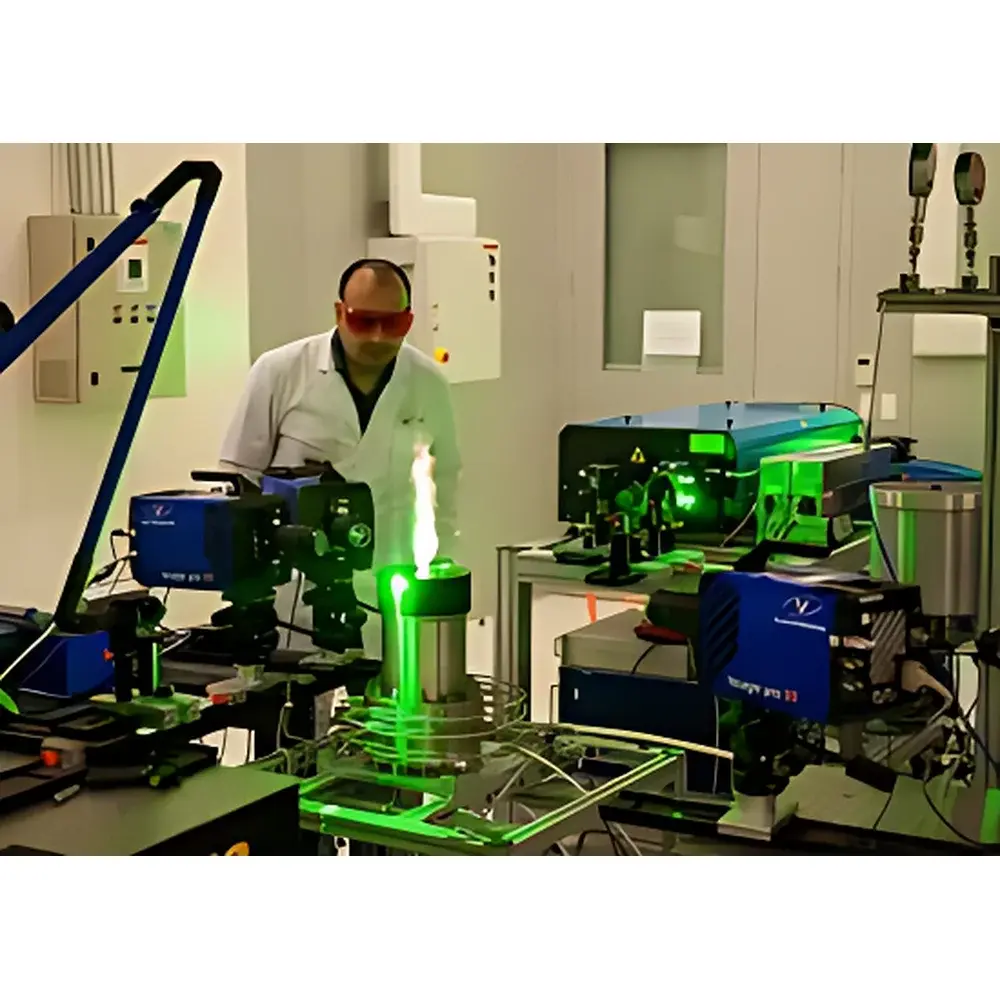
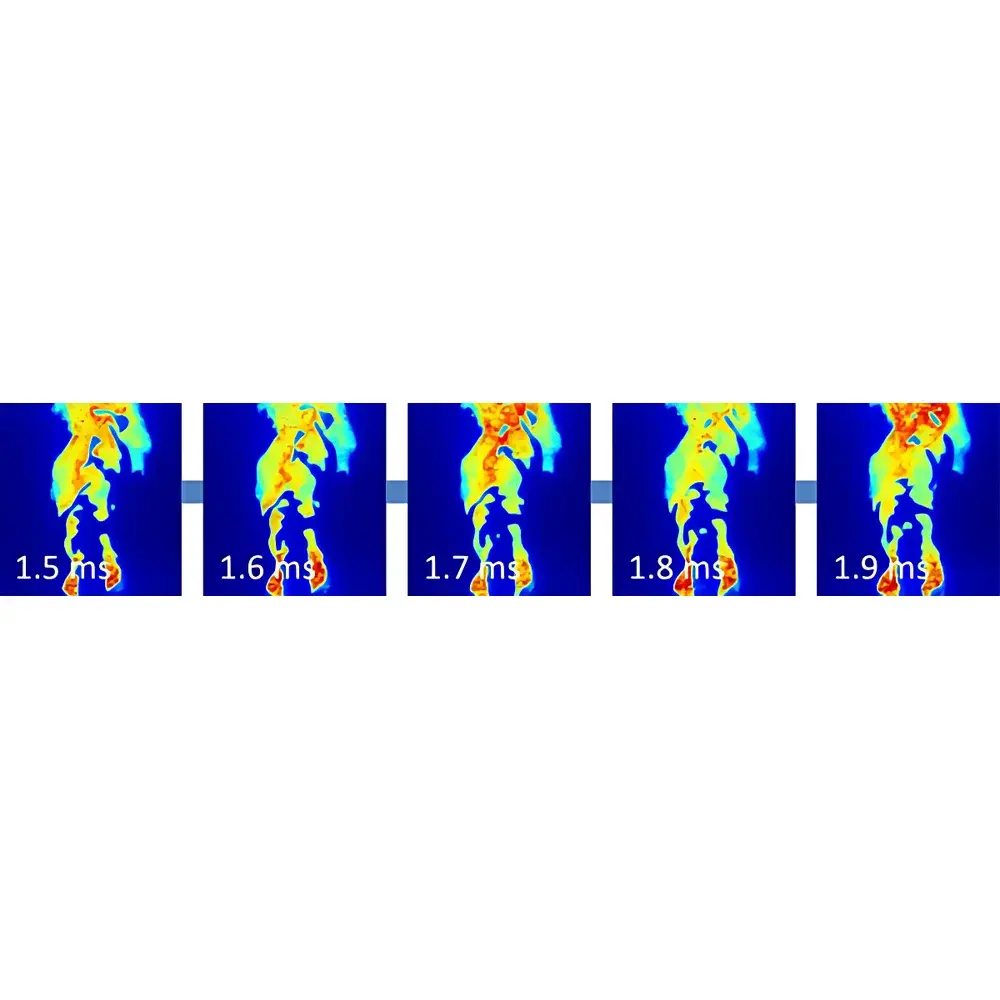
The LaVision PLIF-HS High-Speed Laser-Induced Fluorescence Flame Imaging System is an integrated diagnostic platform engineered for quantitative, time-resolved planar imaging of reactive scalars and flow structures in turbulent combustion environments. It operates on the physical principle of laser-induced fluorescence (LIF), where tunable ultraviolet or visible laser sheets excite specific rovibronic transitions in target species (e.g., OH radicals at 283 nm, CH at 431 nm, or acetone-seeded fuel tracers at 266 nm), generating spatially resolved fluorescence emission captured by a gated, intensified high-speed CMOS camera. With synchronized framing rates up to 10 kHz and sub-nanosecond temporal jitter enabled by the PTU X programmable timing unit, the system resolves transient flame front dynamics, local extinction/re-ignition events, turbulent flame brush thickness evolution, and turbulence–chemistry interactions at millisecond-to-microsecond timescales—critical for validating large-eddy simulation (LES) and direct numerical simulation (DNS) models.
Key Features
- Full-system integration of high-repetition-rate pulsed lasers (Nd:YAG, dye, or OPO-based), precision optical beam delivery, and ultra-fast intensified CMOS cameras (e.g., Imager sCMOS or HiCAM Flex) optimized for low-light LIF signal capture.
- PTU X synchronization architecture providing deterministic, multi-channel triggering with <1 ns timing jitter across laser pulses, camera gate windows, particle image velocimetry (PIV) lasers, and auxiliary sensors (e.g., pressure transducers, thermocouples).
- FlameMaster v5.x software suite supporting real-time acquisition control, hardware-synchronized dual-plane or multi-modal acquisition (e.g., simultaneous OH-PLIF + CH-PLIF + PIV), spectral calibration, background subtraction, quenching correction, and absolute mole fraction quantification via calibrated reference cells or two-line thermometry extensions.
- Rugged opto-mechanical design compliant with ISO 14644-1 Class 7 cleanroom compatibility for integration into high-pressure combustion test rigs, gas turbine combustor test benches, and shock-tube facilities.
- Modular configuration support for single-species or multi-species PLIF (e.g., OH/CH dual-plane), combined with stereoscopic PIV or tomographic PIV for joint scalar–vector field analysis.
Sample Compatibility & Compliance
The PLIF-HS system is validated for use with gaseous, liquid-fueled, and alternative-fuel (e.g., hydrogen, ammonia, bio-derived syngas) combustion systems operating from atmospheric to 30 bar pressure and temperatures up to 2500 K. It supports standard combustion diagnostics protocols aligned with ASTM E2936 (Standard Guide for Laser Diagnostics in Combustion Research) and ISO 17289 (Combustion—Optical Diagnostic Methods). Data acquisition workflows comply with GLP and GMP documentation requirements, including full audit trails, user access control, electronic signatures, and raw data immutability—meeting foundational expectations for FDA 21 CFR Part 11 compliance when deployed in regulated R&D environments.
Software & Data Management
FlameMaster v5.x provides a unified interface for experiment definition, hardware orchestration, and physics-based post-processing. Acquired image sequences are stored in HDF5 format with embedded metadata (laser energy, gate delay, pressure, temperature, stoichiometry). Built-in tools include pixel-wise intensity normalization, Abel inversion for axisymmetric flames, chemiluminescence background rejection, and export to Tecplot, ParaView, or MATLAB for further statistical analysis (e.g., conditional averaging, joint PDFs of scalar gradients and strain rate). All processing steps are scriptable via Python API, enabling automated batch analysis across hundreds of high-speed sequences.
Applications
- Time-resolved OH-PLIF imaging of flame propagation and local extinction in lean-premixed gas turbine combustors (e.g., studies published in Proceedings of the Combustion Institute, Vol. 35, 2014).
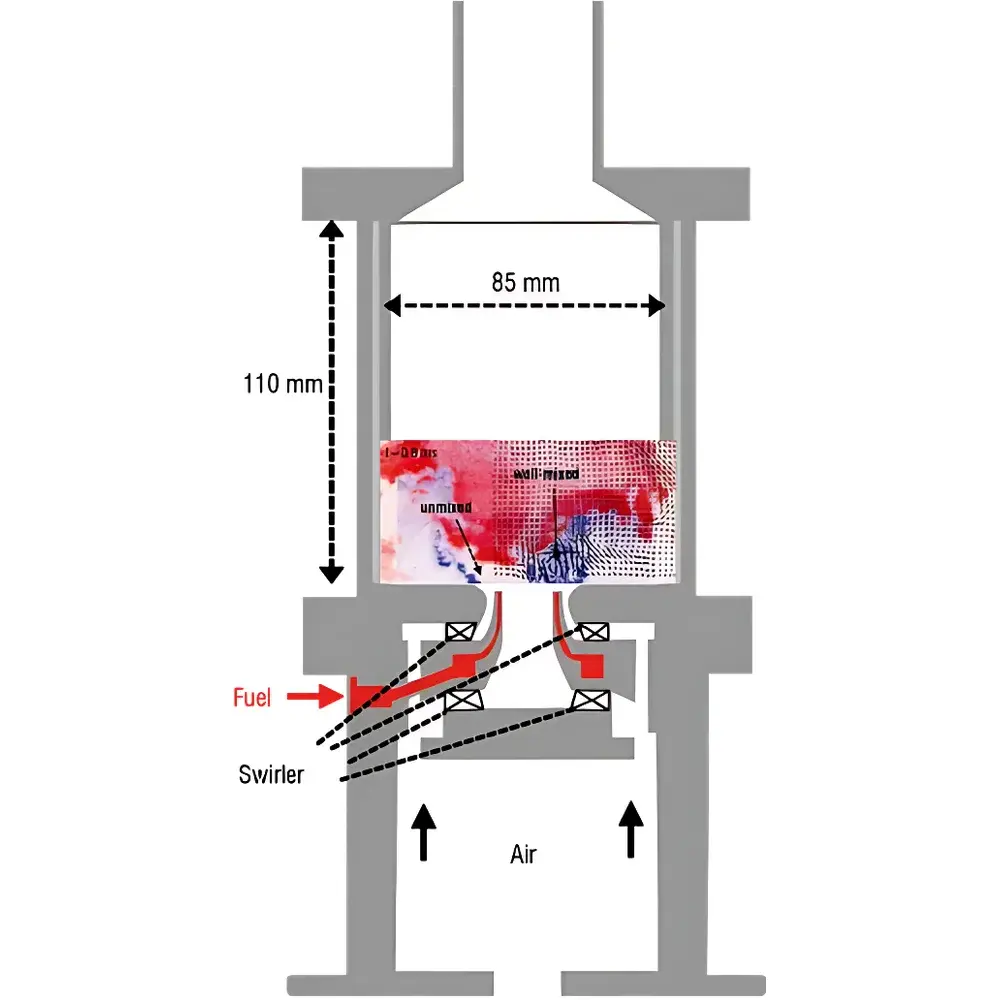
- Acetone-PLIF quantification of turbulent fuel-air mixing in direct-injection engines under transient load conditions.
- NO-PLIF monitoring of thermal NO formation pathways in high-temperature recirculation zones.
- Multi-species PLIF (OH + CH + formaldehyde) for identifying reaction intermediates during autoignition in HCCI and RCCI engines.
- Validation of turbulent combustion models including flamelet-generated manifolds (FGM), transported probability density function (PDF) methods, and thickened flame approaches.
FAQ
What laser wavelengths are supported for OH-PLIF imaging?
The system supports tunable excitation at 283.0 nm (Q1 line of OH A–X transition) using frequency-doubled dye lasers or OPO systems; optional configurations extend coverage to 228–300 nm for CH, NO, and polycyclic aromatic hydrocarbon (PAH) detection.
Can the PLIF-HS be integrated with existing PIV or CARS systems?
Yes—via the PTU X timing unit, which provides fully programmable trigger outputs and input synchronization channels compatible with LaVision’s FlowMaster PIV systems and third-party coherent anti-Stokes Raman scattering (CARS) platforms.
Is quantitative species concentration mapping possible?
Yes, through calibrated reference cell measurements, two-line LIF thermometry, and collisional quenching corrections implemented in FlameMaster; absolute OH number densities can be reported with ±15% uncertainty under well-characterized conditions.
What level of technical support and calibration services does LaVision provide?
LaVision GmbH offers factory calibration certificates traceable to PTB (Physikalisch-Technische Bundesanstalt), on-site installation commissioning, application-specific training, and annual preventive maintenance contracts with certified engineers.



