
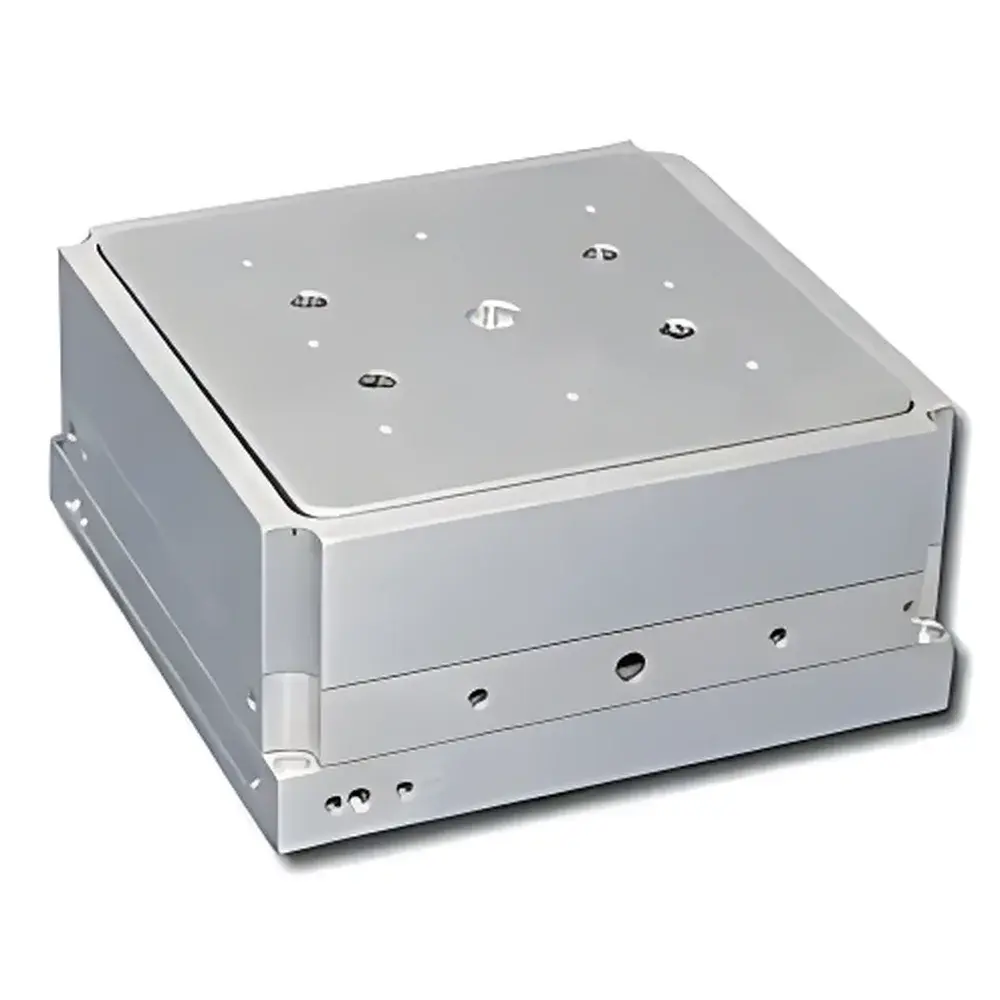
MCL Think Nano Nano-3D500 Three-Axis Closed-Loop Flexure-Guided Nanopositioning Stage
| Brand | MCL Think Nano |
|---|---|
| Origin | USA |
| Model | Nano-3D500 |
| Motion Range (XYZ) | 500 µm |
| Resolution | 1 nm |
| Resonant Frequency (X/Y) | 150 Hz ±20% |
| Resonant Frequency (Z) | 200 Hz ±20% |
| Stiffness | 1.0 N/µm |
| Max. Horizontal Load | 0.5 kg |
| Max. Vertical Load | 0.2 kg |
| Body Material | Aluminum |
| Control Architecture | Closed-loop with integrated Nano-Drive® controller |
| Center Aperture | 12.7 mm (0.5 in) diameter |
| Guidance Mechanism | Monolithic flexure design |
Overview
The MCL Think Nano Nano-3D500 is a high-precision, three-axis (X-Y-Z) nanopositioning stage engineered for applications demanding sub-nanometer resolution, mechanical stability, and true decoupled motion across orthogonal axes. Built on a monolithic aluminum architecture with proprietary flexure-based guidance, the Nano-3D500 eliminates backlash, friction, and hysteresis—common limitations of screw- or piezo-motor-driven translation stages. Its operational principle relies on capacitive or strain-gauge-based position sensing integrated directly into the flexure structure, enabling real-time closed-loop feedback to the Nano-Drive® controller. This architecture ensures absolute positional accuracy, long-term thermal and mechanical drift suppression, and repeatable positioning over millions of cycles. Designed explicitly for optical laboratory environments, the stage features a central 12.7 mm aperture that maintains unobstructed optical throughput—critical for collinear beam paths in interferometry, fiber coupling, and confocal microscopy setups.
Key Features
- True flexure-guided motion: Monolithic aluminum flexures provide frictionless, wear-free, and maintenance-free XYZ displacement without mechanical play or stick-slip behavior.
- Closed-loop control with 1 nm resolution: High-stability position sensors deliver real-time feedback to the Nano-Drive® controller, ensuring traceable, repeatable positioning within ±1 nm typical repeatability.
- High dynamic performance: Resonant frequencies of 150 Hz (X/Y) and 200 Hz (Z) support rapid step-and-settle positioning and enable integration into active stabilization or scanning workflows.
- Optical-grade mechanical design: 0.5 kg horizontal and 0.2 kg vertical load capacity reflects optimized stiffness-to-mass ratio (1.0 N/µm), minimizing settling time and enhancing vibration immunity.
- Modular control interface: Compatible with standard analog voltage inputs (±10 V), digital USB/Ethernet commands, and optional wireless 3-axis joystick for intuitive manual alignment—eliminating dependency on custom software during setup.
- Compact footprint (approx. 102 × 102 × 32 mm): Enables integration into space-constrained optical breadboards, vacuum-compatible enclosures (with optional non-outgassing coating), and multi-stage nested positioning systems.
Sample Compatibility & Compliance
The Nano-3D500 is compatible with standard optical mounting hardware (e.g., 1/4″-20 and M4 threaded holes on top and base plates) and integrates seamlessly with industry-standard optical tables, kinematic mounts, and automated alignment platforms. While not certified to ISO 9001 or ISO/IEC 17025 out-of-the-box, its closed-loop architecture and documented metrological performance align with GLP-compliant instrumentation requirements for R&D laboratories performing optical calibration, fiber-optic device characterization, or micro-opto-electro-mechanical systems (MOEMS) prototyping. The aluminum construction meets RoHS directives; vacuum-compatible variants (with dry-lubricated flexures and low-outgassing adhesives) are available upon engineering consultation.
Software & Data Management
Control is facilitated via the Nano-Drive® software suite, supporting Windows/Linux environments and offering API access through C/C++, Python, and LabVIEW libraries. All position data—including timestamps, commanded setpoints, sensor feedback, and error residuals—are logged in CSV or HDF5 format with configurable sampling rates up to 10 kHz. Audit trails include user authentication logs, parameter change history, and firmware version stamps—supporting compliance with FDA 21 CFR Part 11 when deployed in regulated QC/QA environments under validated SOPs. Remote operation via Ethernet TCP/IP enables centralized control in multi-stage optical test benches without latency-sensitive USB dependencies.
Applications
- Single-mode optical fiber alignment in photonic packaging and telecom component testing, where <50 nm lateral offset tolerance dictates coupling efficiency.
- Hybrid positioning systems combining coarse motorized stages with fine nano-adjustment for semiconductor wafer inspection and mask alignment.
- Micromachining toolpath correction using real-time interferometric feedback loops integrated with CNC motion controllers.
- Micromanipulation in scanning probe microscopy (SPM) and optical tweezer setups requiring synchronized XYZ nanodisplacement with minimal thermal drift.
- Active compensation of thermal expansion in ultra-stable optical cavities and gravitational wave detector prototypes.
FAQ
Is the Nano-3D500 suitable for vacuum environments?
Yes—vacuum-rated configurations (UHV-compatible up to 10⁻⁹ Torr) are available with modified flexure materials, non-outgassing adhesives, and ceramic-coated electronics. Contact MCL Think Nano engineering for qualification documentation.
What is the typical warm-up time to achieve thermal equilibrium?
Under ambient lab conditions (23 ±1 °C), positional stability within ±2 nm is achieved within 15 minutes after power-on; full thermal equilibrium for metrology-grade use requires 60 minutes.
Can multiple Nano-3D500 stages be synchronized?
Yes—the Nano-Drive® controller supports daisy-chained EtherCAT or synchronized analog triggering, enabling coordinated motion across up to 8 axes with sub-microsecond timing jitter.
Does the system support third-party motion control software?
Yes—open-source drivers and vendor-neutral SCPI command sets are provided, enabling integration with MATLAB, Python (via PyVISA), and National Instruments Veristand.
How is long-term calibration maintained?
The closed-loop architecture inherently corrects for drift; however, annual recalibration against NIST-traceable interferometric standards is recommended for applications requiring ISO/IEC 17025 traceability.





