
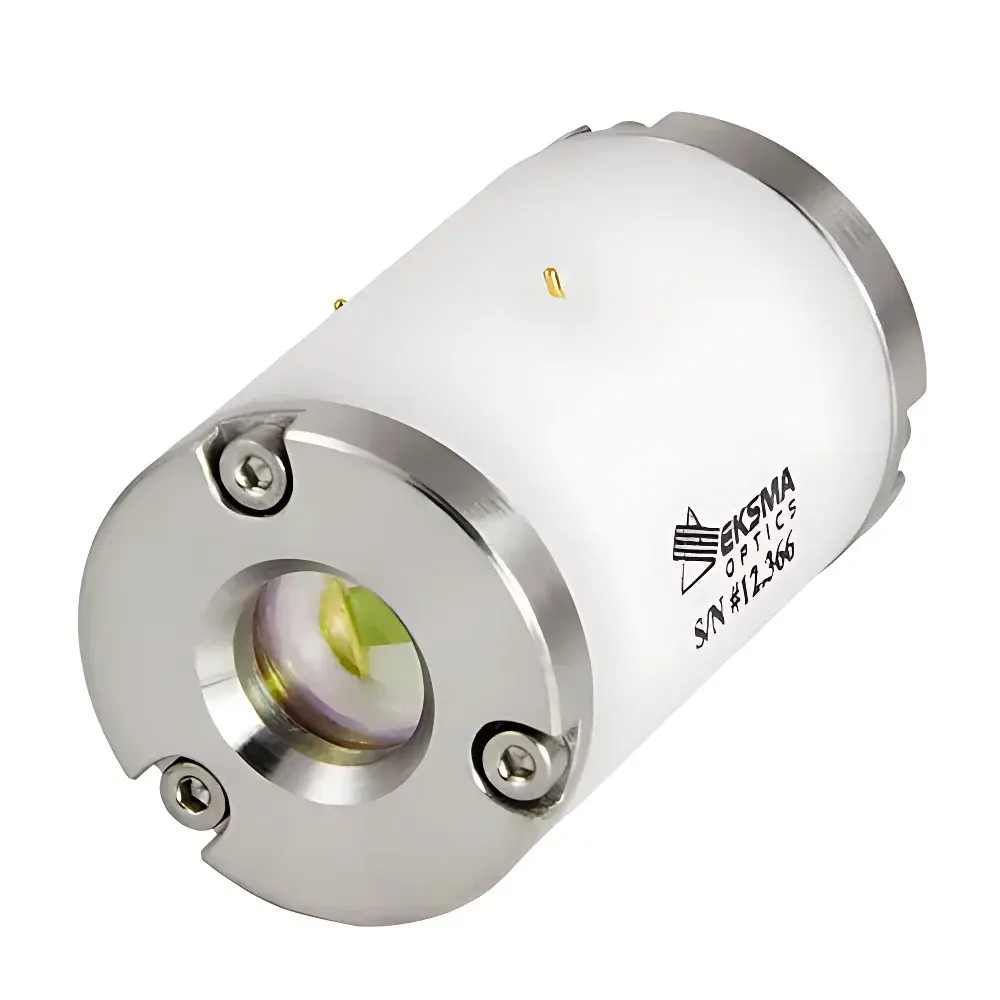
EKSMA PCK Series KTP Pockels Cell
| Brand | EKSMA |
|---|---|
| Origin | Lithuania (Imported) |
| Manufacturer Type | Authorized Distributor |
| Model | PCK-KTP |
| Aperture Options | 3×3 mm², 4×4 mm², 6×6 mm², 8×8 mm² |
| Operating Repetition Rate | 1 kHz – 1 MHz |
| Drive Voltage Requirement | ~50% of BBO-based Pockels cells |
| Electro-Optic Material | High-Quality Flux-Grown KTP (KTiOPO₄) |
| Damage Threshold | >500 MW/cm² (10 ns, 1064 nm, 10 Hz) |
| Rise/Fall Time | <10 ns (typ.) |
| Compliance | RoHS, CE |
Overview
The EKSMA PCK Series KTP Pockels Cell is a high-performance electro-optic modulator engineered for precision Q-switching and pulse picking in solid-state and fiber-integrated laser systems operating at repetition rates from 1 kHz to 1 MHz. Based on optically homogeneous, flux-grown potassium titanyl phosphate (KTiOPO₄ or KTP), this device leverages the material’s large electro-optic coefficient (r₂₃ ≈ 36 pm/V), low half-wave voltage (Vλ/2), and exceptional resistance to optical damage. Unlike BBO-based Pockels cells, the KTP variant requires approximately half the drive voltage for equivalent retardation—reducing stress on high-voltage pulsers and improving long-term system reliability. Its low piezoelectric ringing ensures minimal temporal distortion of switching waveforms, critical for maintaining pulse fidelity in ultrafast and high-repetition-rate applications.
Key Features
- Optimized for high-duty-cycle operation: Stable performance under continuous high-intensity irradiation (e.g., CW-pumped Nd:YAG or Yb-doped fiber lasers)
- Flux-grown KTP crystal with superior optical homogeneity (Δn < 5×10⁻⁶ over aperture) and bulk laser-induced damage threshold exceeding 500 MW/cm² (10 ns, 1064 nm, 10 Hz)
- Low half-wave voltage: Typically 2.8–4.2 kV depending on aperture and wavelength (1064 nm), enabling compatibility with commercial HV pulsers rated ≤5 kV
- Sub-10 ns electrical-to-optical rise/fall time, verified via calibrated photodiode + oscilloscope measurement
- Minimal piezoelectric ringing (<1% residual oscillation amplitude after switching edge), achieved through optimized crystal mounting and electrode design
- Standard AR-coated faces (R<0.2% per surface @ 1064 nm or custom wavelength); optional dual-band coatings available (e.g., 1064/532 nm)
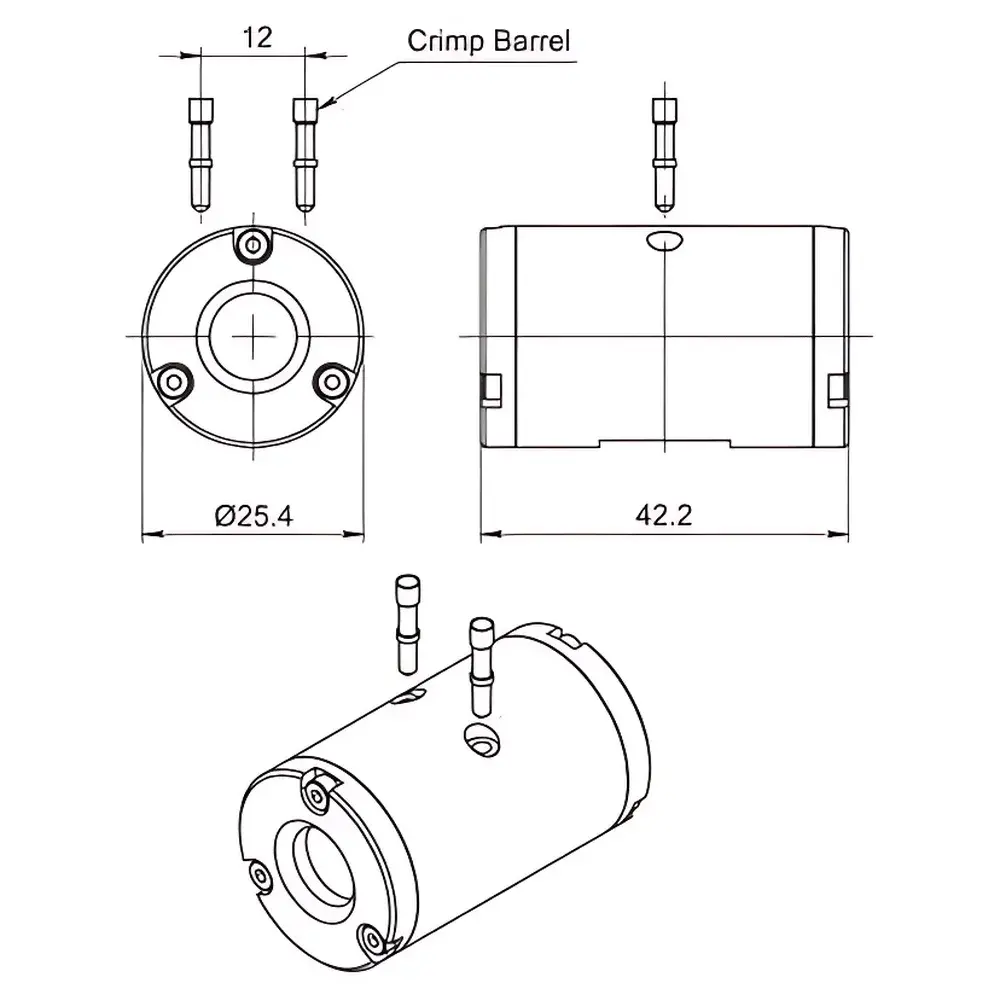
- Mechanically robust housing with SMA or SHV high-voltage connectors and kinematic mounting interface for alignment stability
Sample Compatibility & Compliance
The PCK-KTP is compatible with common near-infrared and visible laser sources including Nd:YAG (1064 nm, 532 nm), Nd:YLF (1053 nm), Yb:fiber (1030–1080 nm), and Ti:sapphire (700–900 nm) systems. All units undergo individual verification of extinction ratio (>30 dB at 1064 nm), wavefront distortion (<λ/8 PV over full aperture), and thermal stability across ambient temperatures from 15 °C to 35 °C. The device complies with EU Directive 2011/65/EU (RoHS) and carries CE marking for electromagnetic compatibility (EN 61326-1) and safety (EN 61010-1). Documentation includes traceable calibration reports and material certificates conforming to ISO 9001:2015 quality management requirements.
Software & Data Management
While the PCK-KTP is a passive electro-optic component requiring external HV pulsers, it integrates seamlessly into automated laser control environments. Users commonly pair it with programmable delay generators (e.g., Stanford Research DG645), arbitrary waveform generators (Keysight 33600A series), or OEM laser controllers supporting TTL/CMOS trigger inputs. EKSMA provides detailed timing diagrams, HV connector pinouts, and mechanical drawings (STEP/IGES) for CAD integration. For GLP/GMP-regulated environments, system-level validation protocols—including IQ/OQ documentation templates and traceable test procedures aligned with ISO/IEC 17025—are available upon request.
Applications
- Active Q-switching in diode-pumped solid-state lasers (DPSSLs) for micro-machining, LIBS, and LIDAR transmitters
- Pulse selection (cavity dumping or intra-cavity slicing) in mode-locked oscillator-amplifier chains
- High-speed optical gating for time-resolved fluorescence or pump-probe spectroscopy
- Laser safety interlocks requiring sub-10 ns response time
- Seed injection control in MOPA architectures for industrial fiber laser systems
- Beam blanking in scanning microscopy and additive manufacturing platforms
FAQ
What is the maximum average power the PCK-KTP can handle without thermal lensing?
Thermal lensing is negligible below 10 W average power at 1064 nm with proper beam expansion (M² < 1.3) and collimated incidence; active cooling is not required within this range.
Can the cell be used at 532 nm with the same voltage rating?
Yes—the half-wave voltage scales inversely with wavelength; Vλ/2 at 532 nm is approximately 1.9–2.7 kV for standard apertures, assuming identical crystal length and orientation.
Is there a version with integrated HV driver?
No—EKSMA supplies the PCK-KTP as a bare electro-optic module; external HV pulsers (e.g., Quantum Composers, Directed Energy) must be selected based on required rise time, jitter, and repetition rate.
Do you provide custom anti-reflection coatings?
Yes—standard options include single-wavelength (1064 nm, 532 nm, 800 nm) and dual-band (1064+532 nm, 1030+515 nm); custom multilayer designs are available with lead times of 6–8 weeks.
How is crystal orientation verified during manufacturing?
Each KTP crystal undergoes polarimetric mapping using a Mueller matrix imaging system to confirm phase-matching angle accuracy (±0.1° tolerance) and absence of domain inversion defects.



