
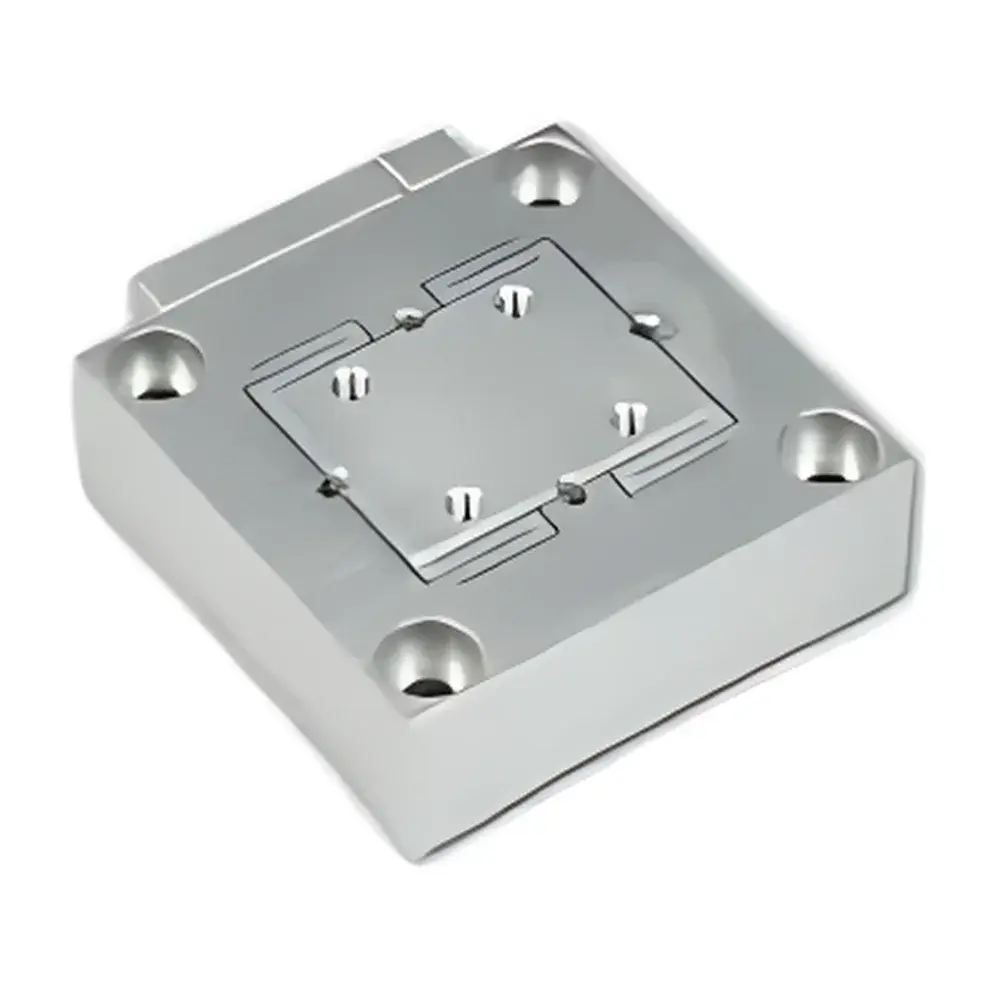
MCL Think Nano Nano-MET10 & Nano-MET20 Picometer-Resolution Closed-Loop Nanopositioning Stage
| Brand | MCL Think Nano |
|---|---|
| Origin | USA |
| Model | Nano-MET10 & Nano-MET20 |
| Motion Range | 10 µm (Nano-MET10), 20 µm (Nano-MET20) |
| Positioning Resolution | 0.01 nm (Nano-MET10), 0.02 nm (Nano-MET20) |
| Resonant Frequency | 4.6 kHz |
| Max. Load (Horizontal/Vertical) | 100 g |
| Sensor Technology | Integrated PicoQ® Absolute Encoder |
| Controller | Nano-Drive® |
| Body Material | Aluminum |
| Control Mode | Closed-Loop |
Overview
The MCL Think Nano Nano-MET10 and Nano-MET20 are high-precision, single-axis nanopositioning stages engineered for applications demanding sub-nanometer stability, ultra-low mechanical noise, and deterministic dynamic response. Based on piezoelectric actuation with integrated capacitive or strain-gauge-based position sensing—enhanced by MCL’s proprietary PicoQ® absolute encoder architecture—these stages operate on a direct-drive, frictionless flexure-guided mechanism. This design eliminates backlash, hysteresis, and stick-slip artifacts common in lead-screw or stepper-motor-driven translation stages. The 4.6 kHz resonant frequency enables rapid step-and-settle behavior with settling times under 100 µs (typical), while the closed-loop architecture ensures real-time position verification and correction at bandwidths exceeding 1 kHz. These characteristics make the Nano-MET series particularly suited for integration into optical interferometry setups, scanning probe microscopy (SPM) head assemblies, and precision alignment sub-systems where thermal drift, vibration coupling, and electronic noise must be minimized to below 10 pm RMS.
Key Features
- Picometer-class positioning resolution: 0.01 nm (Nano-MET10) and 0.02 nm (Nano-MET20), traceable via internal PicoQ® absolute position sensors
- Closed-loop control with real-time feedback—no homing required, zero cumulative error over repeated scans
- Ultra-low mechanical and electronic noise floor: <10 pm RMS in bandwidth-limited metrology configurations
- High resonant frequency (4.6 kHz) supports high-speed raster scanning and dynamic trajectory tracking
- Compact footprint (≤35 mm × 35 mm base) with standardized mounting holes (M3/M4) for OEM integration
- Aluminum monolithic body with optimized thermal mass and CTE-matched flexure design for improved thermal stability
- Compatible with MCL’s Nano-Drive® controller, supporting analog voltage input (±10 V), digital USB/Ethernet command interface, and programmable waveform generation (sine, sawtooth, arbitrary)
Sample Compatibility & Compliance
The Nano-MET10 and Nano-MET20 are designed for use with inertial loads up to 100 g in both horizontal and vertical orientations; load optimization beyond this threshold requires mechanical coupling analysis and is subject to engineering review. The stages comply with RoHS 2011/65/EU directives and meet CE marking requirements for electromagnetic compatibility (EMC Directive 2014/30/EU) and low-voltage safety (LVD Directive 2014/35/EU). While not certified as medical devices, their performance consistency and repeatability support GLP-compliant calibration workflows when paired with NIST-traceable displacement metrology tools (e.g., heterodyne laser interferometers per ISO 230-6). No intrinsic radiation emission or hazardous material content is present; operation falls within Class 1 laser product safety limits when used with standard optical alignment lasers.
Software & Data Management
Control and data acquisition are enabled through MCL’s Nano-Drive® software suite (v5.2+), which provides cross-platform support (Windows/Linux/macOS) and native API bindings for Python, MATLAB, LabVIEW, and C/C++. All position commands, sensor readings, and system status logs are timestamped with microsecond precision and stored in HDF5 format—ensuring compatibility with FAIR data principles. Audit trails record user-initiated moves, firmware updates, and calibration events, satisfying documentation requirements under FDA 21 CFR Part 11 for regulated environments when deployed with validated installation and operational qualification (IQ/OQ) protocols. Real-time streaming of position data at up to 100 kS/s enables synchronization with external triggers (TTL/PECL), facilitating lock-in detection, pump-probe timing, and multi-axis coordinated motion.
Applications
- Atomic force microscopy (AFM) Z-positioning and coarse/fine approach stages
- Interferometric displacement metrology and cavity length stabilization in ultra-stable lasers
- Nanoscale mask alignment in photolithography R&D and electron-beam writing systems
- Active vibration cancellation platforms requiring sub-picometer actuation fidelity
- Single-photon source positioning in quantum optics testbeds (e.g., NV-center alignment, fiber coupling)
- In-situ TEM/SEM nanomanipulation stages when integrated with vacuum-compatible variants (Nano-MET-V series)
FAQ
What is the difference between Nano-MET10 and Nano-MET20 in terms of control electronics?
Both models use identical Nano-Drive® controller firmware and interface protocols; only the actuator stroke and sensor scaling differ.
Can the Nano-MET stages be operated in vacuum environments?
Standard units are rated for ambient air; vacuum-compatible versions (Nano-MET-V) feature outgassing-controlled adhesives, ceramic-coated flexures, and feedthrough-optimized cabling.
Is third-party software integration supported?
Yes—full SDK documentation, DLLs, shared libraries, and example scripts are provided for Python, MATLAB, LabVIEW, and C/C++.
How is calibration traceability maintained across the product lifecycle?
Each unit ships with a factory calibration certificate referencing NIST-traceable interferometric verification; field recalibration is possible using optional Nano-Cal™ reference modules.
What maintenance is required for long-term picometer stability?
No scheduled maintenance is required; however, periodic verification against a calibrated interferometer (annually recommended for metrology-critical use) is advised.




