
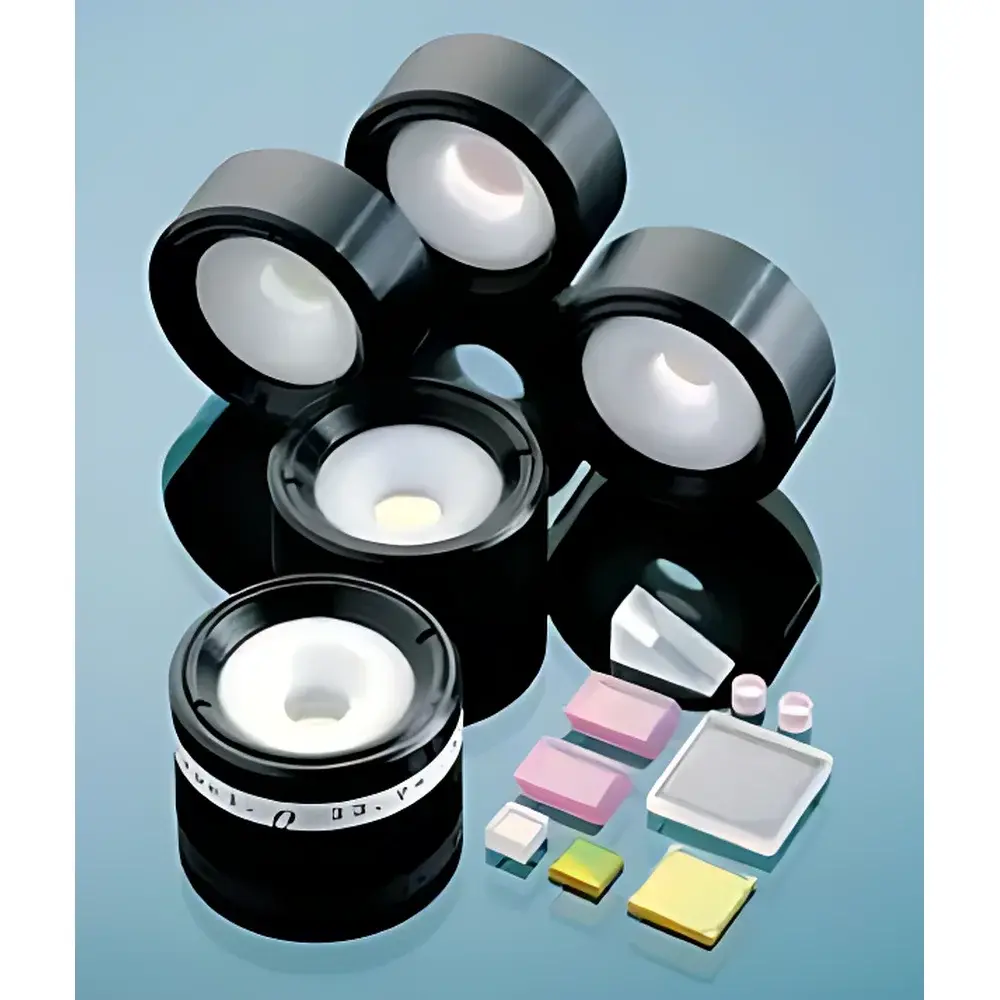
EKSMA Femtosecond-Optimized Ultra-Thin Nonlinear Optical Crystal
| Brand | EKSMA |
|---|---|
| Origin | Lithuania (Imported) |
| Type | Femtosecond Crystal |
| Material Options | BBO, LBO, KTP, KDP, DKDP, LiIO₃, AgGaS₂, AgGaSe₂, GaSe, ZnGeP₂ |
| Thickness Range | < 100 µm (customizable per GVM/GDD constraints) |
| Phase-Matching Types | Type I & Type II (angle- or temperature-tuned) |
| Application Domain | Ultrafast Laser Frequency Conversion |
Overview
EKSMA’s femtosecond-optimized ultra-thin nonlinear optical crystals are precision-engineered components for high-fidelity frequency conversion in ultrashort pulse laser systems. Designed explicitly to mitigate group velocity mismatch (GVM) and second-order group delay dispersion (GDD), these crystals enable efficient, bandwidth-preserving processes—including second-harmonic generation (SHG), sum-frequency generation (SFG), difference-frequency generation (DFG), optical parametric amplification (OPA), and terahertz generation—without significant temporal pulse broadening. Unlike standard bulk nonlinear crystals, ultra-thin variants maintain phase-matching conditions while minimizing the interaction length to match the coherence length of sub-100-fs pulses. This architecture is grounded in rigorous nonlinear optics theory: for collinear Type I interactions at 800 nm, the quasi-static interaction length (Lqs = τ / GVM) dictates the maximum usable thickness; exceeding this limit introduces spectral shear and temporal distortion that degrades conversion efficiency and pulse fidelity.
Key Features
- Sub-100 µm thickness options available for BBO, LBO, KTP, KDP, DKDP, LiIO₃, GaSe, and ZnGeP₂—tailored to specific pump pulse duration (e.g., 30–150 fs) and target wavelength region (UV to THz)
- Precision angle-polishing and anti-reflection coatings optimized for broadband femtosecond operation (R < 0.2% per surface, 400–2000 nm)
- High optical homogeneity (Δn < 5 × 10⁻⁶) and wavefront distortion < λ/8 @ 633 nm over aperture
- Controlled crystal orientation (±0.1° angular tolerance) with full certification of cut angle relative to crystallographic axes
- Available in standard diameters (3 mm, 5 mm, 10 mm) and custom apertures; rapid-ship inventory for common configurations
- Compliant with ISO 10110-3 (surface quality) and ISO 14997 (laser damage threshold testing per ISO 21254-1)
Sample Compatibility & Compliance
These crystals are compatible with Ti:sapphire, Yb:fiber, and Cr:forsterite amplifier systems operating at repetition rates from 1 kHz to 100 MHz. Each batch undergoes spectral transmission verification (200–12,000 nm), laser-induced damage threshold (LIDT) validation at 800 nm, 100-fs, 10-Hz (≥ 0.5 J/cm² for coated BBO), and interferometric surface flatness inspection. All crystals meet RoHS Directive 2011/65/EU and are supplied with traceable calibration reports including phase-matching angle, acceptance angle (Δθ), and temperature bandwidth (ΔT). For regulated environments—such as ISO/IEC 17025-accredited metrology labs or GLP-compliant photonics R&D—the material lot numbers, polishing date, coating deposition logs, and interferogram data are archived for audit readiness.
Software & Data Management
While the crystal itself is a passive optical component, EKSMA provides downloadable technical datasheets containing comprehensive GVM and GDD coefficients (ps²/mm) for all standard materials under Type I and Type II phase matching at key wavelengths (e.g., 800 nm SHG, 1550 nm DFG). These datasets integrate seamlessly with commercial simulation platforms including MATLAB-based nonlinear propagation toolboxes (e.g., SNLO, RP Fiber Power), enabling users to model pulse evolution, optimize crystal thickness, and predict spectral broadening prior to experimental implementation. No proprietary software or cloud dependency is required—data is delivered in CSV and PDF formats with SI-unit consistency and uncertainty annotations per ISO/IEC Guide 98-3 (GUM).
Applications
- Ultrafast pulse characterization: autocorrelation and cross-correlation using SHG crystals with thickness calibrated to preserve temporal resolution
- Compact OPA/OPG stages in few-cycle laser systems requiring minimal dispersion accumulation
- THz generation via optical rectification in GaSe and ZnGeP₂ with minimized walk-off and GVM-induced pulse splitting
- Entangled photon-pair sources based on spontaneous parametric down-conversion (SPDC) in periodically poled or angle-tuned ultra-thin crystals
- Frequency comb stabilization and octave-spanning supercontinuum seeding where phase-matching bandwidth exceeds 100 THz
FAQ
What is the typical thickness range for ultra-thin crystals used in 35-fs Ti:sapphire systems?
For Type I SHG at 800 nm, BBO thickness is typically limited to ≤ 50 µm; LBO to ≤ 120 µm; KDP to ≤ 200 µm—values derived from published GVM coefficients and validated experimentally.
Do you provide AR coatings optimized for both fundamental and harmonic wavelengths?
Yes—dual-band or multi-band coatings (e.g., 780–820 nm + 390–410 nm) are available upon request, with performance verified by spectrophotometry and LIDT testing.
Can ultra-thin crystals be mounted in kinematic holders without stress-induced birefringence?
All crystals ≥ 3 mm diameter are supplied with optional low-stress metallic mounts (Invar or titanium) featuring compliant edge contact and thermal expansion matching.
Is phase-matching angle data provided for non-standard temperatures?
Yes—temperature-dependent dn/dT values and tuning curves (θ vs. T) are included for all major materials, referenced to IUPAC-standardized thermal expansion coefficients.
How is crystal damage threshold validated for femtosecond pulses?
Per ISO 21254-2, LIDT is measured using raster-scan methodology with 1-on-1 and S-on-1 protocols at specified pulse duration, spot size, and fluence ramp rates—full test reports available upon order.




