
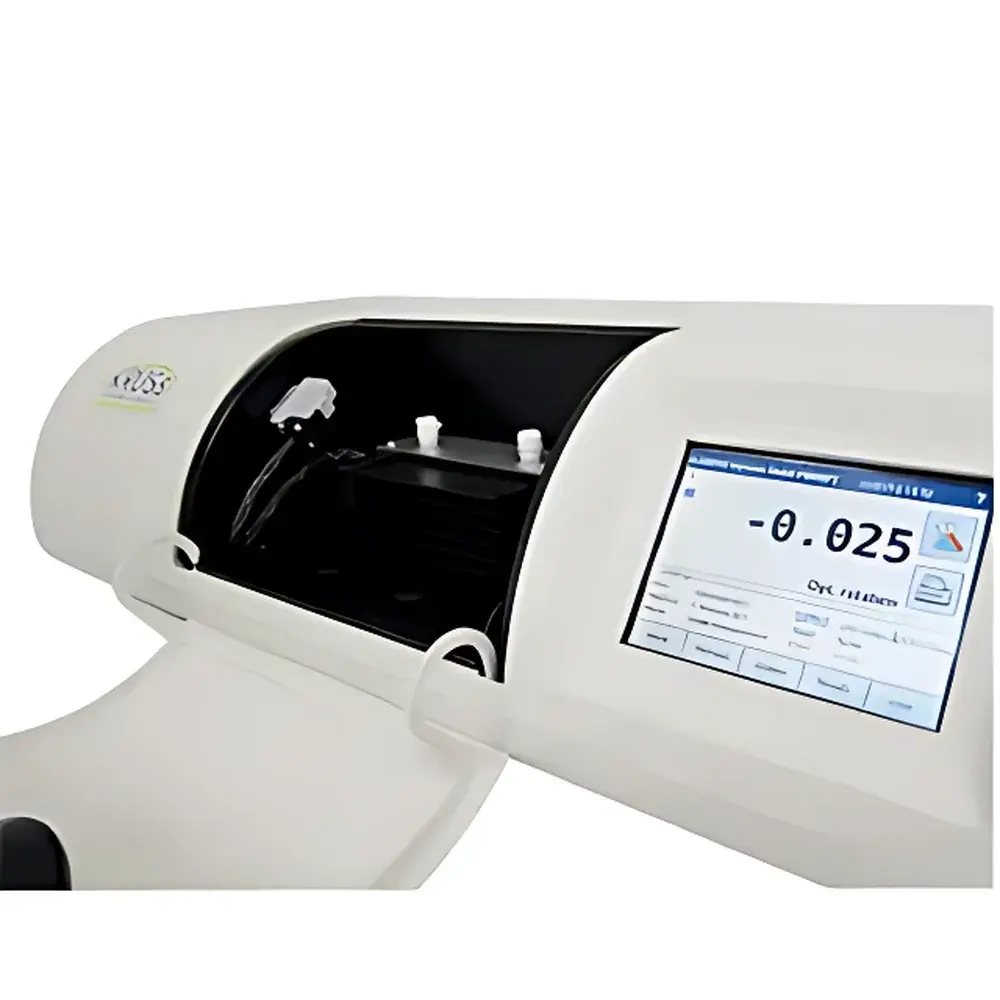
KRUESS P8000-DT Automated Polarimeter with Integrated Rinse & Dry Module
| Brand | KRUESS |
|---|---|
| Origin | Germany |
| Model | P8000-DT |
| Sample Cell Temperature Control | Yes (Peltier, −15 °C to 40.0 °C, ±0.2 °C accuracy) |
| Display | 5.7″ TFT touchscreen (320 × 240 px) |
| Light Source | LED with 589 nm filter (optional alternate wavelengths) |
| Measurement Range | ±90° optical rotation, ±259 °Z, 0–99.9 g/100 mL |
| Resolution | 0.001°, 0.01 °Z, 0.1 g/100 mL |
| Accuracy | ±0.003°, ±0.01 °Z, ±0.5 g/100 mL |
| Repeatability | 0.002° |
| Measurement Time (full range) | 1 s |
| Sample Handling | Semi-automated fluidic sampling with integrated rinse & dry cycle |
| Wetted Materials | PTFE, PFA, Viton®, borosilicate glass |
| Data Storage | 999 measurements |
| Interfaces | RS-232, USB, Ethernet |
| Power | 90–250 V AC, 50/60 Hz |
| Dimensions (W×D×H) | 64.5 × 20.0 × 36.0 cm |
| Weight | 28 kg |
Overview
The KRUESS P8000-DT is a high-precision automated polarimeter engineered for laboratories requiring rigorous optical activity measurement under fully controlled thermal and hygienic conditions. It operates on the fundamental principle of optical rotation—quantifying the angular deviation of plane-polarized light as it passes through chiral substances in solution. Unlike conventional manual or basic semi-automated systems, the P8000-DT integrates a dedicated rinse-and-dry module directly into its fluidic architecture, enabling seamless transition between samples without manual disassembly of the measurement cell. This design eliminates cross-contamination risks and significantly reduces operator intervention, making it especially suitable for regulated environments where sample integrity, traceability, and process efficiency are critical—such as pharmaceutical development, fine chemical synthesis, and flavor/fragrance QC.
Key Features
- Integrated Peltier-based temperature control system (−15 °C to +40.0 °C) with ±0.2 °C stability, ensuring reproducible measurements across thermally sensitive analytes.
- Dedicated rinse-and-dry module using inert, chemically resistant wetted materials (PTFE, PFA, Viton®, and borosilicate glass), compatible with aggressive solvents and high-value APIs.
- LED light source at 589 nm (sodium D-line equivalent), with optional wavelength selection for method-specific validation per USP , Ph. Eur. 2.2.7, or ISO 5725.
- Semi-automated fluidic sampling via peristaltic tubing—no syringes or external pumps required—enabling rapid, low-volume (<1 mL) sample introduction and full cell evacuation.
- High-resolution detection (0.001° angular resolution) and fast acquisition (≤1 s per reading), supporting real-time monitoring of dynamic reactions such as enzymatic hydrolysis or epimerization.
- Touchscreen interface with intuitive menu-driven calibration, user-defined concentration units, and configurable rinse/dry parameters (duration, flow rate, drying time).
Sample Compatibility & Compliance
The P8000-DT accommodates a broad spectrum of optically active compounds—including sugars (glucose, fructose, sucrose), amino acids, antibiotics, steroids, and synthetic chiral intermediates—across diverse matrices (aqueous, alcoholic, acidic, or mildly corrosive solutions). Its chemically inert flow path ensures compatibility with common organic solvents (e.g., methanol, ethanol, acetone) and mild acids/bases encountered in API purification workflows. The instrument supports compliance with GLP and GMP requirements through audit-trail-capable data logging (timestamped, operator-ID tagged), electronic signature readiness, and alignment with FDA 21 CFR Part 11 principles when paired with KRUESS LabSoft software. All measurement protocols adhere to internationally recognized standards including ISO 11777 (polarimetry), AOAC Official Method 951.02 (sugar analysis), and USP (optical rotation determination).
Software & Data Management
KRUESS LabSoft (v4.x or later) provides full remote operation, method storage, and automated report generation compliant with laboratory quality management systems. Raw and processed data—including rotation angle (°), International Sugar Scale (°Z), and user-defined concentration values—are exportable in CSV, PDF, or XML formats. The embedded 999-entry memory retains all metadata: temperature, timestamp, sample ID, rinse cycle count, and calibration status. Ethernet connectivity enables integration into LIMS environments, while RS-232 and USB ports support legacy instrumentation interfacing and local backup. Audit trails record every parameter change, calibration event, and measurement action—critical for regulatory submissions and internal QA reviews.
Applications
- Pharmaceutical Industry: Monitoring enantiomeric excess during asymmetric synthesis; quantifying chiral purity of active pharmaceutical ingredients (APIs); validating stereochemical stability under accelerated storage conditions.
- Food & Beverage: Determining sucrose, glucose, and fructose concentrations in syrups, juices, and confectionery; verifying authenticity of honey and maple syrup via specific rotation profiling.
- Flavor & Fragrance: Assessing optical purity of terpenes (e.g., limonene, menthol), lactones, and esters; controlling batch-to-batch consistency of natural isolates.
- Chemical Manufacturing: Tracking reaction progress in chiral catalysis; verifying configuration retention during functional group transformations; certifying final product enantiomeric composition prior to release.
- Academic & Research Labs: Supporting mechanistic studies of racemization kinetics; characterizing novel chiral catalysts; teaching core principles of molecular chirality and spectroscopic analysis.
FAQ
Does the P8000-DT require external water baths or chillers for temperature control?
No—the integrated Peltier thermoelectric module provides self-contained, rapid thermal stabilization from −15 °C to +40.0 °C without auxiliary cooling systems.
Can the rinse-and-dry sequence be customized for different solvent classes?
Yes—users define rinse volume, dwell time, air purge duration, and number of cycles per method, allowing optimization for volatile organics, viscous oils, or aqueous buffers.
Is the 220-mm sample cell compatible with standard ISO-compliant tubes?
Yes—the cell conforms to ISO 11777 specifications and accepts standard 100-mm, 200-mm, and 220-mm pathlength cells with interchangeable sealing caps.
How is calibration performed, and does it support multi-point verification?
Calibration is fully automated via on-screen wizard using certified quartz control plates or sucrose reference standards; both zero-point and span calibration are supported with traceable certificate documentation.
What safety certifications does the P8000-DT hold?
The instrument complies with IEC 61010-1 (electrical safety), CE marking (EMC Directive 2014/30/EU and Low Voltage Directive 2014/35/EU), and RoHS 2011/65/EU.




