
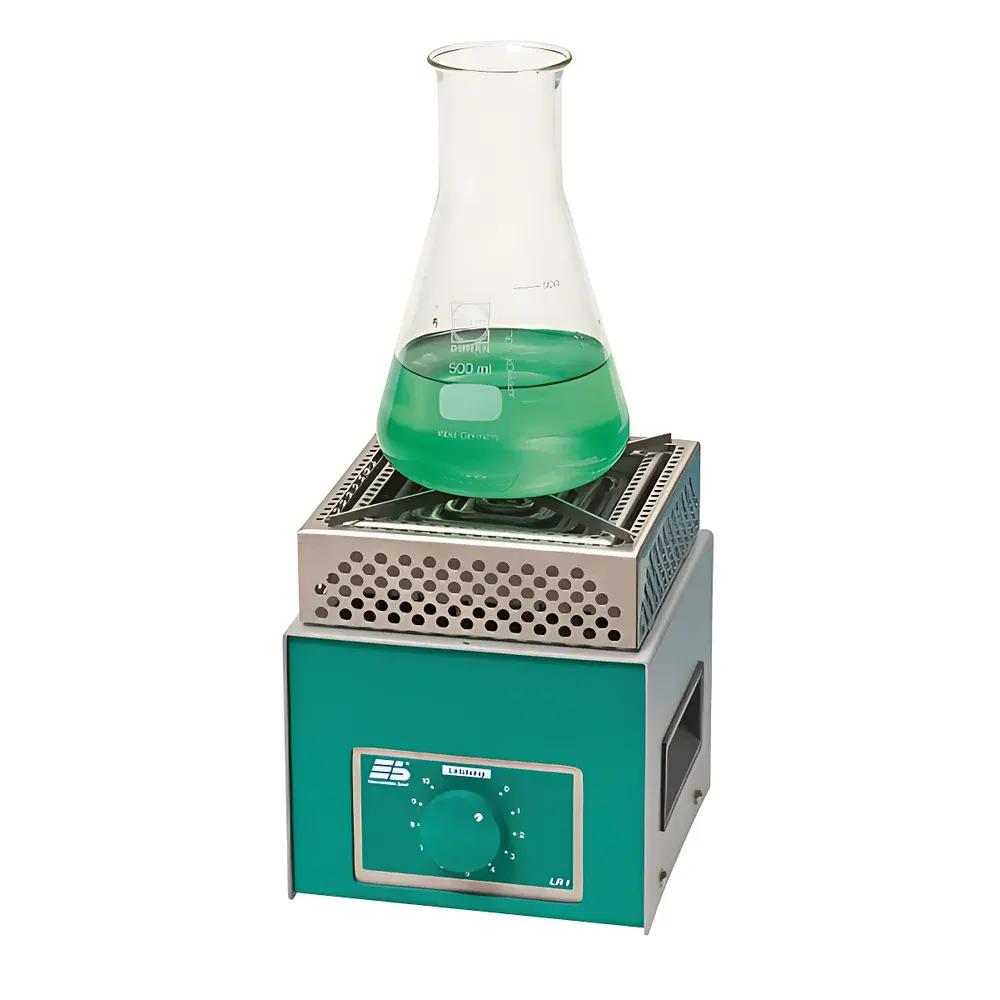
Edmund Bühler IRB 2 Infrared Heating Unit with Continuous Power Control
| Brand | Edmund Bühler |
|---|---|
| Origin | Germany |
| Model | IRB 2 Infrared Heating Unit with Continuous Power Control |
| Max. Temperature | 900 °C |
| Heating Power | 800 W |
| Heating Area | 100 × 100 mm |
| Power Regulation | 0–100 % continuous (infinitely variable) |
| Max. Ambient Temperature | 30 °C |
| Supply Voltage | 230 V, 50/60 Hz (115 V version available on request) |
| Dimensions (W × D × H) | 150 × 150 × 170 mm |
| Weight | 2.5 kg |
Overview
The Edmund Bühler IRB 2 Infrared Heating Unit with Continuous Power Control is a compact, high-precision laboratory heating system engineered for reproducible thermal treatment of solid and powdered samples under controlled radiant heat exposure. Unlike convection or conductive heating methods, the IRB 2 employs medium-wave infrared radiation (peak emission ~2.5–4 µm) generated by a high-emissivity ceramic heating element, enabling rapid, non-contact surface heating with minimal thermal inertia and negligible air disturbance. This principle ensures uniform energy delivery across the defined 100 × 100 mm active zone—critical for applications requiring spatially consistent thermal profiles, such as pre-drying of analytical samples, controlled thermal activation of catalysts, or conditioning of ceramic green bodies prior to sintering. Designed and manufactured in Germany, the unit complies with IEC 61000-6-3 (EMC emission) and IEC 61000-6-2 (immunity) standards, and its robust metal housing with integrated thermal shielding meets IP20 environmental protection requirements for laboratory use.
Key Features
- Continuous, infinitely variable power regulation from 0 to 100 % via precision potentiometer—enabling fine-tuned thermal ramping and stabilization without overshoot
- Ceramic infrared emitter with optimized spectral output for efficient absorption by common inorganic and polymeric materials
- Stable maximum operating temperature of 900 °C at the sample surface under nominal load conditions; thermal stability ±5 °C over 30 min at 750 °C (measured with calibrated thermocouple)
- Compact footprint (150 × 150 × 170 mm) and lightweight construction (2.5 kg) facilitate integration into fume hoods, gloveboxes, or automated sample handling workstations
- Dual-voltage compatibility: standard 230 V, 50/60 Hz operation; optional 115 V configuration available for North American and Japanese laboratory networks
- Integrated overtemperature protection with independent bimetallic cut-off (triggered at ≥950 °C) and ambient temperature monitoring (deactivation above 30 °C ambient)
Sample Compatibility & Compliance
The IRB 2 is compatible with crucibles, ceramic boats, quartz dishes, and stainless-steel trays up to 100 × 100 mm in planar dimension. It supports inert-atmosphere applications when used inside nitrogen-purged enclosures or vacuum-compatible gloveboxes (provided external feedthroughs accommodate power cabling). The unit does not generate airflow or particulate emissions, making it suitable for cleanroom-adjacent workflows and ISO/IEC 17025-accredited laboratories where contamination control is mandated. While not intrinsically rated for hazardous locations, its design adheres to EN 61010-1:2010 safety requirements for electrical equipment for measurement, control, and laboratory use—including creepage/clearance distances, insulation resistance (>2 MΩ), and dielectric strength testing (1500 V AC for 1 min).
Software & Data Management
The IRB 2 operates as a standalone analog-controlled instrument with no embedded microprocessor or digital interface. However, it is fully compatible with external data acquisition systems via optional analog voltage output (0–10 V corresponding to 0–100 % power setting) and auxiliary thermocouple input terminals (K-type, unamplified). When integrated with programmable logic controllers (PLCs) or PC-based DAQ platforms (e.g., National Instruments CompactDAQ), users can implement closed-loop temperature control using external PID algorithms, log time-stamped power and thermocouple readings, and generate audit-ready CSV reports compliant with GLP documentation practices. No proprietary software or drivers are required; all signal conditioning follows IEEE 11073-10201 standards for analog biomedical instrumentation interoperability.
Applications
- Routine drying and moisture loss-on-ignition (LOI) analysis per ASTM C114 and ISO 562 for cementitious materials
- Thermal pretreatment of soil, sediment, and fly ash samples prior to XRF or ICP-OES digestion
- Controlled pyrolysis screening of polymer composites and battery electrode coatings
- Preheating of substrates for thin-film deposition (e.g., spin-coating, dip-coating) to minimize solvent retention
- Accelerated aging studies of packaging materials under elevated radiant heat stress (aligned with ISTA 3A and ASTM D4332 protocols)
- Calibration verification of infrared thermometers and thermal imaging systems across 100–800 °C range
FAQ
Is the IRB 2 suitable for use inside a nitrogen-filled glovebox?
Yes—provided the glovebox feedthrough accommodates the 230 V power cable and optional thermocouple leads. No internal electronics or outgassing components are present.
Does the unit include a built-in temperature sensor?
No. Surface temperature must be monitored externally using a calibrated K-type thermocouple placed in direct contact with the sample or substrate.
Can the heating profile be programmed?
Not natively. Programming requires integration with an external controller supporting analog setpoint modulation and thermocouple feedback.
What is the typical time-to-temperature for reaching 600 °C?
Approximately 4–6 minutes from ambient, depending on sample mass, emissivity, and ambient airflow; cooling to 100 °C takes ~12–15 minutes with natural convection only.
Is CE marking applicable?
Yes—the IRB 2 carries full CE marking under the Low Voltage Directive (2014/35/EU) and EMC Directive (2014/30/EU), with technical documentation available upon request for quality audits.



