
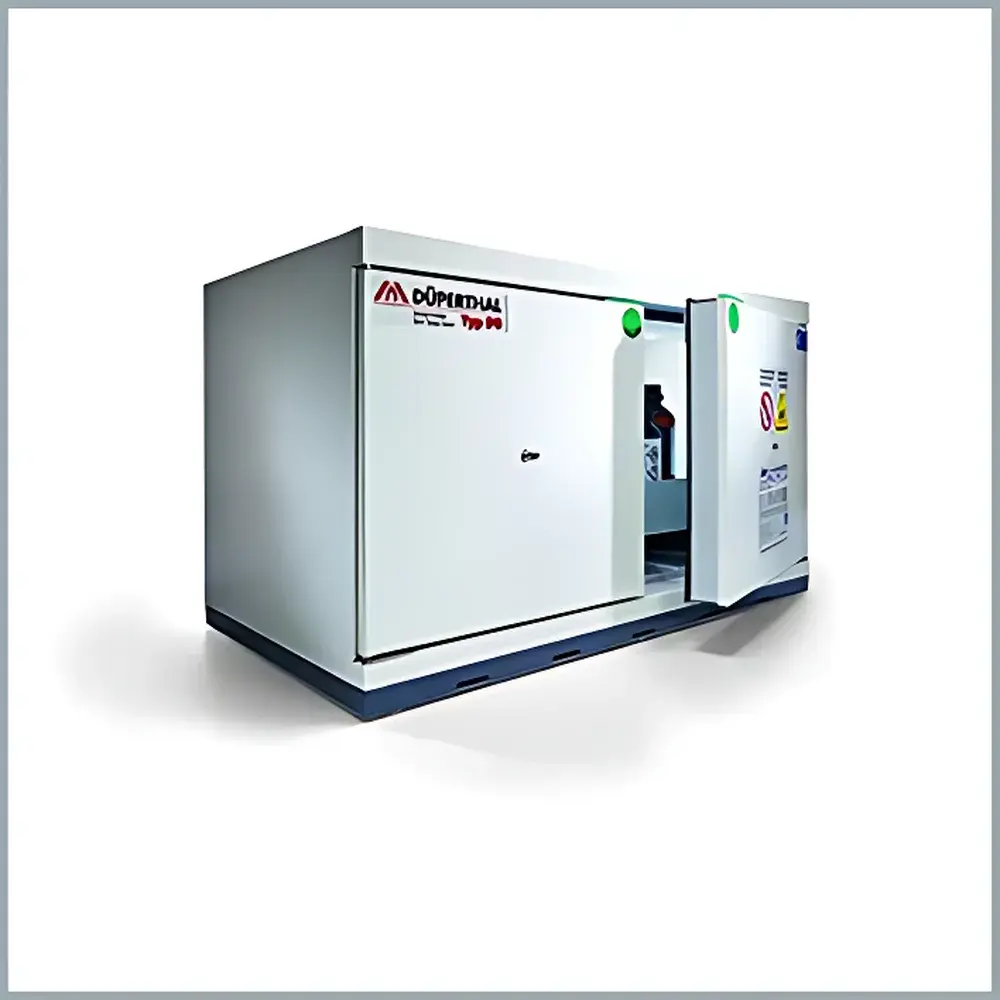
Dueperthal EX-Grade Undercounter Explosion-Proof Refrigerator
| Brand | Dueperthal |
|---|---|
| Origin | Germany |
| Type | Undercounter (Horizontal) |
| Certification | ATEX Directive 2014/34/EU, IECEx, DIN EN 60079-1 & 60079-15, CE, GS, ISO 9001 |
| Construction | Cold-rolled steel housing with epoxy-polyester powder coating, stainless steel interior |
| Temperature Range | -20 °C to +8 °C (adjustable in 1 °C increments) |
| Safety Classification | Class I, Division 1, Groups C & D (US NEC), Zone 1 (IEC/ATEX) |
| Internal Volume | 120–320 L (model-dependent) |
| Door Configuration | Front-access single or dual door, optional lockable handles and key-lock system |
| Shelving | Adjustable galvanized steel shelves or pull-out stainless steel drawers |
| Compressor | Hermetically sealed, non-sparking, intrinsically safe refrigeration unit with R290 (propane) refrigerant |
| Electrical | 230 V AC, 50 Hz, IP54-rated junction box |
Overview
The Dueperthal EX-Grade Undercounter Explosion-Proof Refrigerator is an engineered solution for the secure, temperature-controlled storage of hazardous substances in laboratory, pharmaceutical, chemical, and industrial environments where flammable vapors, combustible dusts, or reactive gases may be present. Designed and manufactured in Germany to stringent European and international explosion protection standards, this undercounter (horizontal) refrigerator integrates intrinsic safety principles at every level—from motor windings and thermostat circuits to lighting assemblies and compressor enclosures. Its operational principle relies on a fully isolated refrigeration system using R290 (propane), a natural refrigerant with zero ozone depletion potential (ODP) and negligible global warming potential (GWP), housed within a certified explosion-proof enclosure. Unlike standard refrigerators, all electrical components—including the compressor, fan motors, thermostats, and internal LED lighting—are either intrinsically safe (Ex i), flameproof (Ex d), or encapsulated (Ex m), ensuring no ignition source can propagate in classified atmospheres. The unit is rated for continuous operation in Zone 1 (gas/vapor) and Class I, Division 1 (NEC) hazardous locations, making it suitable for use adjacent to fume hoods, solvent dispensing stations, QC labs, and pilot-scale synthesis areas.
Key Features
- Full compliance with ATEX 2014/34/EU, IECEx, and UL/cUL Class I, Div 1 standards—certified by notified bodies including DEKRA and SGS
- Robust cold-rolled steel cabinet with epoxy-polyester finish; interior constructed from electropolished stainless steel (AISI 304) for corrosion resistance against acids, bases, and solvents
- Temperature stability maintained within ±1.5 °C across the full operating range (–20 °C to +8 °C), verified per DIN EN 60068-2-1 and -2-2
- Non-sparking, hermetically sealed compressor with thermal overload protection and redundant high/low pressure cutouts
- Optional data logging capability via RS485 interface supporting Modbus RTU protocol for integration into centralized BMS or LIMS platforms
- Integrated mechanical door lock with dual-key access control; optional electronic audit trail module compliant with FDA 21 CFR Part 11 requirements
Sample Compatibility & Compliance
This refrigerator accommodates a broad spectrum of regulated and hazardous materials—including flammable liquids (e.g., acetone, ethanol, hexane), corrosive reagents (HCl, HNO₃, NaOH solutions), toxic compounds (cyanides, organophosphates), environmental water samples containing VOCs, biological culture media requiring chilled stabilization, pressurized gas cylinders (up to 20 L), and archival documentation requiring humidity-controlled preservation. All models are validated for storage per ASTM E2551–22 (Standard Guide for Safe Storage of Flammable Liquids) and align with ISO/IEC 17025:2017 clause 5.4.2 regarding environmental condition control in testing laboratories. Units undergo factory calibration and come with a traceable certificate of conformity issued against EN 60079-0 and EN 60079-15.
Software & Data Management
While the base configuration operates via analog electromechanical controls, optional digital controllers provide programmable setpoints, real-time temperature monitoring, alarm history (with timestamps), and configurable relay outputs for external annunciators or HVAC interlocks. When equipped with the Dueperthal DataBridge module, units support GLP/GMP-compliant data integrity features—including user-level permissions, electronic signatures, immutable audit trails, and encrypted CSV export. All firmware adheres to IEC 62443-3-3 security requirements for industrial control systems, with secure boot and signed firmware updates.
Applications
- Storage of flammable solvents in analytical chemistry labs conducting GC, HPLC, or spectroscopy sample prep
- Chilled containment of unstable intermediates during API development under cGMP conditions
- Secure holding of field-collected environmental samples prior to EPA Method 524.2 or 8260D analysis
- Backup refrigeration for emergency response kits in petrochemical facilities with Zone 1 classification
- Compliance-driven storage of SDS-managed inventory in university research facilities subject to OSHA 1910.1200 and EU CLP Regulation
FAQ
What hazardous area classifications does this refrigerator support?
It is certified for Zone 1 (IEC/ATEX) and Class I, Division 1 (NEC), Groups C & D — covering atmospheres with ethyl ether, gasoline, acetone, and other common laboratory solvents.
Can it be installed beneath a standard lab bench?
Yes — designed as an undercounter unit with front-venting architecture; requires minimum 50 mm rear clearance and unobstructed floor-level air intake.
Is remote monitoring available?
Yes — optional Ethernet or RS485 connectivity enables integration with building management systems (BMS) or enterprise LIMS via Modbus TCP/RTU.
Does it meet FDA 21 CFR Part 11 requirements?
When configured with the DataBridge module and appropriate user administration protocols, it supports electronic records and signatures in regulated pharmaceutical and biotech environments.
What maintenance intervals are recommended?
Compressor oil and filter inspection every 24 months; door gasket integrity check quarterly; temperature sensor calibration annually per ISO/IEC 17025 requirements.
Related Products



