
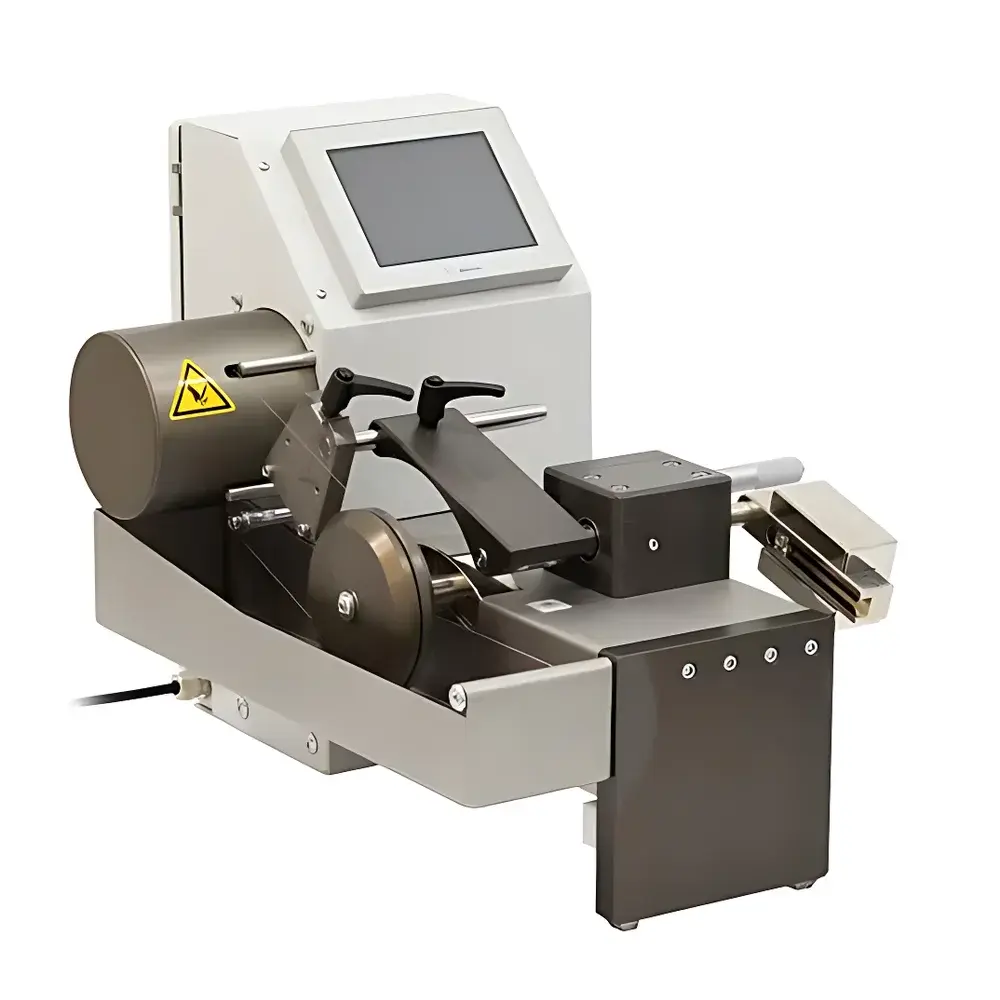
Diamond WireTec DWS100 Diamond Wire Saw
| Brand | Diamond WireTec |
|---|---|
| Origin | Germany |
| Model | DWS100 |
| Cutting Principle | Reciprocating Diamond-impregnated Wire |
| Max Wire Speed | 0–4 m/s |
| Max Sample Cross-section | 85 × 85 mm |
| Wire Feed Force | Gravity-driven Constant Tension |
| Cutting Modes | Dry or Wet (with Coolant Reservoir) |
| Kerf Width | 0.1–0.5 mm |
| Positioning Accuracy | ±0.01 mm (via Integrated Micrometer) |
| Safety Features | Automatic Wire Break Detection, End-of-Cut Stop, Emergency Stop Circuit |
| Display | 7-inch Color Touchscreen (English Firmware Available) |
| Compliance | CE, RoHS, ISO 9001 Manufacturing Environment |
| Power Supply | 230 V AC, 50/60 Hz, 1.2 kW |
Overview
The Diamond WireTec DWS100 is a compact, horizontally configured diamond wire saw engineered for high-precision sample sectioning in research laboratories, quality control facilities, and materials science departments. It employs reciprocating motion of a diamond-impregnated wire—tensioned solely by gravity—to achieve low-thermal, low-stress cutting across heterogeneous and brittle materials. Unlike abrasive wheel cutters or high-speed rotating blades, the DWS100 operates on the principle of controlled abrasion: diamond particles embedded along the wire’s length remove material through micro-fracture rather than plastic deformation, preserving microstructural integrity at the cut interface. This makes it especially suitable for preparing specimens for subsequent metallographic analysis, SEM/TEM cross-sectioning, XRD phase mapping, or non-destructive evaluation where thermal damage, recast layers, or mechanical distortion must be minimized.
Key Features
- Gravity-fed wire tension system eliminates need for pneumatic components—ensuring silent, maintenance-free operation with zero risk of pressure-related failure modes.
- Reciprocating wire drive with programmable forward/reverse alternation reduces localized wear and extends wire service life while maintaining consistent kerf geometry.
- Integrated micrometer stage (0.01 mm resolution) enables precise thickness control for serial sectioning, wafer slicing, or layered material delamination studies.
- 7-inch industrial touchscreen interface supports multilingual firmware (English default), graphical workflow prompts, and intuitive parameter entry—no prior training required.
- Automatic wire winding mechanism simplifies line replacement and ensures repeatable wire alignment without manual spooling or tension calibration.
- Dual-mode operation: dry cutting for dust-sensitive environments (e.g., cleanrooms), or wet cutting using a built-in coolant reservoir to suppress particulate generation and dissipate residual heat.
- CE-certified safety architecture includes real-time wire break detection, end-of-travel limit switches, and hardware-enforced emergency stop circuitry compliant with EN 60204-1.
Sample Compatibility & Compliance
The DWS100 accommodates diverse material classes—including fused silica, sapphire, alumina ceramics, CFRP composites, cast iron, tungsten carbide, geological core samples, fossilized bone, and reinforced concrete—without requiring material-specific tool changes. Its low-kerf geometry (0.1–0.5 mm) minimizes material loss, critical when working with irreplaceable archival or high-value specimens. All structural components are fabricated from corrosion-resistant anodized aluminum and stainless steel, ensuring long-term dimensional stability in humid or chemically aggressive lab environments. The system conforms to ISO 9001 manufacturing standards and carries full CE marking under the Machinery Directive 2006/42/EC and Electromagnetic Compatibility Directive 2014/30/EU. Optional documentation packages support GLP/GMP audit readiness, including factory calibration certificates traceable to PTB (Physikalisch-Technische Bundesanstalt).
Software & Data Management
While the DWS100 operates via embedded firmware—not PC-dependent software—it logs all operational events (start/stop timestamps, wire speed profiles, fault codes, and user-initiated actions) to internal non-volatile memory. Audit trails are exportable via USB interface in CSV format, supporting compliance with FDA 21 CFR Part 11 requirements when paired with validated laboratory information management systems (LIMS). Firmware updates are delivered as signed binary files with SHA-256 checksum verification. No cloud connectivity or remote access functionality is implemented—ensuring data sovereignty and eliminating cybersecurity exposure vectors common in networked instrumentation.
Applications
- Preparation of TEM lamellae from bulk ceramic or semiconductor substrates without ion-beam thinning artifacts.
- Cutting of photovoltaic wafers, battery electrode stacks, or thermoelectric modules for interfacial adhesion analysis.
- Sectioning of archaeological artifacts, paleontological specimens, or heritage conservation samples where mechanical shock must be avoided.
- Routine QC sectioning of PCB laminates, MMCs (metal matrix composites), or additively manufactured parts for porosity and grain structure assessment.
- Serial block-face imaging (SBFI) sample preparation for 3D electron microscopy reconstruction workflows.
FAQ
What types of diamond wire are compatible with the DWS100?
Standard wire diameters range from 0.12 mm to 0.35 mm, with resin-bonded or electroplated diamond coatings. Wire selection depends on material hardness and desired kerf width; Diamond WireTec provides application-specific recommendations based on ASTM C1327–22 guidelines.
Can the DWS100 perform angled cuts?
Yes—using optional 360° rotational angle fixtures or precision side-cutting chucks, users can achieve oblique sections from 0° to 90° relative to the primary plane, enabling crystallographic orientation control for anisotropic material analysis.
Is coolant recycling supported?
The integrated coolant reservoir is designed for single-use or batch filtration; closed-loop recirculation requires external pump/filtration integration and is not natively supported to maintain CE-compliant electrical isolation.
How is positional repeatability verified during calibration?
Traceable calibration uses certified gauge blocks and optical interferometry per ISO 230-2; factory documentation includes uncertainty budgets for linear axis positioning (k=2, U = ±0.012 mm).
Does the system meet vibration sensitivity requirements for SEM sample prep labs?
Vibration emission levels are <0.12 mm/s RMS (measured per ISO 20816-1 at 1 m distance), making it suitable for installation adjacent to high-resolution electron microscopes without active damping.



