
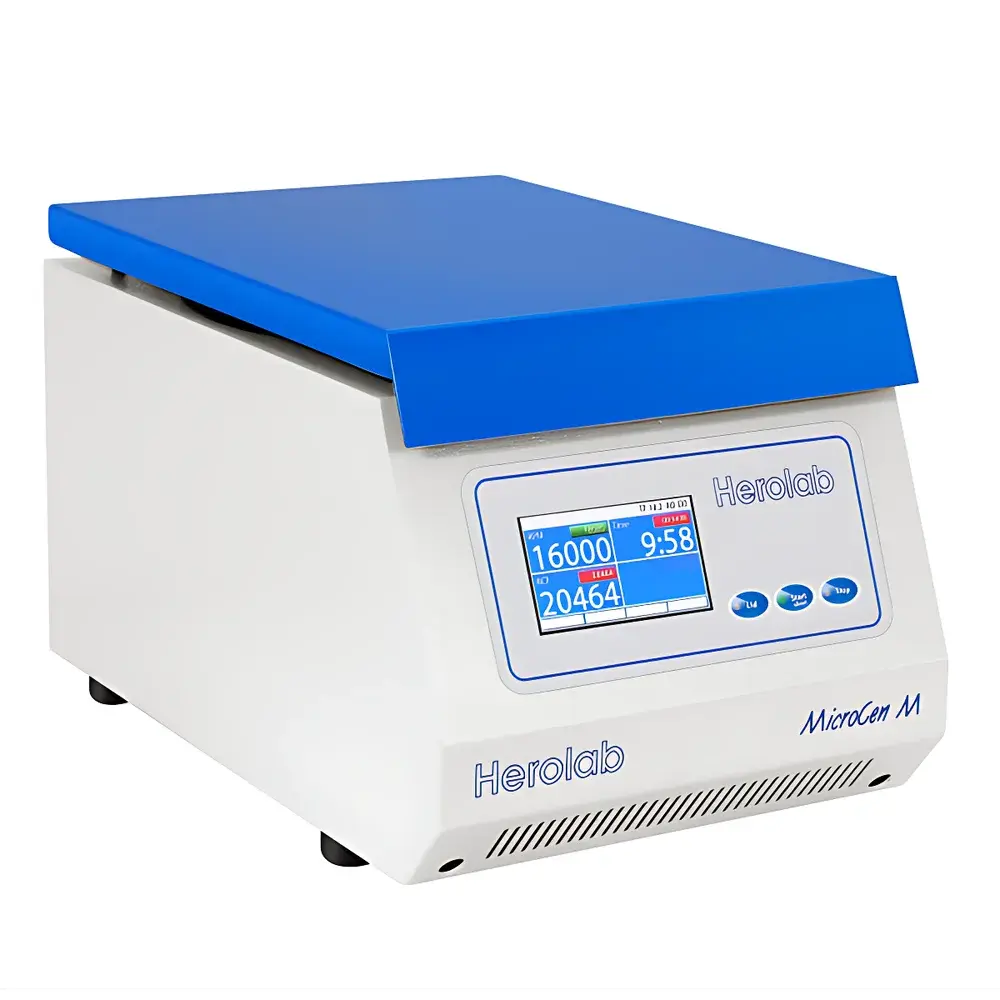
Herolab MicroCen M Desktop High-Speed Centrifuge
| Brand | Herolab |
|---|---|
| Origin | Germany |
| Model | MicroCen M |
| Type | Benchtop Centrifuge |
| Speed Range | 200–16,000 rpm |
| Max RCF | 20,464 × g (angular rotor) / 12,927 × g (swing-out rotor) |
| Max Capacity | 12 × 10 mL (angular) or 24 × 1.5/2.2 mL (swing-out) |
| Drive System | Maintenance-free high-speed induction motor with auto-centering |
| Transmission | Flexible self-centering shaft |
| Braking | Dynamic reverse magnetic resistance deceleration |
| Temperature Control | Non-refrigerated |
| Rotor Recognition | APRITM™ automatic rotor identification and imbalance detection |
| Power Supply | 230 V, 50–60 Hz |
| Dimensions (W×D×H) | 33.4 × 48.8 × 30.0 cm |
| Weight (net) | 32.0 kg |
Overview
The Herolab MicroCen M is a precision-engineered benchtop high-speed centrifuge designed for routine and demanding separation tasks in life science, clinical diagnostics, and quality control laboratories. Operating on the principle of sedimentation under controlled centrifugal force, the MicroCen M delivers reproducible separation performance across a wide range of biological and chemical sample types. Its robust architecture supports angular and swing-out rotor configurations, enabling flexible adaptation to diverse protocols—including cell pelleting, bacterial harvesting, microfiltration support, and nucleic acid precipitation. As a non-refrigerated system, it is optimized for ambient-temperature applications where thermal stability of samples is not a primary constraint, while maintaining compliance with ISO 13485-aligned manufacturing practices and CE marking per Directive 2014/30/EU (EMC) and 2014/35/EU (LVD).
Key Features
- Maintenance-free high-speed induction motor with auto-centering capability ensures long-term rotational stability and minimal vibration at maximum speeds (up to 16,000 rpm).
- Flexible self-centering shaft transmission reduces mechanical wear and enhances rotor alignment accuracy during acceleration and deceleration cycles.
- Dynamic reverse magnetic resistance braking provides smooth, controllable deceleration—reducing sample resuspension risk and extending rotor lifespan.
- APRITM™ (Automatic Rotor Identification and Protection) system electronically identifies installed rotors and continuously monitors load imbalance; automatically halts operation if imbalance exceeds safety thresholds per IEC 61010-2-020.
- Intuitive rotary dial interface with LED display enables rapid parameter selection (speed, time, acceleration/deceleration profiles) without software dependency.
- Compact footprint (33.4 × 48.8 × 30.0 cm) and 32 kg net weight facilitate integration into space-constrained lab benches or biosafety cabinets.
Sample Compatibility & Compliance
The MicroCen M accommodates standard laboratory consumables including polypropylene and polycarbonate tubes (0.2–10 mL), PCR strips, and capillary hematocrit tubes. Its nine available rotor options—including one swing-out rotor (24 × 1.5/2.2 mL), seven angular rotors (e.g., 12 × 10 mL max), and one capillary rotor—support method scalability from small-volume nucleic acid work to mid-scale cell culture harvests. All rotors are certified to EN 61010-2-020 for mechanical integrity under maximum RCF conditions. The system meets GLP documentation requirements when paired with optional external audit trail logging via RS232 interface (compatible with LIMS integration). It does not comply with FDA 21 CFR Part 11 out-of-the-box but supports third-party electronic signature validation frameworks.
Software & Data Management
The MicroCen M operates as a standalone instrument with no embedded operating system or network connectivity. All operational parameters are stored locally in non-volatile memory and recalled via front-panel controls. For traceability, users may manually log run records—including date/time stamp, rotor ID, speed, duration, and RCF—using printed protocol templates aligned with ISO/IEC 17025 clause 7.7. Optional RS232 output allows connection to external PCs for automated data capture using terminal emulation software (e.g., PuTTY or Tera Term). No proprietary drivers or cloud services are required or supported. Firmware updates are performed exclusively by authorized Herolab service technicians using calibrated diagnostic hardware.
Applications
- Routine pelleting of mammalian and microbial cells (E. coli, yeast, CHO, HEK293) at 10,000–16,000 rpm.
- Clarification of lysates and supernatants prior to chromatography or electrophoresis.
- Preparation of plasma and serum from whole blood using capillary rotors (hematocrit determination).
- Concentration of viral particles and exosomes in research-grade workflows.
- Separation of organic-aqueous phases in extraction protocols (e.g., phenol-chloroform RNA isolation).
- Quality assurance testing of colloidal suspensions and nanoparticle dispersions.
FAQ
Is the MicroCen M suitable for use with infectious or biohazardous samples?
Yes—when operated inside certified Class II biosafety cabinets and fitted with sealed rotors and aerosol-tight tube caps. Routine decontamination of the chamber and rotor surfaces with 70% ethanol or approved sporicidal agents is recommended between runs.
Does the centrifuge support programmable acceleration and deceleration ramps?
Yes—three preset ramp profiles (soft, standard, fast) are selectable per run, allowing optimization for shear-sensitive samples such as intact organelles or protein complexes.
Can third-party rotors be used with the MicroCen M?
No—only Herolab-certified rotors with integrated APRITM™ RFID tags are recognized and enabled by the control system. Use of non-certified rotors will trigger immediate shutdown.
What is the expected service interval for preventive maintenance?
Herolab recommends annual calibration verification and mechanical inspection by an authorized service provider. Motor and bearing lifetime exceeds 25,000 operating hours under typical usage conditions (≤8 hrs/day, 5 days/week).
Is rotor lifetime tracked by the instrument?
No—rotor usage history must be maintained externally via lab-specific asset tracking logs. Each rotor carries a serial number and maximum cycle rating engraved on its flange per DIN EN ISO 13485 Annex C.



