
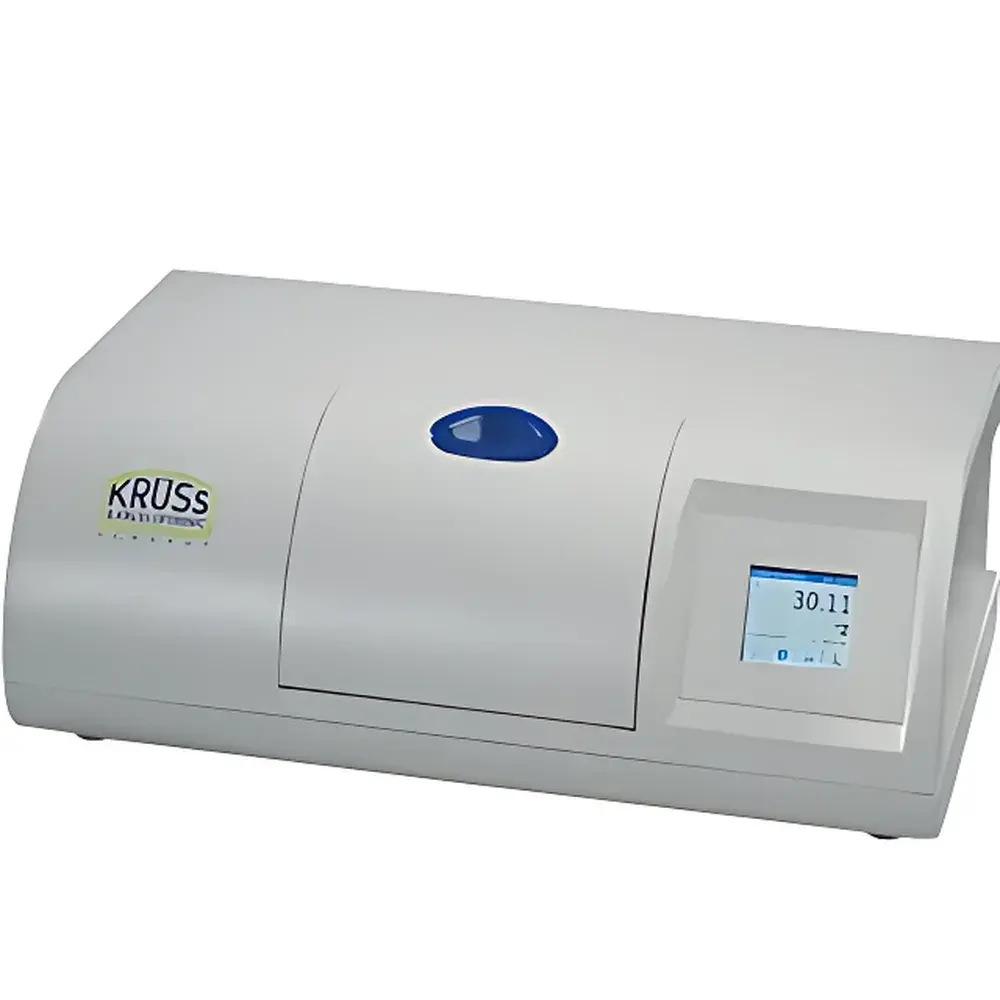
KRUESS P3000 Economical Automatic Polarimeter
| Brand | KRUESS |
|---|---|
| Origin | Germany |
| Model | P3000 |
| Product Type | Automatic Polarimeter |
| Temperature Control | None |
| Digital Display | Yes |
| Light Source | LED |
| Measurement Range | ±90°, ±259°Z |
| Resolution | 0.01°Z |
| Accuracy | ±0.01°Z |
| Repeatability | 0.01° |
| Measurement Time (±90°) | 1 s |
| Wavelength | 589 nm (fixed) |
| Temperature Monitoring Range | 0–99.9 °C |
| Temperature Resolution | 0.1 °C |
| Sample Cell Length | 220 mm |
| Calibration | Menu-driven automatic calibration |
| Display | 5.7-inch LCD (320 × 240 px) |
| Interface | RS-232 |
| Power Supply | 90–250 V, 50/60 Hz |
| Dimensions (W×D×H) | 64.5 × 20.0 × 36.0 cm |
| Weight | 28 kg |
Overview
The KRUESS P3000 Economical Automatic Polarimeter is a precision optical instrument engineered for rapid, reliable measurement of optical rotation in chiral substances. Based on the fundamental principle of polarimetry—detection of the angular deviation of plane-polarized light as it passes through optically active media—the P3000 delivers high reproducibility and traceable results in pharmaceutical, chemical, food, and sugar industry applications. Unlike temperature-controlled polarimeters, the P3000 operates at ambient conditions and integrates a stable 589 nm sodium-D line-equivalent LED light source with narrow-band filtering, ensuring wavelength consistency without lamp degradation or warm-up delays. Its core architecture prioritizes operational efficiency: measurements across the full ±90° angular range are completed in under one second, enabling high-throughput quality control workflows without compromising resolution (0.01°Z) or repeatability (0.01°). Designed as a streamlined variant of the P8000 platform, the P3000 retains identical optical path geometry and signal processing algorithms while omitting active thermal regulation—making it ideal for laboratories where sample temperature stability is maintained externally or where ambient-temperature compliance suffices.
Key Features
- Single-wavelength LED illumination at 589 nm—no warm-up time, no mercury vapor lamps, long service life (>10,000 h)
- Touchscreen-driven interface with intuitive menu navigation on a 5.7-inch VGA-resolution LCD (320 × 240 px)
- Simultaneous dual-unit display: optical rotation (°) and International Sugar Scale (°Z), both resolved to 0.01 units
- Automatic calibration routine accessible via on-screen prompts—no external standards required for routine verification
- Real-time temperature monitoring at the sample cell (0–99.9 °C, 0.1 °C resolution), supporting ambient-condition documentation per ISO 5725 and USP <781>
- RS-232 serial interface for direct connection to LIMS or laboratory PCs; supports ASCII-based data export for audit trail generation
- Rugged mechanical design (28 kg cast-aluminum chassis) optimized for benchtop stability and vibration resistance in shared lab environments
Sample Compatibility & Compliance
The P3000 accommodates standard 220 mm path-length sample tubes—compatible with all common quartz or glass polarimetric cells meeting DIN 1344 specifications. Its sensitivity threshold (minimum detectable concentration ≈ 0.1% w/v for sucrose at OD3) ensures robust performance across low-concentration APIs, intermediates, and food-grade syrups. While lacking active temperature control, its integrated Pt100 sensor enables post-measurement temperature annotation—a requirement for GLP-compliant reporting when combined with procedural controls (e.g., equilibration protocols, environmental logs). The instrument conforms to IEC 61010-1 for electrical safety and meets EMC directive 2014/30/EU. All measurement outputs—including raw angle, °Z conversion, timestamp, and temperature—are exportable in human-readable format, facilitating alignment with FDA 21 CFR Part 11 expectations for electronic records when paired with validated software workflows.
Software & Data Management
No proprietary PC software is bundled with the P3000; instead, it relies on standardized RS-232 communication using ASCII protocol (baud rate 9600, 8N1). This architecture allows seamless integration with third-party platforms—including LabWare LIMS, Thermo Fisher SampleManager, and custom Python/Excel automation scripts—without vendor lock-in. Each measurement record includes: date/time stamp, measured angle (°), converted °Z value, cell temperature (°C), operator ID (manually entered), and calibration status flag. Data logging supports batch-level traceability, and the absence of internal storage eliminates concerns over data retention lifecycle or firmware-mediated deletion—enhancing transparency during regulatory audits.
Applications
- Pharmaceutical QC: Identity confirmation and enantiomeric purity assessment of chiral active pharmaceutical ingredients (APIs), excipients, and intermediates per EP 2.2.7 and USP <781>
- Sugar & Beverage Industry: Routine determination of sucrose, fructose, and glucose concentrations in cane juice, beet extracts, syrups, and finished beverages using °Z scale traceable to ICUMSA methods
- Chemical Synthesis: Monitoring stereoselective reactions, epimerization kinetics, and racemization endpoints via real-time optical rotation trends
- Food & Flavor Analysis: Quantitative verification of natural vs. synthetic flavor compounds (e.g., limonene, menthol), essential oil authenticity, and honey adulteration screening
- Academic Research: Teaching polarimetric theory, calibration methodology, and chiroptical behavior of biomolecules (e.g., amino acids, carbohydrates, peptides) in undergraduate and graduate labs
FAQ
Does the P3000 support temperature regulation during measurement?
No—the P3000 does not include active temperature control. It features a built-in temperature sensor for ambient monitoring only.
Can the P3000 measure samples outside the ±90° range?
No—its calibrated angular range is strictly ±90° (equivalent to ±259°Z). Samples exceeding this require dilution or use of a shorter cell.
Is the 589 nm wavelength user-selectable?
No—the LED source is fixed at 589 nm and cannot be changed or tuned.
How is calibration performed?
Through an on-screen menu-driven automatic calibration sequence using internal reference optics—no manual standard insertion is needed.
What sample cell length is supported?
The P3000 is optimized for 220 mm path-length cells, compliant with ISO 11714 and DIN 1344 dimensional standards.





