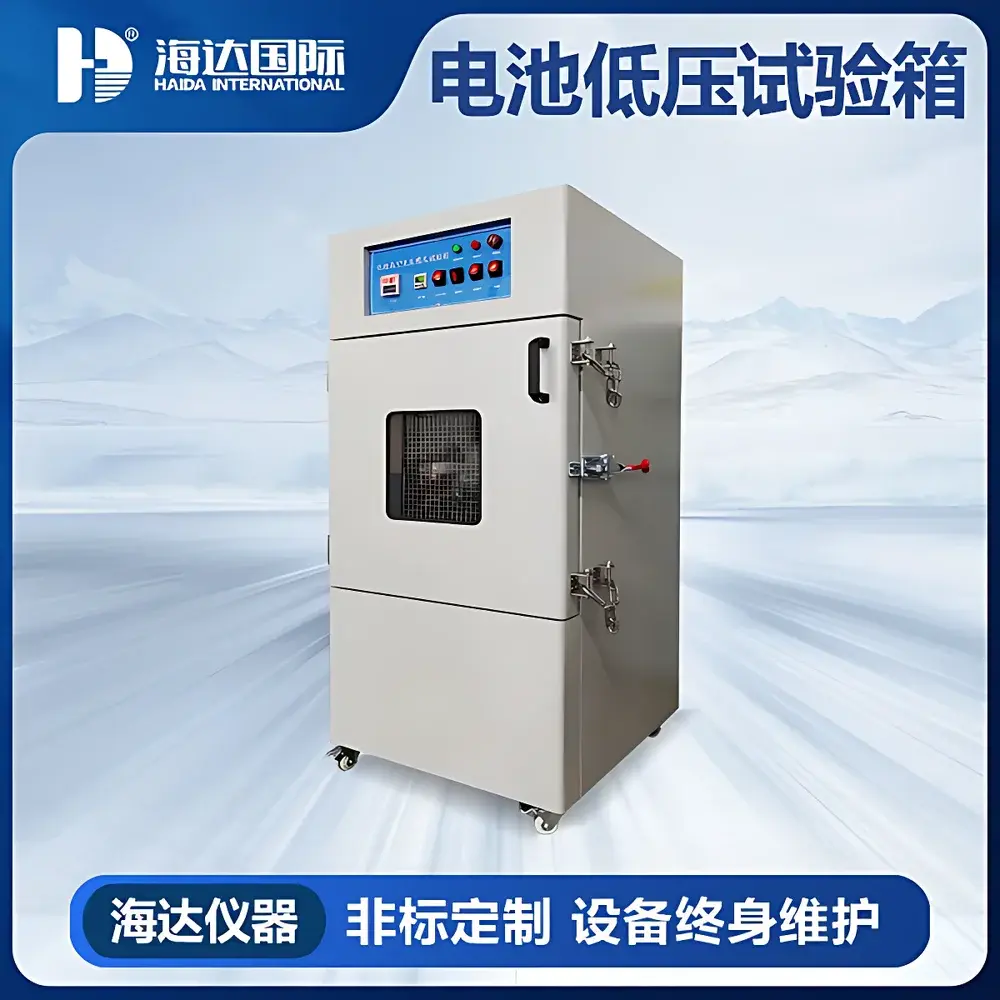
HAIDA HD-H204 High-Altitude Low-Pressure Simulation Chamber for Battery Safety Testing
| Brand | HAIDA INTERNATIONAL |
|---|---|
| Origin | Guangdong, China |
| Manufacturer Type | Direct Manufacturer |
| Product Origin | Domestic (China) |
| Model | HD-H204 |
| Quotation | Upon Request |
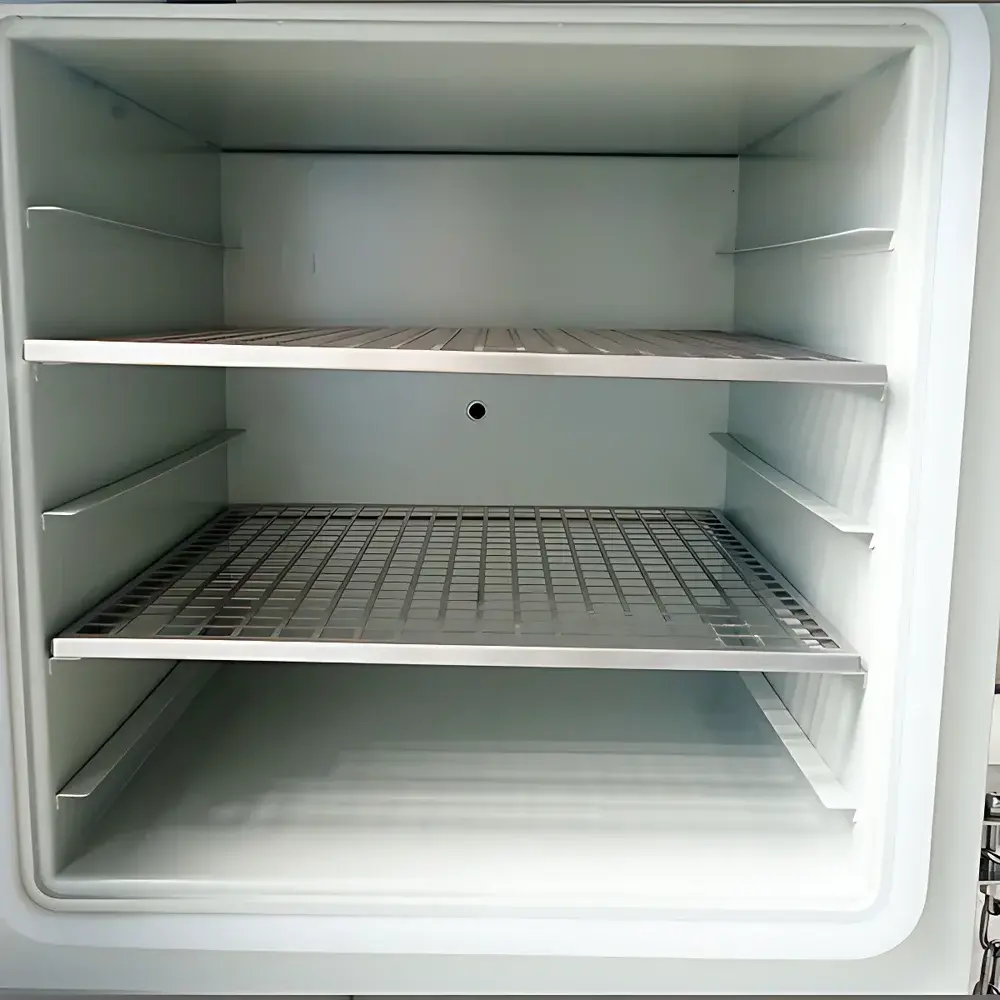
| Internal Chamber Dimensions | 400 × 400 × 400 mm (W×D×H) |
| External Dimensions | 630 × 620 × 1130 mm (W×D×H) |
| Internal Material | SUS304 Stainless Steel, 3.0 mm Thickness |
| External Material | Powder-Coated Cold-Rolled Steel, 1.5 mm Thickness |
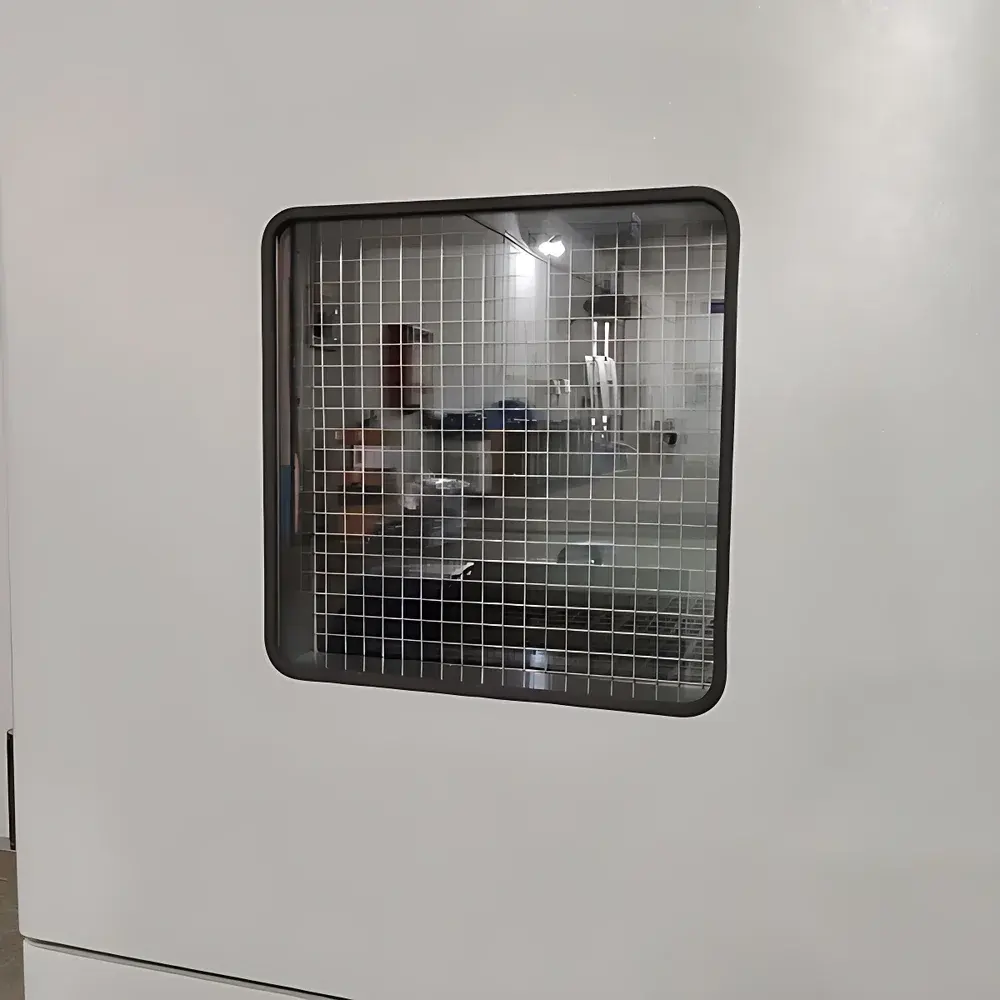
| Observation Window | 250 × 250 mm, Dual-Layer Tempered Glass with Stainless Steel Mesh |
| Mobility | Four Swivel Casters with Brakes |
| Pressure Range | 0.5–100 kPa (Typical Test Point: 11.6 kPa) |
| Vacuum Display | Digital SMC Pressure Gauge |
| Control Interface | Push-Button Panel with LED Timer (0–9999 h) |
| Pressure Stability | ≤ ±5% of Setpoint |
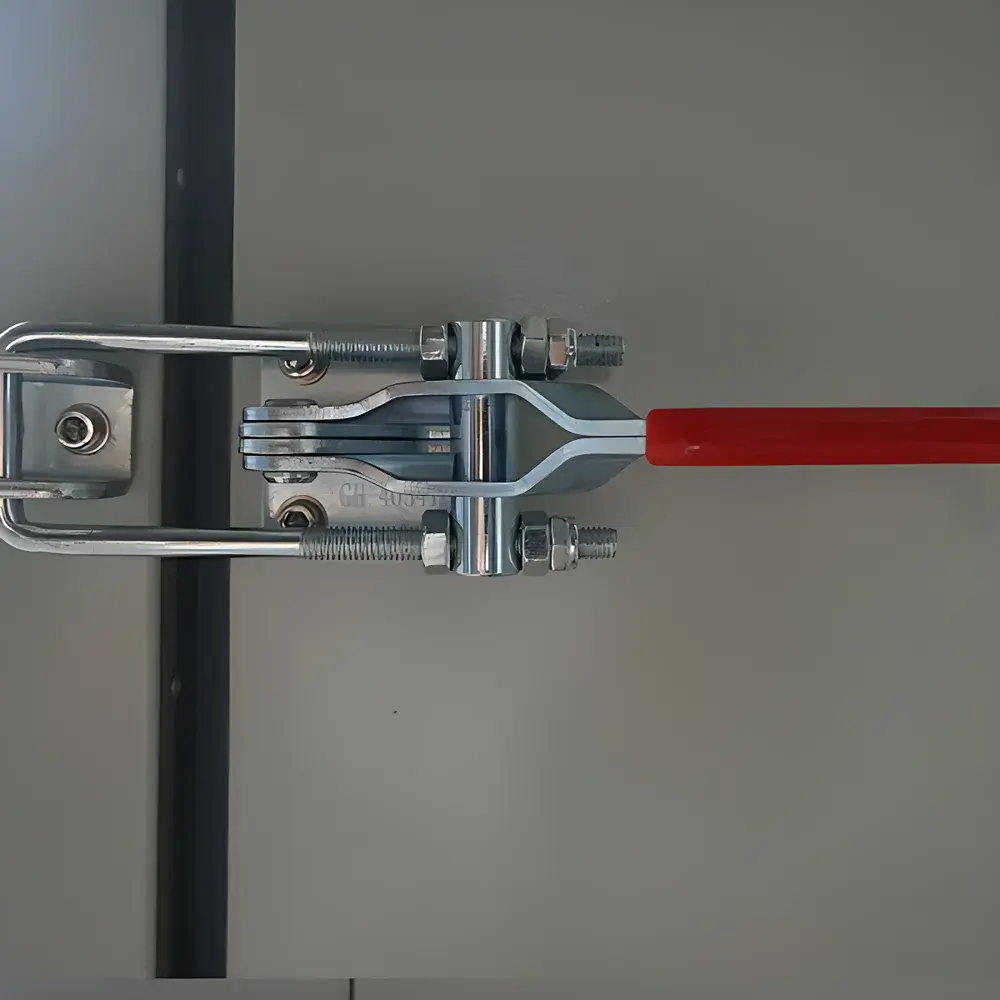
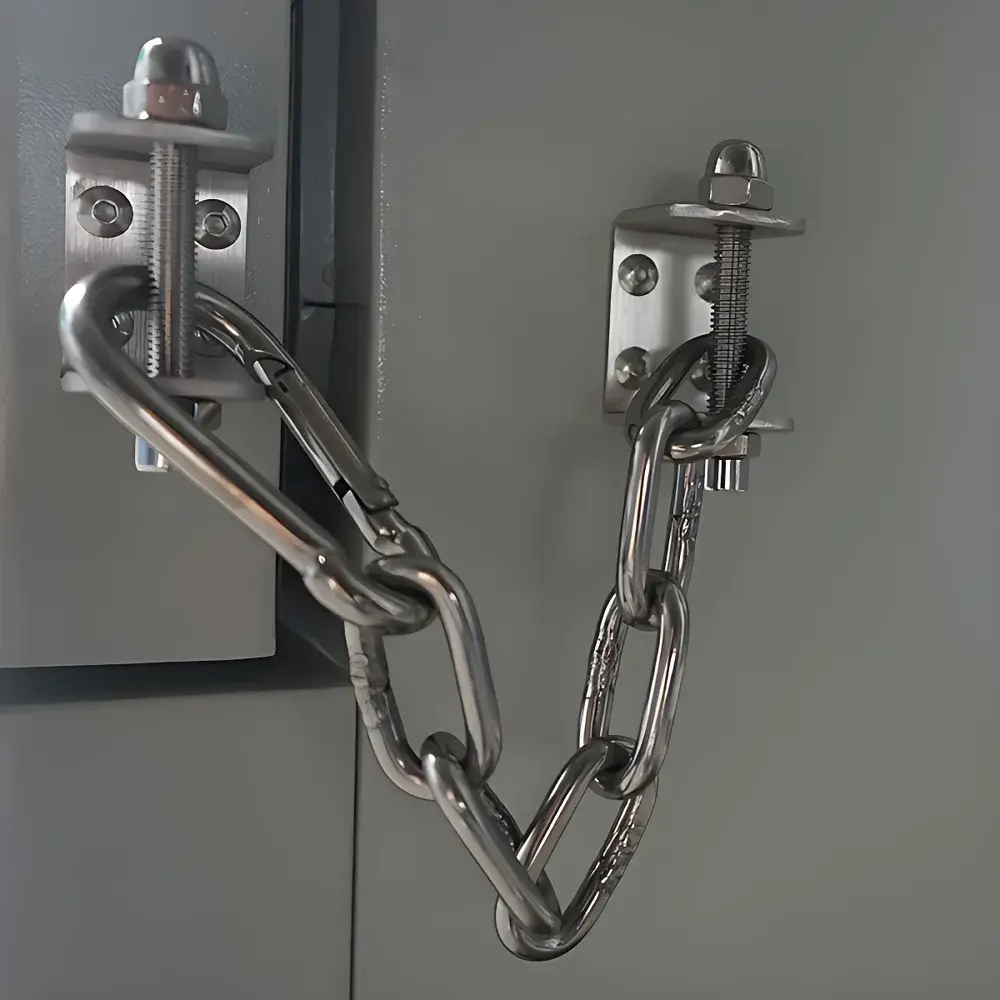
| Door Configuration | Single Left-Swing Door with Explosion-Resistant Chain |
| Load Trays | 2 Stainless Steel Shelves |
| Net Weight | 120 kg |
| Power Supply | AC 220 V, 1 kW |
Overview
The HAIDA HD-H204 High-Altitude Low-Pressure Simulation Chamber is an engineered environmental test system designed specifically for evaluating the safety performance of lithium-ion batteries and battery packs under simulated high-altitude conditions. It operates on the principle of controlled vacuum generation to replicate atmospheric pressures equivalent to altitudes up to approximately 15,240 meters (50,000 ft), where ambient pressure drops to ≤11.6 kPa — a critical threshold defined in international transport and safety standards for lithium-based energy storage devices. The chamber enables precise, repeatable exposure of battery samples to low-pressure environments at stabilized ambient temperature (20 ± 5 °C), supporting pass/fail assessment based on non-ignition and non-explosion criteria over a standardized 6-hour dwell period. Its architecture integrates mechanical vacuum integrity, thermal stability, and real-time pressure monitoring to ensure compliance with regulatory test protocols without operator intervention.
Key Features
- Stainless steel internal chamber (SUS304, 3.0 mm thick) ensures long-term corrosion resistance and structural integrity under repeated vacuum cycling.
- Dual-layer tempered glass observation window (250 × 250 mm) with integrated stainless steel mesh provides safe visual monitoring while maintaining pressure containment.
- Digital SMC pressure gauge delivers real-time, high-resolution vacuum readout across the full 0.5–100 kPa range, with typical test setpoint accuracy at 11.6 kPa ±0.3 kPa.
- Push-button control interface with LED digital timer supports programmable test duration from 1 minute to 9999 hours, enabling both short-duration qualification tests and extended reliability studies.
- Explosion-resistant door design includes left-swing configuration with reinforced hinge and safety chain to mitigate risk during pressure equalization or emergency access.
- Four heavy-duty swivel casters with locking brakes facilitate repositioning within laboratory or QC testing environments without requiring permanent installation.
- Integrated load trays (2 pcs, stainless steel) support uniform sample placement and airflow distribution, minimizing localized pressure gradients inside the chamber.
Sample Compatibility & Compliance
The HD-H204 accommodates battery cells (cylindrical, prismatic, pouch), modules, and small-format battery packs—up to dimensions of 380 × 380 × 380 mm—within its 400 × 400 × 400 mm internal volume. It is validated for use in accordance with globally recognized safety and transportation standards, including but not limited to: GB/T 31485–2015 (Electric Vehicle Traction Batteries), GB/T 31241–2014 (Portable Lithium Batteries), UN Manual of Tests and Criteria, Part III, Subsection 38.3 (Transportation Safety), IEC 62133–2 (Secondary Cells and Batteries Containing Alkaline or Other Non-Acid Electrolytes), and UL 1642–2012 (Lithium Batteries). All test cycles are executed under ambient thermal conditions maintained within 20 ± 5 °C per standard requirements, with no active temperature control subsystem—consistent with the passive thermal environment stipulated in Clause 38.3.15 and IEC 62133 Section 8.2.2.
Software & Data Management
The HD-H204 operates via embedded microcontroller-based logic with no external PC dependency. While it does not include proprietary software or USB/RS-232 connectivity, all operational parameters—including start time, elapsed duration, target pressure, and real-time pressure readings—are logged internally and displayed continuously on the front-panel LED interface. For laboratories operating under GLP or GMP frameworks, manual recording of test initiation/completion timestamps and pressure validation points satisfies audit requirements under FDA 21 CFR Part 11 (when combined with procedural SOPs and controlled documentation practices). Optional external data loggers may be interfaced via analog 4–20 mA or 0–10 V output signals (available upon request) to support automated traceability in regulated quality systems.
Applications
- Pre-shipment safety validation of lithium-ion batteries destined for air cargo transport, in alignment with IATA Dangerous Goods Regulations.
- Design verification testing for aerospace-grade battery systems subjected to cabin pressure loss scenarios.
- Root cause analysis of pressure-induced thermal runaway mechanisms in cell-level failure investigations.
- Quality assurance screening for battery manufacturers performing routine batch sampling per ISO/IEC 17025-accredited test procedures.
- Regulatory submission support for CE marking (EN 62133), KC certification (Korean Standards), and CCC certification (China Compulsory Certification).
FAQ
What is the minimum pressure achievable by the HD-H204?
The chamber achieves a stable vacuum down to 0.5 kPa absolute pressure, corresponding to an altitude simulation of ~35,000 meters; however, standard test protocols (e.g., UN 38.3) require only 11.6 kPa, which the system maintains with ≤5% fluctuation.
Does the HD-H204 include temperature control?
No — the unit is designed for ambient-temperature low-pressure testing only. Users must conduct tests in climate-controlled rooms held at 20 ± 5 °C to meet referenced standards.
Can the chamber be used for hydrogen fuel cell stack testing?
While primarily intended for lithium battery safety evaluation, the HD-H204’s pressure range and stainless steel construction make it suitable for preliminary low-pressure functional checks of PEM fuel cell components — provided gas compatibility and leak integrity are independently verified.
Is calibration documentation provided with shipment?
Yes — each unit ships with a factory calibration certificate for the SMC pressure transducer, traceable to national metrology institutes via HAIDA’s ISO/IEC 17025-accredited calibration lab.
What electrical safety certifications does the HD-H204 hold?
The system complies with GB 4793.1–2019 (Safety Requirements for Electrical Equipment for Measurement, Control, and Laboratory Use) and carries CCC mark for domestic use; CE marking is available upon request for export configurations.
Related Products