
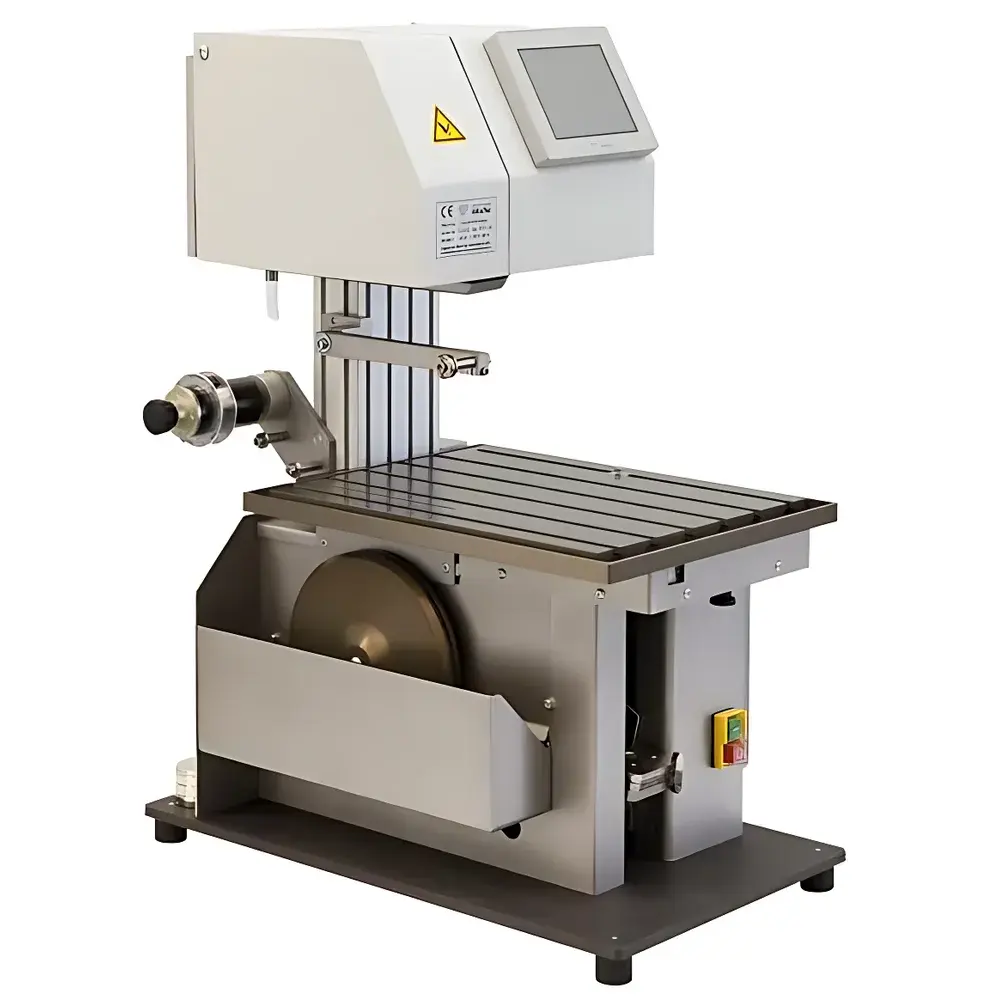
Diamond WireTec DWS175 & DWS250 Vertical Diamond Wire Saw
| Brand | Diamond WireTec |
|---|---|
| Origin | Germany |
| Model | DWS175 / DWS250 |
| Cutting Mode | Dry or Wet |
| Max Wire Speed | 0–4 m/s |
| Max Sample Cross-Section | 175 × 175 mm (DWS175) / 245 × 245 mm (DWS250) |
| Kerf Width | 0.1–0.5 mm |
| Feed Force | Gravity-Driven Constant Load |
| Control Interface | 7-inch Color Touchscreen (Native Chinese UI) |
| Positioning Accuracy | 0.01 mm (with Manual Micrometer Stage) |
| Safety Features | Automatic Wire Break Stop, End-of-Cut Auto-Shutdown |
| Drive System | Linear Motor + Industrial PLC Controller |
| Worktable | T-Slot Steel Base |
| Compliance | CE, RoHS, ISO 9001 Manufacturing Environment |
| Sample Compatibility | Brittle, Composite, and Heterogeneous Materials (Ceramics, Glass, Concrete, Minerals, Fossils, Metals, Polymers) |
Overview
The Diamond WireTec DWS175 and DWS250 are precision vertical diamond wire saws engineered for high-fidelity sample sectioning in materials science, geology, metallurgy, and quality assurance laboratories. These instruments employ a reciprocating diamond-impregnated wire (monofilament or stranded) under controlled tension to perform cold-cutting via abrasive wear—minimizing thermal distortion, microcracking, and phase transformation at the cut interface. Unlike abrasive wheel saws or laser-based systems, diamond wire cutting operates at low specific energy input, preserving structural integrity of multi-phase composites, porous media, and thermally sensitive specimens. The gravity-fed feed mechanism ensures consistent downforce without pneumatic complexity, delivering repeatable kerf geometry and surface finish across extended operation cycles.
Key Features
- Industrial-grade linear motor drive system with closed-loop position feedback for stable, vibration-damped wire motion at speeds up to 4 m/s.
- Reciprocating wire path with programmable clockwise/counterclockwise alternation to extend wire life and ensure uniform wear distribution.
- Integrated automatic wire winding and tensioning module—reducing setup time and operator dependency during line replacement.
- 7-inch full-color touchscreen HMI with intuitive icon-based workflow navigation; supports multilingual firmware (English, German, Chinese) and real-time status visualization (wire speed, feed progress, error logs).
- T-slot steel worktable (ISO 2083 compliant) compatible with modular fixturing: standard T-nuts, quick-release clamps, rotary side-cutting fixtures, micrometer-limited translation stages, and cylindrical specimen holders.
- Gravity-driven constant-force feed mechanism—eliminates air compressors, pressure regulators, and associated maintenance while maintaining ≤±2% force deviation over full stroke.
- Dual-mode cutting capability: dry cutting for inert or non-hygroscopic samples; wet cutting with recirculating coolant reservoir (optional filtration kit available) for heat-sensitive or dust-prone materials.
- Safety-certified interlocks including real-time wire break detection, emergency stop circuitry compliant with EN ISO 13857, and automatic shutdown upon completion of programmed cut depth.
- Robust enclosure constructed from anodized aluminum and stainless-steel components; rated IP54 for lab environments with particulate exposure.
Sample Compatibility & Compliance
The DWS175/DWS250 accommodates heterogeneous, anisotropic, and brittle materials where conventional sectioning induces delamination or edge chipping—including sintered ceramics, optical glass substrates, reinforced polymer composites, geological core samples, fossilized bone, cementitious matrices, and metal matrix composites. Kerf widths range from 0.1 mm (using 0.12 mm diameter wire) to 0.5 mm (0.35 mm wire), enabling minimal material loss during serial sectioning for SEM/EBSD preparation or tomographic reconstruction. All units are manufactured under ISO 9001-certified processes and bear CE marking per Machinery Directive 2006/42/EC and EMC Directive 2014/30/EU. Optional documentation packages support GLP-compliant validation (IQ/OQ protocols) and audit readiness for ISO/IEC 17025-accredited testing labs.
Software & Data Management
Embedded firmware includes parameter logging (date/time-stamped cut profiles, wire usage hours, fault codes) stored locally on SD card with CSV export capability. While no PC-dependent software is required for basic operation, optional DiamondWireControl Suite (v3.2+) enables remote monitoring via Ethernet, batch job queuing, G-code import for complex multi-pass trajectories, and integration with LIMS through RESTful API endpoints. Audit trail functionality complies with FDA 21 CFR Part 11 requirements when paired with user access control and electronic signature modules. All configuration changes are timestamped and attributed to operator ID, supporting traceability in regulated QA/QC workflows.
Applications
- Precision wafer slicing for semiconductor packaging failure analysis (die attach inspection, TIM evaluation).
- Sectioning of archaeological artifacts and paleontological specimens without mechanical shock-induced fracturing.
- Preparation of cross-sections from additively manufactured metal parts for porosity quantification (ASTM E2109).
- Cutting of refractory ceramic tiles and thermal barrier coatings for adhesion interface characterization.
- Serial sectioning of concrete cores for chloride penetration depth mapping (ASTM C1556).
- Isolation of representative volumes from geological drill cores for XRD/XRF mineralogical mapping.
- Trimming of battery electrode laminates prior to cross-sectional SEM imaging (IEC 62660-1).
FAQ
What wire diameters are compatible with the DWS175 and DWS250?
Standard configurations support diamond wires from 0.12 mm to 0.35 mm diameter, with corresponding kerf widths of 0.1–0.5 mm. Custom wire spools (up to 500 m length) can be loaded manually or via automated winding station.
Is coolant recycling supported out of the box?
A passive drip-collection tray is standard; active recirculation with magnetic particle filtration requires the optional Coolant Management Kit (CMK-DWS), which includes submersible pump, 10-L reservoir, and 5-µm depth filter cartridge.
Can the machine perform angled cuts?
Yes—when equipped with the optional Motorized Rotary Side-Cut Fixture (DWS-RSC-200), users achieve programmable tilt angles from –10° to +10° with ±0.1° repeatability.
How is positional accuracy verified during calibration?
Calibration follows a two-point method using certified gauge blocks traceable to NIST standards; final verification reports include uncertainty budgets per ISO/IEC 17025 Annex A.3.
Does the system meet requirements for pharmaceutical excipient characterization?
While not classified as GMP equipment per se, its mechanical stability, low contamination risk (no oil-lubricated components), and documented change control procedures make it suitable for USP compliant sample prep in API solid-state analysis workflows.



