
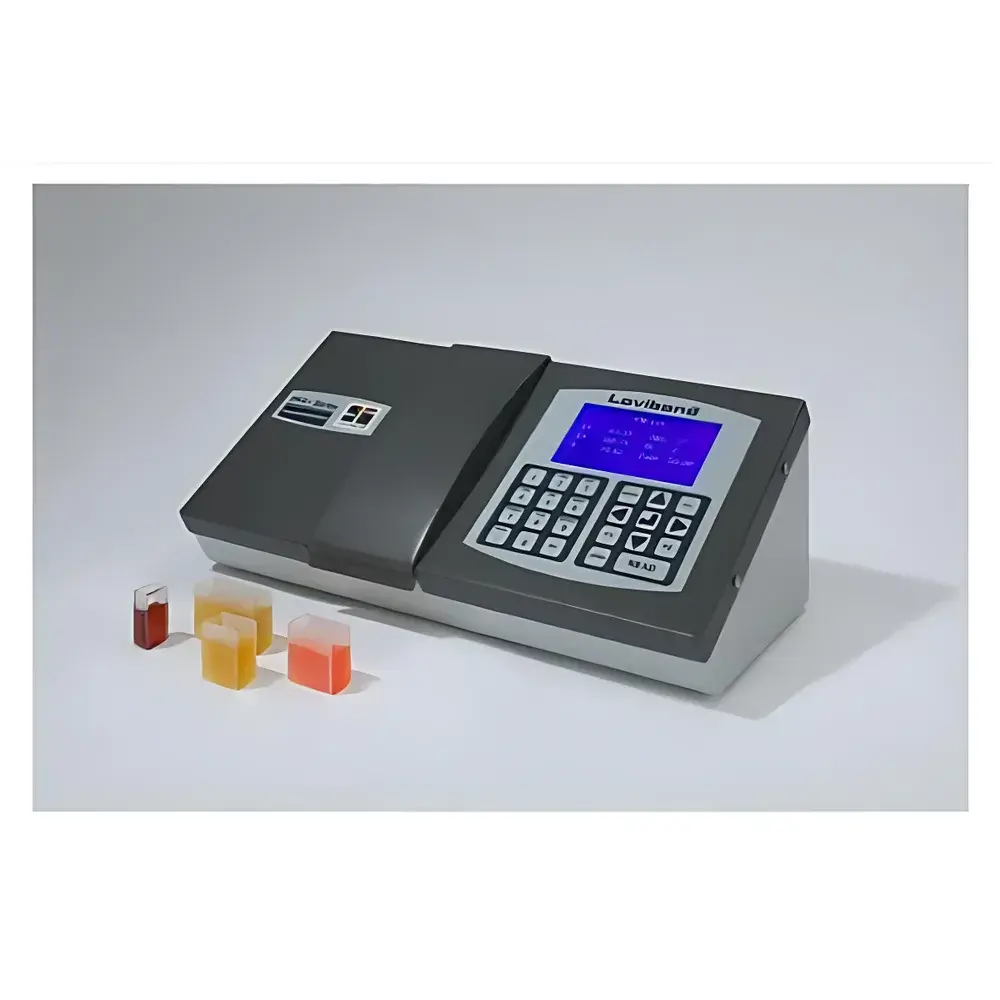
Lovibond PFXi195/5 Automated Colorimeter
| Brand | Lovibond (Tintometer) |
|---|---|
| Origin | United Kingdom |
| Model | PFXi195/5 |
| Compliance Standards | EP, USP, Pt-Co/Hazen/APHA, CIE L*a*b*, CIE XYZ, Spectral Data |
| Interface | USB & LAN (RCMSi Remote Calibration and Maintenance System) |
| Display | Large backlit LCD with multilingual UI (including Chinese) |
| Sample Holders | Compatible with multiple pathlength cuvettes (10–50 mm), optional flow-through cell |
| Construction | Stainless steel measurement chamber, chemical-resistant housing |
| Software | Included Color Control Software for spectral visualization, CIE chromaticity diagrams, data export, instrument remote control, GLP-compliant reporting |
| GLP Features | Date/time stamp, user ID, sample ID, audit trail, password protection |
| Customization | User-defined color standards, selectable display parameters, language selection, access-level passwords |
| Delta-E & Bias Analysis | Quantitative deviation reporting (ΔL*, Δa*, Δb*, ΔE*ab, hue angle, saturation ratio, bias factor) |
| Calibration | Certified liquid standards (ISO/IEC 17025 traceable per ASTM D1209, D5386 |
Overview
The Lovibond® PFXi195/5 Automated Colorimeter is a precision-engineered optical measurement instrument designed for objective, repeatable color assessment in regulated pharmaceutical, chemical, food, and water quality laboratories. Based on the principle of spectrophotometric absorbance measurement at discrete wavelengths (420–710 nm), the PFXi195/5 eliminates observer-dependent variability inherent in visual color comparison methods. It operates by directing stabilized tungsten-halogen light through a precisely aligned optical path onto a silicon photodiode array detector, enabling accurate quantification of transmitted intensity across standardized color scales. The instrument complies fully with pharmacopoeial requirements—specifically European Pharmacopoeia (EP) Chapter 2.2.43 and United States Pharmacopeia (USP) —and supports routine validation under Good Laboratory Practice (GLP) and current Good Manufacturing Practice (cGMP) frameworks. Its robust stainless-steel measurement chamber, chemically inert optics mount, and modular cuvette interface ensure long-term stability in high-throughput QC environments where reagent exposure and frequent cleaning are routine.
Key Features
- Automated measurement cycle completed in ≤20 seconds—no manual alignment or operator interpretation required
- Pre-programmed color scales: Pt-Co/Hazen/APHA (ASTM D1209, D5386), Gardner (ASTM D1544), Saybolt (ASTM D156), CIE L*a*b*, CIE XYZ, and spectral reflectance/transmittance output (31-point, 10 nm intervals)
- RCMSi-enabled remote calibration verification and firmware updates via LAN or USB—fully traceable to Tintometer’s ISO 9001-certified manufacturing system
- Stainless steel optical chamber with removable, autoclavable cuvette holder—designed for compatibility with aggressive solvents (e.g., ethanol, acetone, dilute acids/bases)
- Full GLP compliance: embedded electronic audit trail, operator authentication (multi-level password protection), timestamped results with sample ID and method reference
- Delta-E and bias analysis engine calculating quantitative deviations—including ΔL*, Δa*, Δb*, total color difference (ΔE*ab), hue angle shift, relative saturation ratio, and proprietary bias factor for pass/fail thresholding
Sample Compatibility & Compliance
The PFXi195/5 accepts standard rectangular cuvettes (10, 20, 33, and 50 mm pathlengths) and supports optional flow-through cells for inline process monitoring. It is validated for aqueous and organic-phase pharmaceutical solutions, including injectables, syrups, and excipient suspensions. All preloaded color methods adhere to internationally recognized metrological frameworks: Pt-Co calibration standards are certified per ISO 6271 and traceable to NIST SRM 2134; EP/USP methods conform to pharmacopoeial linearity, repeatability, and specificity requirements. Instrument performance verification follows ISO/IEC 17025 principles using Tintometer-certified liquid standards (certificates include uncertainty budgets per GUM). Glass filter standards comply with ISO 9001 production controls and are supplied with individual calibration certificates.
Software & Data Management
The included Color Control Software provides full instrument control via USB or Ethernet, enabling method deployment, real-time spectral visualization, CIE 1931 chromaticity diagram plotting, and statistical trend analysis (X-bar/R charts, capability indices). Data exports support CSV, PDF, and XML formats compatible with LIMS and ELN systems. All reports embed GLP metadata: date/time, analyst ID, instrument serial number, calibration status, and measurement uncertainty estimates. Software logs retain full command history and parameter changes for regulatory review. Remote software updates and method library synchronization are supported through RCMSi cloud services—audit-ready and compliant with FDA 21 CFR Part 11 when configured with electronic signatures and role-based access.
Applications
- Pharmaceutical QC: Routine color testing of active pharmaceutical ingredients (APIs), finished dosage forms, and purified water (PW) per USP and EP 2.2.43
- Chemical manufacturing: Monitoring oxidation state in catalyst solutions, purity assessment of dyes and pigments, and batch-to-batch consistency of intermediates
- Food & beverage: Objective evaluation of honey, vinegar, edible oils, and fruit juices against industry-specific color indices (e.g., AOAC 983.17)
- Environmental labs: APHA color analysis of wastewater effluents and surface water per Standard Methods 2120B
- R&D settings: Development of custom color specifications, formulation optimization, and stability-indicating assays under ICH Q5C guidelines
FAQ
Does the PFXi195/5 meet FDA 21 CFR Part 11 requirements for electronic records?
Yes—when deployed with Color Control Software v4.2+ and configured with user authentication, audit trail logging, and electronic signature protocols, the system satisfies predicate rule requirements for closed systems.
Can I import my own reference spectra or custom color tolerances?
Yes—the software supports user-defined spectral libraries and delta-E-based acceptance criteria with configurable upper/lower limits per parameter (L*, a*, b*, hue, saturation).
What maintenance is required to maintain ISO/IEC 17025 compliance?
Annual verification using certified liquid standards or glass filters is recommended; full calibration verification (including wavelength accuracy and photometric linearity) should be performed every 6 months in regulated environments.
Is the stainless steel measurement chamber resistant to hydrochloric acid or sodium hydroxide solutions?
The chamber is rated for intermittent contact with ≤10% v/v HCl and ≤5% w/w NaOH at ambient temperature; extended exposure requires post-measurement rinsing with deionized water.
How is traceability documented for calibration standards used with this instrument?
Each certified liquid standard includes a certificate of analysis referencing ISO/IEC 17025-accredited testing, measurement uncertainty, and direct traceability to NIST or UKAS reference materials.




