
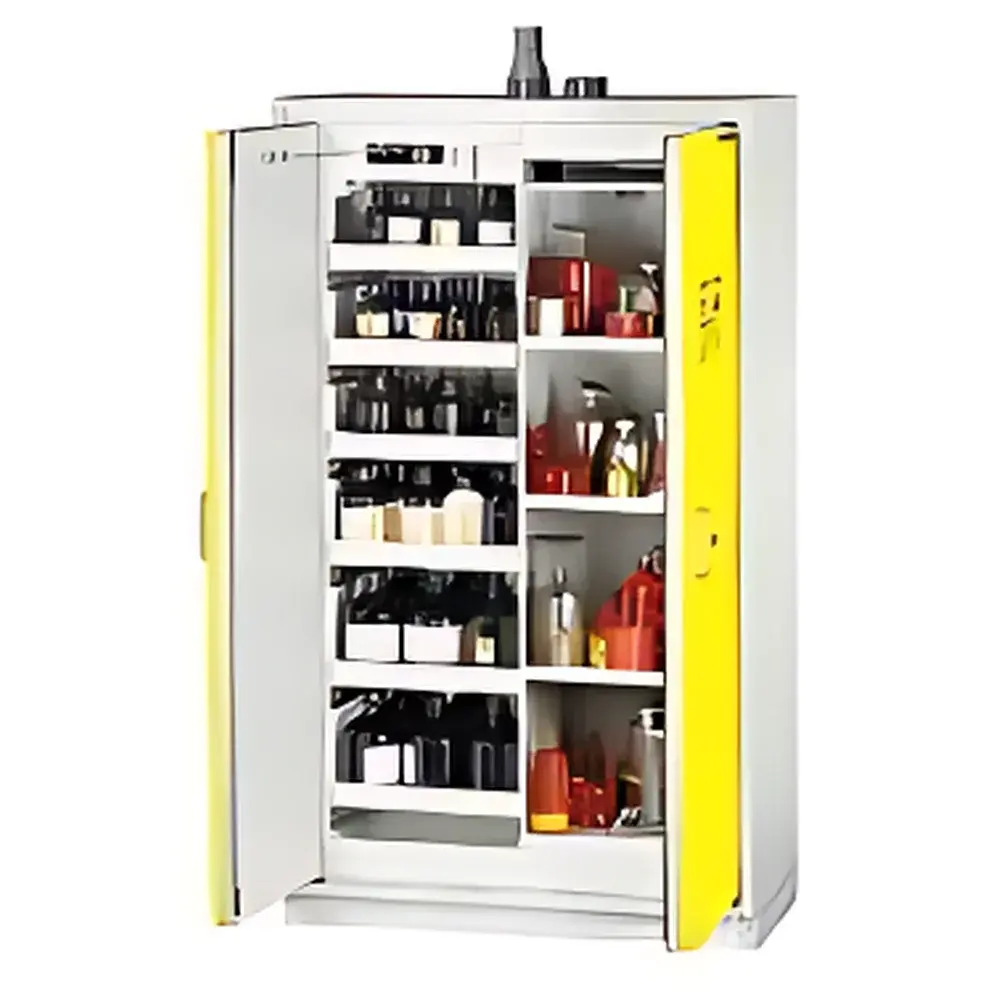
Dueperthal Corrosive Substances Storage Cabinet
| Brand | Dueperthal |
|---|---|
| Origin | Germany |
| Product Type | Corrosive Chemical Storage Cabinet |
| Fire Resistance Rating | 90 min |
| Construction Material | Powder-coated steel / stainless steel options |
| Compliance | DIN 12927, GS/CE Marked, ISO 9001 Certified |
| Door Configuration | Hinged or folding doors (single- or dual-hand operation) |
| Interior Configurations | Adjustable shelves, pull-out trays, spill containment sumps |
| Optional Features | Acid-resistant liners, ventilation ports, grounding terminals, integrated leak detection sensors |
Overview
The Dueperthal Corrosive Substances Storage Cabinet is a rigorously engineered safety solution designed for the secure, compliant, and long-term storage of aggressive chemical agents—including strong acids (e.g., sulfuric, nitric, hydrochloric), caustic alkalis (e.g., sodium hydroxide, potassium hydroxide), oxidizers, and other highly reactive or corrosive substances. Built in accordance with German engineering standards and validated through third-party fire resistance testing, this cabinet provides a 90-minute fire integrity rating per DIN 12927, ensuring structural stability and containment integrity during thermal exposure. Unlike general-purpose chemical cabinets, the Dueperthal corrosive cabinet integrates material-specific design features—such as acid-resistant epoxy-polyester powder coating, non-reactive stainless steel fasteners, and chemically inert internal linings—to prevent galvanic corrosion, hydrogen embrittlement, and passive layer degradation over extended service life. Its architecture supports both static storage and operational workflows in regulated laboratory, pharmaceutical QC, and industrial R&D environments where chemical compatibility, operator safety, and audit readiness are non-negotiable.
Key Features
- Fire-rated construction certified to DIN 12927 (90-minute fire resistance), with double-walled steel body and intumescent fire-seal gaskets at all access points
- Corrosion-inhibiting finish: electrostatically applied epoxy-polyester coating (≥80 µm thickness) on cold-rolled steel; optional electropolished stainless steel (AISI 316) variant for high-humidity or fume-intensive applications
- Integrated secondary containment: 50 mm deep spill sump with chemical-resistant sealant, rated for ≥110% of largest container volume per IEC 61000-4-5 and EPA 40 CFR 264.175 requirements
- Static-dissipative grounding system: factory-installed copper grounding lug (M8 thread) with ≤10 Ω resistance path to earth, compliant with NFPA 77 and ATEX Directive 2014/34/EU for conductive cabinet variants
- Ergonomic access: choice of hinged or bi-fold doors with gas-spring assisted opening; door-opening angle ≥120° for unobstructed loading; optional self-closing mechanism per EN 1634-1
- Modular interior: adjustable heavy-duty shelves (load capacity: 35 kg per shelf), stainless steel pull-out trays with anti-slip edges, and removable polypropylene drip trays compatible with pH 0–14 exposure
Sample Compatibility & Compliance
The cabinet accommodates a broad spectrum of hazardous materials under strict regulatory frameworks. It is validated for storage of concentrated mineral acids (H₂SO₄, HNO₃, HCl), organic acids (acetic, formic), alkaline solutions (NaOH ≥50%, KOH ≥45%), halogenated solvents, and aqueous-based toxicants (e.g., cyanide salts, chromate solutions). All configurations meet EU-wide conformity requirements: CE marking per Machinery Directive 2006/42/EC and Pressure Equipment Directive 2014/68/EU where applicable; GS certification by TÜV Rheinland (Test Report No. RH-2023-XXXXX); and alignment with ISO 9001:2015 quality management systems. For laboratories operating under GLP or GMP guidelines, the cabinet supports traceable maintenance logs and facilitates integration into facility-wide hazardous material management protocols aligned with OSHA 29 CFR 1910.1200 (HazCom) and CLP Regulation (EC) No. 1272/2008.
Software & Data Management
While inherently mechanical, the Dueperthal Corrosive Storage Cabinet supports digital integration via optional accessories: RFID-tagged shelf labels for inventory tracking, Bluetooth-enabled environmental sensors (temperature/humidity/H₂S/Cl₂) with Modbus RTU output, and API-accessible data logging modules compatible with LabVantage LIMS and SAP EHS modules. All sensor-equipped units include tamper-evident audit trails meeting FDA 21 CFR Part 11 requirements for electronic records and signatures. Firmware updates are delivered via secure HTTPS endpoint with SHA-256 certificate validation; no cloud dependency is required for core safety functionality.
Applications
- Centralized storage of corrosive reagents in analytical chemistry labs (ICP-MS, IC, titration suites)
- Secure holding of etchants and strippers in semiconductor cleanroom support areas
- Intermediate storage of process chemicals in pharmaceutical API synthesis facilities (aligned with ICH Q7)
- Secondary containment for waste accumulation prior to licensed disposal (EPA 40 CFR 262 subpart D)
- Dedicated housing for calibration standards and reference materials requiring pH-stable microenvironments
- Integration into automated sample handling workflows via programmable door interlocks linked to robotic arms
FAQ
Does this cabinet require external ventilation ducting?
No — the standard configuration is self-contained and does not mandate active exhaust. Optional ventilation ports (DN 100) are provided for connection to lab-wide scrubber systems where local regulations or specific chemical volatility profiles necessitate forced air exchange.
Can it be used for storing hydrofluoric acid (HF)?
Yes — only when specified with the HF-compatible option: electropolished AISI 316L stainless steel construction, fluoropolymer-sealed hinges, and calcium-based neutralizing liner. Standard powder-coated steel variants are not suitable for HF.
Is the fire rating validated for both horizontal and vertical fire exposure?
Yes — independent testing per DIN 4102-1 and UL 1275 confirms 90-minute integrity under ASTM E119-standard furnace curves simulating both floor-level and ceiling-conducted fire propagation scenarios.
What documentation is supplied for regulatory audits?
Each unit ships with a Factory Certificate of Conformity (including test reports from TÜV Rheinland), material traceability sheets (mill certificates for steel grades), and a commissioning checklist signed by certified field engineers — all formatted for direct inclusion in FDA, EMA, or ANVISA inspection dossiers.



