
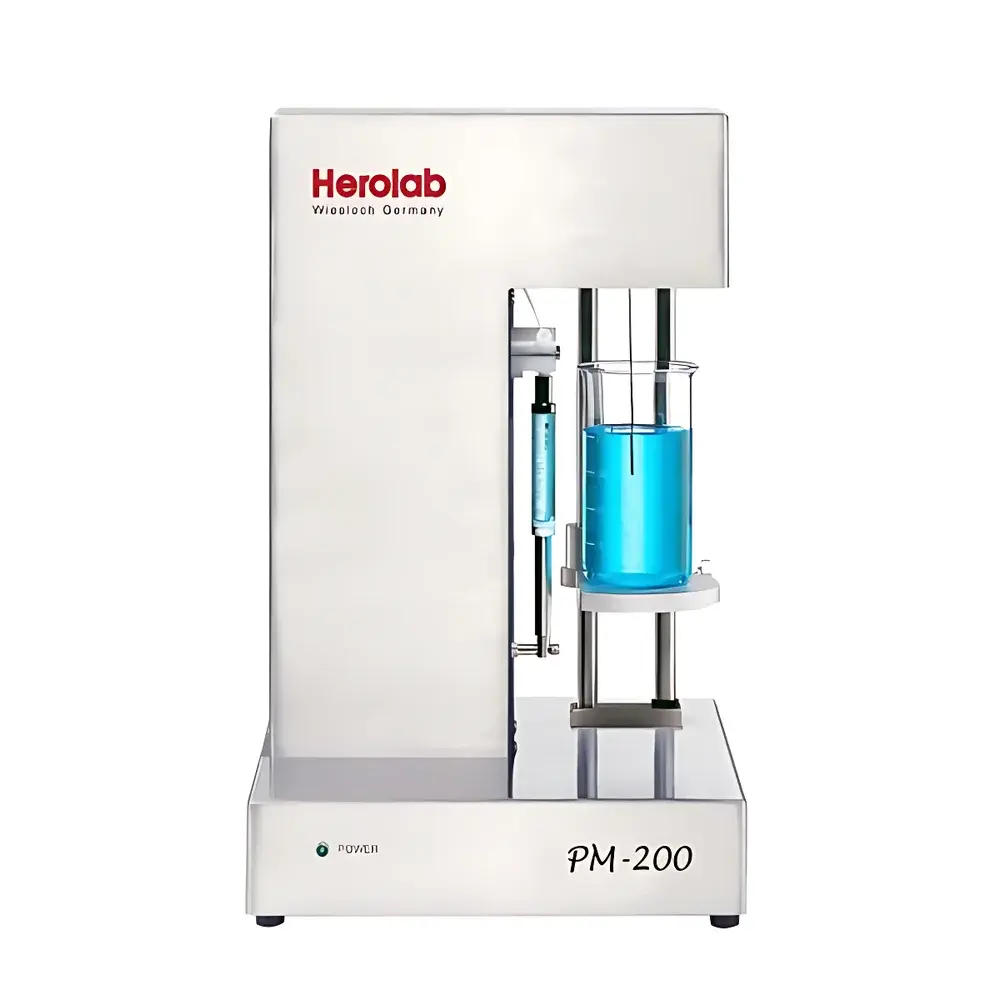
Herolab PM-200 Optical Particle Counter (formerly KLOTZ Technology)
| Brand | Herolab |
|---|---|
| Origin | Germany |
| Model | PM-200 |
| Instrument Type | Optical Particle Counter (Light Obscuration Principle) |
| Particle Size Range | 1–200 µm or 2–400 µm |
| Particle Concentration Range | 0–70,000 particles/mL |
| Minimum Sample Volume | 100 µL |
| Measurement Accuracy | >95% |
| Data Interface | USB |
| Regulatory Compliance | USP <787>, <788>, <789>, <1787>, <1788> |
Overview
The Herolab PM-200 Optical Particle Counter is a precision-engineered instrument designed for quantitative analysis of insoluble particulate matter in parenteral solutions, ophthalmic preparations, and other sterile liquid pharmaceuticals. It operates on the light obscuration (LO) principle — a standardized optical detection method defined in pharmacopoeial monographs including USP , EP 2.9.19, and ChP 0903. In this method, a laminar stream of sample fluid passes through a precisely dimensioned sensing zone illuminated by a collimated light source. As particles traverse the beam perpendicularly, they obstruct incident light proportionally to their projected area, generating voltage pulses whose amplitude correlates directly with particle size. The system digitizes and classifies each pulse in real time against user-defined size thresholds, enabling compliant enumeration across multiple channels (e.g., ≥10 µm, ≥25 µm). The PM-200 is not a generic particle counter but a GxP-aligned analytical platform engineered for reproducible, traceable, and auditable particulate testing in regulated environments.
Key Features
- Optical sensing architecture optimized for high signal-to-noise ratio and minimal coincidence error at elevated particle concentrations (up to 70,000 particles/mL)
- Modular syringe-driven sampling module supporting interchangeable glass or polymer syringes (1 mL, 5 mL, 10 mL, 25 mL) with automatic priming and rinse cycles
- Calibration traceable to NIST-traceable polystyrene latex (PSL) standards; optional certification per ISO 21501-4
- Integrated temperature sensor (±0.5 °C accuracy) for viscosity-corrected flow rate compensation
- Self-diagnostic routines including optical path integrity check, flow verification, and background noise monitoring
- Robust mechanical design compliant with IEC 61010-1 for laboratory use; CE-marked and RoHS-compliant
Sample Compatibility & Compliance
The PM-200 accommodates aqueous and non-aqueous transparent liquids with viscosity ≤25 cP and refractive index difference ≥0.02 relative to the carrier medium. Compatible sample types include saline, dextrose, Ringer’s solution, lipid emulsions (post-dilution), monoclonal antibody formulations, and vaccine suspensions — provided turbidity remains below 0.5 NTU to avoid scattering interference. All hardware and firmware comply with ISO/IEC 17025 requirements for testing laboratories. The instrument meets the essential performance criteria outlined in USP for method suitability verification, including limit of quantitation (LOQ) validation, linearity assessment (R² ≥ 0.995 over 3 logs), and repeatability (RSD ≤ 5% at ≥100 particles/mL). Full documentation packages support GLP and GMP audits, including IQ/OQ/PQ protocols and risk-based validation templates.
Software & Data Management
The SW-CA software suite provides a validated, 21 CFR Part 11–compliant environment for method development, execution, and reporting. Core capabilities include role-based electronic signatures, immutable audit trails recording all user actions (e.g., parameter changes, result deletions, report exports), and automatic data archiving with SHA-256 hashing. Method templates are preconfigured for USP , EP 2.9.19, and ChP 0903 compliance, with configurable pass/fail logic based on batch volume, container size, and pharmacopoeial limits. Raw pulse data, calibrated histograms, and annotated chromatograms are stored in vendor-neutral .csv and .pdf formats. Optional integration with LIMS via ASTM E1482-compliant XML export enables seamless workflow alignment in centralized quality systems.
Applications
- Final container testing of injectables per USP and EU Annex 1 requirements
- Filter integrity verification through upstream/downstream particle challenge studies
- Stability-indicating monitoring of protein aggregation kinetics in biologics
- Raw material qualification (e.g., excipients, water for injection)
- Investigation of visible particle incidents using size distribution trend analysis
- Supporting regulatory submissions with fully documented, ALCOA+-compliant datasets
FAQ
Does the PM-200 require annual recalibration by an accredited service provider?
Yes. Herolab recommends annual calibration using certified PSL reference materials, with full traceability documentation issued per ISO/IEC 17025. Calibration certificates include uncertainty budgets and measurement scope statements.
Can the instrument detect sub-visible particles below 1 µm?
No. The PM-200 is optimized for the 1–200 µm or 2–400 µm range per light obscuration physics limitations. Sub-micron analysis requires complementary techniques such as nanoparticle tracking analysis (NTA) or tunable resistive pulse sensing (TRPS).
Is SW-CA software compatible with Windows 11 and virtualized environments?
Yes. SW-CA v4.2+ supports Windows 10/11 (64-bit) and VMware Workstation 16+ under validated configurations. Virtual deployment requires dedicated CPU cores and passthrough USB controller assignment for hardware authentication.
How does the system handle air bubbles or undissolved crystals during measurement?
The software includes intelligent bubble rejection algorithms that differentiate transient gas artifacts from solid particulates based on pulse shape, duration, and recurrence patterns. Crystalline solids are reported without discrimination if they meet size and obscuration criteria.
What validation documentation is supplied with the instrument?
Each unit ships with a Factory Acceptance Test (FAT) report, Installation Qualification (IQ) checklist, and Operational Qualification (OQ) test scripts aligned with ISO 13485 and ICH Q5A. User-specific Performance Qualification (PQ) support is available upon request.



