
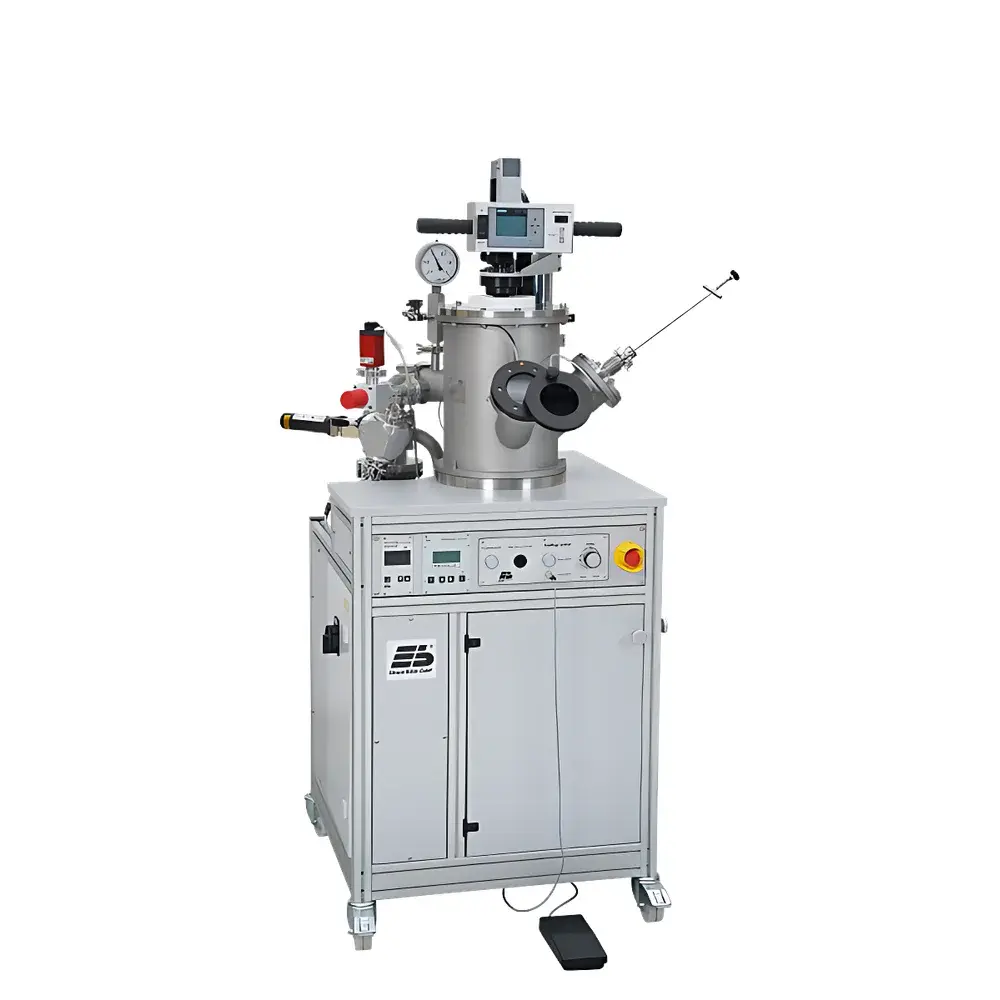
Edmund Bühler AM200 & AM500 Arc Melting Furnaces
| Brand | Edmund Bühler |
|---|---|
| Origin | Germany |
| Equipment Type | Water-Cooled Crucible Arc Melting Furnace |
| Maximum Melting Temperature | 3500 °C |
| Heating Method | Non-Contact DC Arc |
| Crucible Capacity | AM200 – up to 200 g |
| Vacuum System | Integrated High-Vacuum Pump with Absolute Pressure Measurement (1300 mbar abs.) |
| Power Supply | 400 V, 3-phase / 230 V, single-phase, 50/60 Hz |
| Generator Current Output | AM200 – up to 400 A or 800 A |
| Standard Crucibles | AM200 – 4×Ø19×5 mm, 2×Ø30×5 mm, 1×110×15×8 mm |
| Optional Casting Systems | Suction casting (Ø3 mm & Ø5 mm rods, 150 mm length) |
| Cooling | Active water-cooling for crucible, electrodes, and casting coil |
Overview
The Edmund Bühler AM200 and AM500 arc melting furnaces are high-precision, laboratory-scale metallurgical systems engineered for the controlled fusion and solidification of refractory metals, intermetallics, and high-entropy alloys under inert or vacuum conditions. These furnaces operate on the principle of non-contact direct-current (DC) arc discharge between a water-cooled tungsten electrode and a water-cooled copper crucible containing the charge material. This configuration enables localized energy delivery with minimal contamination, achieving stable melt temperatures up to 3500 °C—sufficient to process tungsten, molybdenum, niobium, tantalum, and their alloys. Unlike resistance-heated or induction-based furnaces, arc melting avoids inductive coupling losses and crucible wall reactions, preserving stoichiometric fidelity and enabling rapid, repeatable melt cycles. Both models integrate full vacuum capability (down to 1300 mbar absolute), real-time visual monitoring via quartz viewport, and motorized electrode positioning for precise arc stabilization—making them suitable for R&D laboratories engaged in advanced alloy development, master alloy preparation, and small-batch prototype casting.
Key Features
- Water-cooled copper crucible with interchangeable, customer-specific mold inserts (e.g., button, rod, slab, or custom geometries)
- Motor-driven vertical lift mechanism for chamber access and crucible handling
- Adjustable tungsten electrode mounted on precision linear actuator, enabling dynamic arc positioning above the melt pool
- Dedicated control panel mounted directly above the electrode for intuitive local operation—including arc ignition, current ramping, and process timing
- High-power DC generator with selectable output (AM200: up to 400 A or 800 A; AM500: up to 800 A) and programmable current profiles to prevent thermal shock and overheat-induced segregation
- Integrated high-vacuum pumping station with absolute pressure sensor and automated venting sequence compliant with ISO 27423-2 for residual gas analysis readiness
- Optional suction casting module with pneumatic valve-controlled argon flow, supporting Ø3 mm and Ø5 mm rod production (standard length 150 mm)
- Optional tilt-casting system with motorized 50 mm-diameter water-cooled crucible (11 cm³ capacity), fixed runner geometry, and intermediate ring design ensuring consistent gap clearance between crucible and mold
- Peripherally wound cooling/heating coil around casting zone to accelerate solidification kinetics and refine microstructure
Sample Compatibility & Compliance
The AM200 and AM500 accommodate diverse feedstock forms including elemental powders, pre-alloyed granules, chips, and machined buttons. Crucible configurations support charges ranging from 5 g (for exploratory trials) to 500 g (AM500, full-capacity melts). All wetted components—including crucible, electrode, and mold inserts—are fabricated from high-purity oxygen-free copper and sintered tungsten, minimizing metallic contamination. The system meets mechanical safety requirements per EN 61000-6-4 (EMC) and EN 61000-6-2 (immunity), and its vacuum architecture conforms to ISO 14644-1 Class 8 cleanroom compatibility when operated in glovebox-integrated environments. While not intrinsically certified for GMP manufacturing, the furnace supports GLP-compliant documentation through external data logging interfaces and is routinely deployed in laboratories adhering to ASTM E1447 (Standard Guide for Metallographic Specimen Preparation) and ISO/IEC 17025 calibration traceability frameworks.
Software & Data Management
Both models feature analog and digital I/O ports (RS-485, 0–10 V analog outputs) for integration with third-party SCADA or LIMS platforms. Process parameters—including arc current, chamber pressure, cooling water temperature, and elapsed time—are logged at user-defined intervals (100 ms minimum resolution) to internal flash memory or external USB storage. Optional PC-based control software provides waveform visualization, multi-step program sequencing, and export in CSV or HDF5 format for post-processing in MATLAB or Python. Audit trails meet FDA 21 CFR Part 11 requirements when paired with validated identity authentication and electronic signature modules. No proprietary closed-loop software is embedded—ensuring long-term maintainability and interoperability with institutional IT infrastructure.
Applications
- Preparation of master alloys for subsequent arc remelting or electron beam melting (EBM)
- Rapid prototyping of refractory metal compositions (e.g., W–Re, Mo–Si–B, Nb–Ti–Hf)
- Production of homogeneous button ingots for XRD phase analysis, DSC thermal characterization, and tensile specimen machining
- Suction casting of micro-rod samples for TEM lamella extraction and nanoindentation testing
- Tilt-casting of near-net-shape billets for hot-isostatic pressing (HIP) feedstock
- Investigation of solidification path effects in high-temperature superalloys and MAX phases
- Calibration reference material synthesis under controlled redox potential (via partial pressure control of Ar + H₂ mixtures)
FAQ
What vacuum level can the AM series achieve, and how is it measured?
The integrated vacuum system reaches 1300 mbar absolute pressure, monitored via a calibrated capacitance manometer referenced to atmospheric zero. Residual gas analysis requires optional quadrupole mass spectrometer integration.
Can the AM500 perform continuous melting-casting cycles without manual intervention?
Yes—when equipped with the tilt-casting option and programmable PLC logic, the AM500 supports semi-automated sequences including vacuum purge, arc initiation, melt homogenization, tilt initiation, and controlled solidification—all triggered by preset time/temperature thresholds.
Is crucible customization available for non-standard alloy systems?
Absolutely—Edmund Bühler offers CNC-machined copper crucibles with tailored dimensions, cooling channel layouts, and mold interface geometries, subject to material compatibility review and thermal stress simulation.
How is arc stability maintained during high-current operation?
Stability is ensured through active electrode positioning feedback, high-frequency current ripple suppression (<0.5% RMS), and real-time arc voltage monitoring with automatic current modulation to compensate for surface oxidation or slag formation.
Does the system support inert gas atmosphere processing?
Yes—the chamber is rated for positive-pressure argon or helium operation up to 2 bar gauge, with mass flow controllers and leak-tested gas manifolds available as factory options.



