
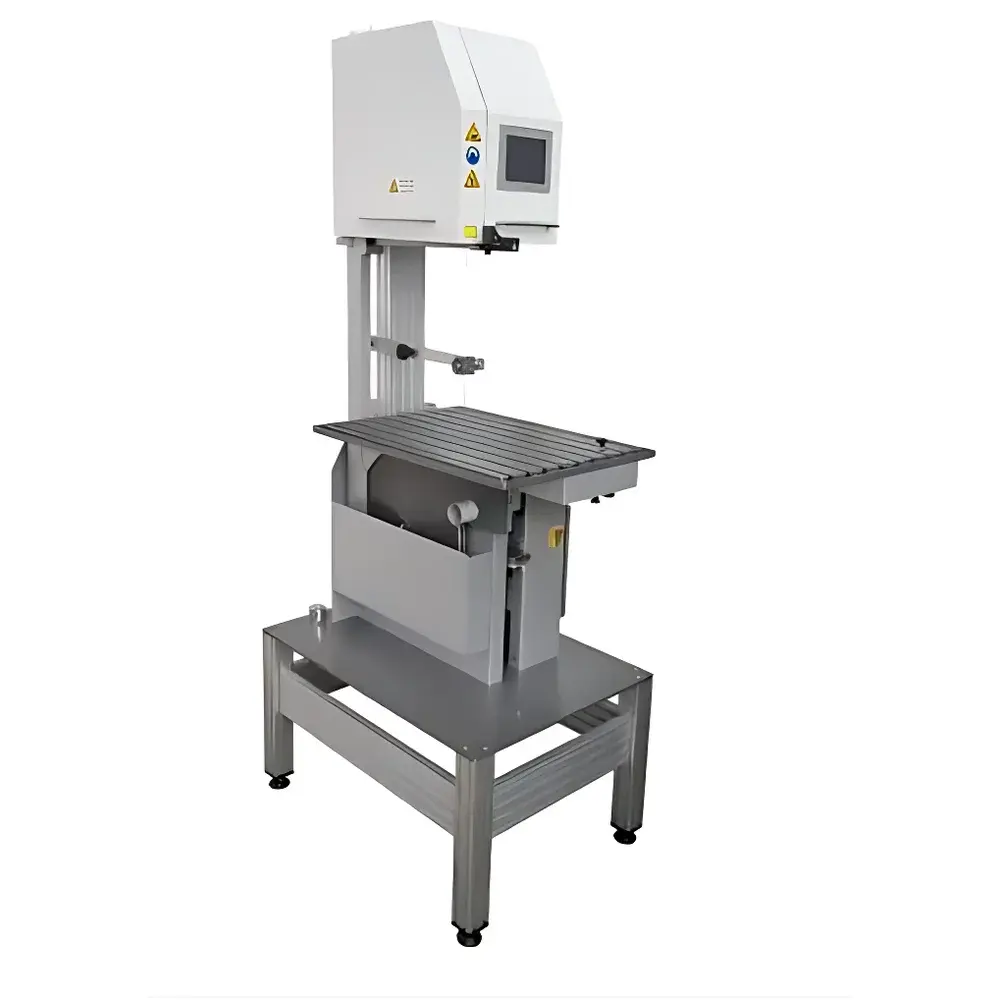
Diamond WireTec DWS375E High-Speed Diamond Wire Saw
| Brand | Diamond WireTec |
|---|---|
| Origin | Germany |
| Model | DWS375E |
| Cutting Method | Dry or Wet |
| Maximum Workpiece Cross-Section | 250 mm (H) × 250 mm (T) |
| Diamond Wire Loop Circumference | 3 m |
| Compatible Wire Diameter | 0.35–0.80 mm |
| Wire Speed | 4–12 m/s (continuously adjustable) |
| Feed Mechanism | Gravity-driven constant-force feed |
| Power Supply | 220 V AC, 50/60 Hz |
| Construction Materials | Stainless steel frame + anodized aluminum chassis |
| Safety Features | Auto-braking upon sample separation, wire break detection, and guard door interlock |
| User Interface | Full-color Chinese-language touchscreen with step-by-step graphical guidance |
| Optional Accessories | Dust extraction port, modular sample clamping fixtures for sliding stage |
Overview
The Diamond WireTec DWS375E is a precision-engineered, vertically oriented, unidirectional diamond wire saw designed for high-fidelity sample sectioning in materials science, geology, electronics, and advanced ceramics laboratories. Unlike reciprocating wire saws, the DWS375E employs a continuous-loop diamond-impregnated wire driven by a single-directional motor system—enabling stable linear motion at speeds up to 12 m/s. This architecture eliminates inertial reversal losses and mechanical backlash, resulting in superior cut surface finish, reduced kerf loss (< 0.3 mm typical), and enhanced dimensional repeatability across serial sections. The instrument operates on the principle of abrasive cutting via fixed diamond grit embedded in nickel or resin-bonded wire matrices; material removal occurs through controlled mechanical abrasion under precisely regulated wire tension and feed force. Its gravity-based feed system delivers consistent downforce without pneumatic actuators or servo-controlled load cells—minimizing vibration transmission, eliminating compressed air dependencies, and ensuring long-term stability during extended cutting cycles.
Key Features
- Unidirectional wire motion: Achieves effective cutting speed three times higher than equivalent reciprocating systems, significantly reducing cycle time per section.
- Rapid wire replacement: Tool-free loop installation completed in under 60 seconds—no re-tensioning calibration required.
- Gravity-fed feed mechanism: Delivers constant, non-variable downward force (adjustable range: 0.5–10 N); inherently immune to pressure fluctuations caused by compressor instability or valve drift.
- Integrated coolant management: Removable waste tray accepts cutting fluid directly; capillary wicking ensures continuous wire lubrication and thermal dissipation without external pump or reservoir.
- Intuitive human-machine interface: 7-inch full-color resistive touchscreen with native Chinese language support, context-sensitive graphical prompts, and guided workflow sequences—designed for first-time users with no prior wire saw experience.
- Dual-groove drive pulley: Extends functional wire life by enabling symmetrical wear distribution; effectively doubles operational lifespan compared to single-groove configurations.
- Multi-sensor safety architecture: Real-time monitoring of wire continuity, specimen separation status, and protective hood position triggers immediate dynamic braking (stopping time < 150 ms).
- Plug-and-play electrical integration: Operates from standard 220 V / 50–60 Hz single-phase supply; no dedicated water inlet/outlet or compressed air infrastructure required.
- Modular fixturing system: Interchangeable clamps—including vise-type, magnetic, vacuum, and custom-machined adapters—mount directly onto the T-slotted aluminum stage for rapid reconfiguration.
Sample Compatibility & Compliance
The DWS375E accommodates brittle, hard, or laminated materials including silicon wafers, sapphire substrates, geological core samples (granite, basalt, quartzite), ceramic composites (Al2O3, SiC, ZrO2), metal alloys (Ti-6Al-4V, Inconel), and battery electrode stacks. Its 250 × 250 mm maximum cross-section enables full-thickness slicing of standard wafer carriers and rock specimens. All structural components meet DIN EN ISO 12100:2012 (risk assessment principles) and are CE-marked per Machinery Directive 2006/42/EC. Electrical design complies with IEC 61000-6-2 (immunity) and IEC 61000-6-4 (emission). The unit supports GLP-compliant documentation when paired with optional timestamped log export (CSV format), satisfying traceability requirements for ASTM E3022, ISO 14704, and USP sample preparation protocols.
Software & Data Management
No proprietary software installation is required—the embedded controller handles all motion sequencing, parameter logging, and fault diagnostics locally. Cut parameters (wire speed, feed duration, total runtime) are stored in non-volatile memory with automatic timestamping. Export options include USB-stick-based CSV reports containing start/stop timestamps, wire consumption estimates, and safety event logs (e.g., “Guard opened at 14:22:18”). While the interface does not implement FDA 21 CFR Part 11 electronic signature functionality, audit trails are machine-generated and tamper-evident—suitable for internal QA review and third-party inspection readiness. Firmware updates are delivered via encrypted USB media and validated using SHA-256 checksum verification.
Applications
- Preparation of TEM lamellae and SEM cross-sections from semiconductor devices and MEMS structures.
- Sectioning of mineralogical thin sections for petrographic analysis (ASTM D3282, ISO 14688-1).
- Controlled slicing of lithium-ion battery electrodes and solid-state electrolyte bilayers for post-mortem microstructural evaluation.
- Dimensionally accurate segmentation of additive-manufactured metal parts for metallurgical grain analysis (ASTM E112).
- Low-damage kerf cutting of optical crystals (e.g., KDP, BBO) where thermal stress-induced cracking must be avoided.
- Routine sectioning of dental zirconia blocks and orthopedic implant prototypes prior to HIP sintering.
FAQ
What wire diameters are supported, and how is tension maintained?
The DWS375E accepts diamond wires ranging from 0.35 mm to 0.80 mm in outer diameter. Tension is pre-set mechanically via spring-loaded idler pulleys and verified during factory calibration—no user adjustment is necessary.
Can the system operate without cutting fluid?
Yes—dry cutting mode is supported for materials with low thermal conductivity or dust-sensitive environments; however, wet operation is recommended for extended runs (>10 min) or heat-prone substrates.
Is the touchscreen interface available in English or other languages?
The standard configuration includes Chinese only; English, German, and Japanese firmware variants are available upon request with minimum order quantity.
How is sample alignment achieved on the sliding stage?
The T-slotted stage features integrated vernier-scale rulers (0.1 mm resolution) and orthogonal reference edges; optional digital inclinometer add-ons enable angular alignment within ±0.05°.
Does the system meet electromagnetic compatibility requirements for shared lab environments?
Yes—tested per IEC 61326-1:2020 Class A emissions and immunity profiles, ensuring coexistence with adjacent analytical instruments such as XRD, SEM, and mass spectrometers.
Related Products



