
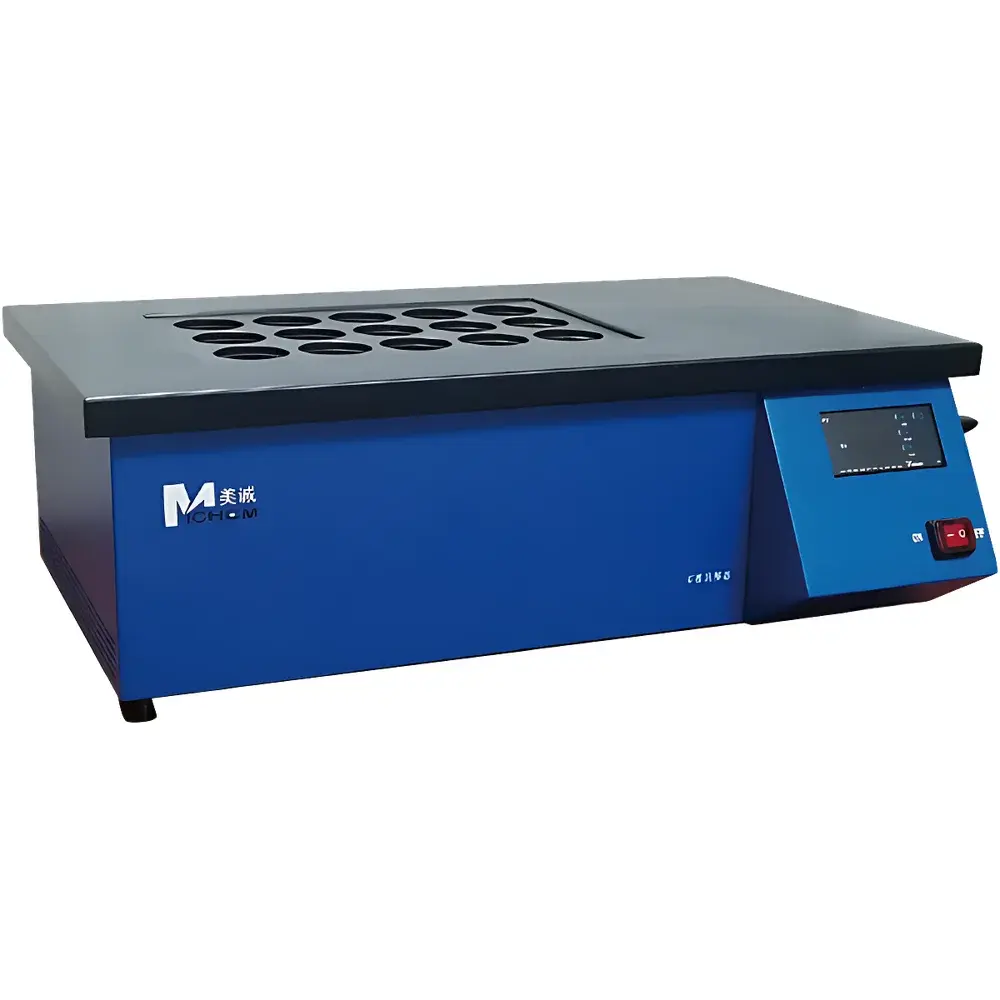
MICHEM DR-15N Graphite Block Digestion System
| Brand | MICHEM |
|---|---|
| Origin | Beijing, China |
| Model | DR-15N |
| Digestion Capacity | 15 × 100 mL |
| Block Material | High-Purity Graphite with 6-Layer PTFE Coating |
| Heating Principle | Infrared Radiant Heating |
| Temperature Range | Ambient to 260 °C |
| Temperature Control | PID Digital Controller |
| Temperature Uniformity | ≤1 °C at 150 °C (inter-hole) |
| Temperature Accuracy | ±1.0 °C |
| Programmable Steps | Single-step or Optional 30-Step Ramp/Soak Profile |
| Max Power Consumption | 1200 W |
| Dimensions (W×D×H) | 650 × 430 × 220 mm |
| Electrical Supply | AC 220 V / 50 Hz / 10 A |
| Digestion Well Dimensions | Φ42 × 50 mm (customizable) |
| Compliance | EPA Method 3050B, 3051A, 3052 |
Overview
The MICHEM DR-15N Graphite Block Digestion System is an electrically heated, benchtop sample preparation instrument engineered for reproducible, high-throughput wet chemical digestion of solid and semi-solid matrices prior to elemental analysis. It operates on the principle of conductive and radiative heating via infrared-emitting elements beneath a monolithic high-purity graphite block—ensuring rapid thermal response and exceptional spatial temperature uniformity across all 15 digestion positions. Unlike open-vessel hot plates or ceramic heaters, the DR-15N’s integrated graphite platform delivers consistent heat transfer kinetics, minimizing inter-sample variability and eliminating cold spots that compromise digestion completeness. Designed in alignment with EPA Methods 3050B (acid digestion of sediments and soils), 3051A (microwave-assisted acid digestion), and 3052 (high-pressure microwave digestion), the system serves as both a primary digestion platform and a dedicated post-microwave acid removal (‘赶酸’, or acid evaporation) station. Its architecture supports routine use in regulated environments where trace metal analysis by AAS, ICP-OES, and ICP-MS demands strict adherence to documented thermal protocols and minimal reagent consumption.
Key Features
- High-purity graphite heating block with six-layer PTFE (Teflon™) coating—resistant to concentrated HNO₃, HCl, HF, H₂SO₄, and aqua regia at temperatures up to 260 °C
- PID-controlled digital temperature regulation with real-time feedback loop, achieving ±1.0 °C accuracy and ≤1 °C inter-well deviation at 150 °C
- Infrared radiant heating design enables rapid thermal ramping (programmable rate: 0.1–10 °C/min) and precise soak duration control (up to 999 min per step)
- Modular construction allows field-replaceable components—including graphite block, heating module, and controller—reducing downtime and total cost of ownership
- Configurable well geometry: standard Φ42 × 50 mm depth accommodates 100 mL borosilicate glass, quartz, or PTFE digestion tubes; custom diameters and depths available upon request
- Automated safety logic halts heating upon reaching setpoint completion or power interruption; no manual shutdown required
- Energy-efficient operation: consumes up to 60% less acid and 40% less electrical energy compared to conventional hot plates or sand baths under identical digestion protocols
Sample Compatibility & Compliance
The DR-15N is validated for digestion of diverse sample types including biological tissues, food composites, pharmaceutical excipients, soil/sediment cores, cosmetic emulsions, and polymer additives. Its corrosion-resistant surface ensures compatibility with aggressive reagent mixtures (e.g., 5:1 HNO₃:H₂O₂, 3:1 HNO₃:HF, or HCl/HNO₃/HF/H₃BO₃ blends). The system conforms to key regulatory frameworks governing analytical sample preparation: EPA SW-846 Methods 3050B, 3051A, and 3052; ISO 11047:1998 (determination of metals in lubricants); ASTM D5174–18 (trace metals in petroleum products); and Chinese national standards GB/T 22918–2008 (heavy metals in aquatic products) and HJ 480–2009 (soil heavy metal analysis). While not intrinsically 21 CFR Part 11 compliant, its optional 30-step programmable controller supports audit-ready parameter logging when interfaced with validated LIMS or ELN systems.
Software & Data Management
The base DR-15N configuration includes a single-step PID digital controller with LED display and manual setpoint entry. The optional M- and HM-series variants integrate a 30-segment programmable temperature profile controller capable of storing up to 10 user-defined methods. All controllers record real-time temperature data at 1-second intervals and support USB export of time-stamped CSV files containing setpoint, actual temperature, and elapsed time per channel. When deployed in GLP/GMP laboratories, method parameters—including ramp rates, hold durations, and final temperature—can be locked via password protection. Data integrity is preserved through non-volatile memory retention during power loss, and firmware updates are performed via standard micro-USB interface without external service tools.
Applications
The DR-15N is routinely employed in accredited testing laboratories for sample preparation prior to quantification of As, Cd, Cr, Cu, Ni, Pb, and Zn in environmental monitoring programs; Al, Fe, Mg, and Mn in nutritional food assays; and residual catalyst metals (e.g., Pd, Pt, Rh) in pharmaceutical intermediates. Its uniform thermal field makes it especially suitable for multi-laboratory collaborative studies requiring inter-lab comparability—such as proficiency testing schemes administered by FAPAS or AOAC. In industrial QC settings, it replaces water baths and hot plates for controlled evaporation of digestates prior to ICP dilution, reducing carryover risk and improving detection limit stability. It also functions as a standardized “cool-down” station after microwave digestion, enabling safe, operator-independent acid fume management.
FAQ
What sample tube materials are compatible with the DR-15N?
Standard configurations support borosilicate glass, quartz, PTFE, and graphite digestion tubes. Custom adapters for polypropylene or ETFE vessels are available upon request.
Is the DR-15N suitable for hydrofluoric acid (HF) digestion?
Yes—provided tubes are HF-compatible (e.g., quartz or PTFE) and the graphite block’s PTFE coating remains intact. Routine visual inspection of coating integrity is recommended after each HF use.
Can the DR-15N be integrated into automated laboratory workflows?
While it lacks native Ethernet or RS-232 ports, analog 0–10 V temperature output and dry-contact relay signals enable integration with PLC-based lab automation systems.
Does MICHEM provide method validation documentation?
Yes—application notes covering EPA 3050B digestion of soil, GB/T 22918–2008 seafood analysis, and ICP-MS trace metal recovery studies are available under NDA upon request.
What maintenance is required to sustain temperature uniformity?
Annual calibration verification using NIST-traceable thermocouples inserted into three representative wells is recommended; graphite surface cleaning with 10% nitric acid followed by deionized water rinse preserves coating longevity.



