
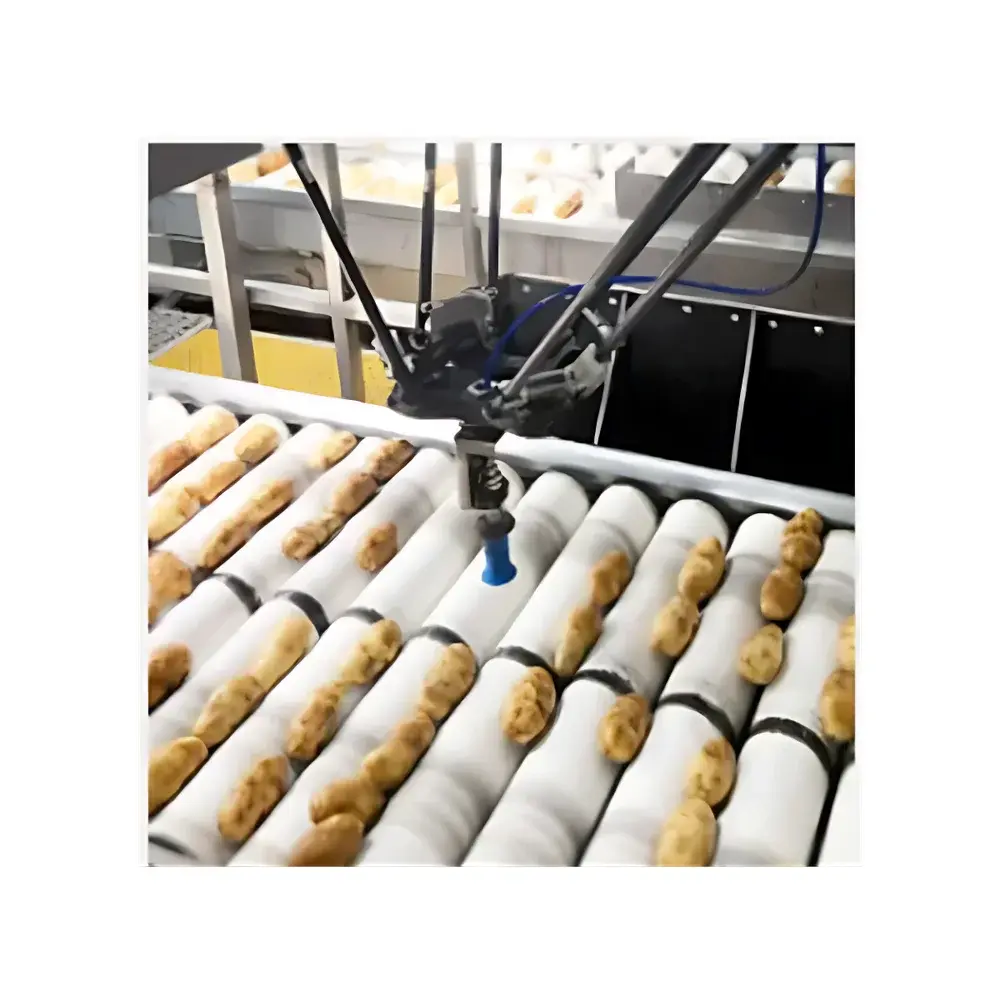
KPM Analytics SiftAI Robotic Potato Sorter
| Brand | KPM Analytics |
|---|---|
| Origin | France |
| Model | SiftAI Robotic Sorter |
| Throughput | Up to 100 units/min (dual-robot configuration) |
| Detection Principle | AI-powered computer vision with multi-angle imaging |
| Compliance | Designed for food-grade environments |
| Software | SiftAI Control Suite v3.x with real-time analytics, user-adjustable defect/size thresholds, and GLP-compliant event logging |
Overview
The KPM Analytics SiftAI Robotic Potato Sorter is a purpose-built, high-throughput optical sorting system engineered for fresh-pack potato processors operating under stringent food safety and quality assurance protocols. Unlike conventional mechanical or rule-based optical sorters, the SiftAI platform integrates deep learning–trained computer vision models with synchronized dual robotic pick-and-place arms to perform real-time, objective assessment of whole potatoes on a continuous rolling conveyor. Its core measurement principle relies on multi-spectral, high-resolution imaging combined with convolutional neural network (CNN) inference—enabling pixel-level segmentation and classification of size, shape, surface defects (e.g., scuffing, cracking, greening), and color anomalies. Positioned as the final in-line quality gate before packaging, the system replaces subjective human grading while maintaining full traceability, repeatability, and regulatory alignment across global supply chains.
Key Features
- Dual-robot architecture delivering up to 100 accurate removals per minute—scalable to line speeds exceeding 8 m/s
- Modular, food-grade stainless-steel frame compliant with IP65 ingress protection and EHEDG hygienic design guidelines
- SiftAI Control Suite v3.x featuring intuitive drag-and-drop model training interface, no-code threshold adjustment for defect severity or dimensional tolerance
- Real-time anomaly detection with sub-100 µm spatial resolution and <±0.5 mm size classification accuracy (calibrated per ASTM D4169)
- Onboard GPU-accelerated inference engine enabling <50 ms latency from image capture to robotic actuation signal
- Full audit trail generation: timestamped images, decision logs, operator interventions, and version-controlled AI model metadata—all exportable in CSV/JSON formats
Sample Compatibility & Compliance
The SiftAI Robotic Sorter is validated for intact, unpeeled, raw potatoes ranging from 35 mm to 120 mm in longest dimension and weighing 30 g to 500 g. It accommodates varietal diversity—including Russet, Maris Piper, Bintje, and Innovator—without hardware recalibration. All optical components meet IEC 62471 photobiological safety standards. The system is designed to operate within USDA-FSIS, EU Regulation (EC) No 852/2004, and ISO 22000–certified facilities. Data handling conforms to GDPR principles, and optional 21 CFR Part 11–compliant electronic signatures and audit trails are available via SiftAI Enterprise License.
Software & Data Management
SiftAI Control Suite provides a unified interface for system calibration, model deployment, and operational oversight. Operators define acceptance criteria via visual sliders—not code—for green area percentage, crack length, scuff depth, and minimum/maximum diameter. Each inspection cycle generates a structured dataset including raw image tiles, annotated heatmaps, confidence scores, and rejection rationale tags. Historical batches are searchable by lot ID, shift, operator, or AI model version. Integration with MES platforms (e.g., Siemens Opcenter, Rockwell FactoryTalk) is supported via OPC UA and RESTful APIs. All logs retain immutable timestamps and support forensic reconstruction during internal audits or third-party supplier reviews.
Applications
- Final quality gate for fresh-pack potato lines supplying retail, foodservice, and export markets
- Root-cause analysis of upstream process deviations (e.g., harvest damage, storage conditions, washing efficacy)
- Supplier performance benchmarking using standardized, quantifiable defect metrics
- Regulatory documentation for BRCGS Food Issue 9, SQF Code Edition 9, and GlobalG.A.P. certification cycles
- Dynamic process optimization—real-time throughput vs. defect rate dashboards inform adjustments to upstream grading or sizing equipment
FAQ
Does the SiftAI system require periodic retraining of its AI models?
No—models are pre-trained on >2.1 million annotated potato images across 17 varieties and 4 growing regions. Retraining is optional and only recommended when introducing new cultivars or processing conditions outside historical validation scope.
Can the system integrate with existing PLC-controlled packaging lines?
Yes—native Modbus TCP and EtherNet/IP drivers are included. Custom protocol bridges (e.g., Profibus, CANopen) are available upon request.
Is remote diagnostics and software update capability supported?
Yes—secure TLS 1.3–encrypted remote access is enabled via KPM’s certified Support Portal, with OTA firmware updates and model hot-swapping without line stoppage.
What maintenance intervals are recommended for optical and robotic subsystems?
Camera lens cleaning every 8 hours of operation; robotic arm lubrication every 2,000 hours; full calibration verification quarterly or after any mechanical impact event.
How does SiftAI handle low-light or variable ambient lighting conditions on the production floor?
Integrated LED strobes with adaptive intensity control ensure consistent illumination regardless of ambient fluctuations. All models are trained exclusively on images captured under this controlled spectral profile.






