
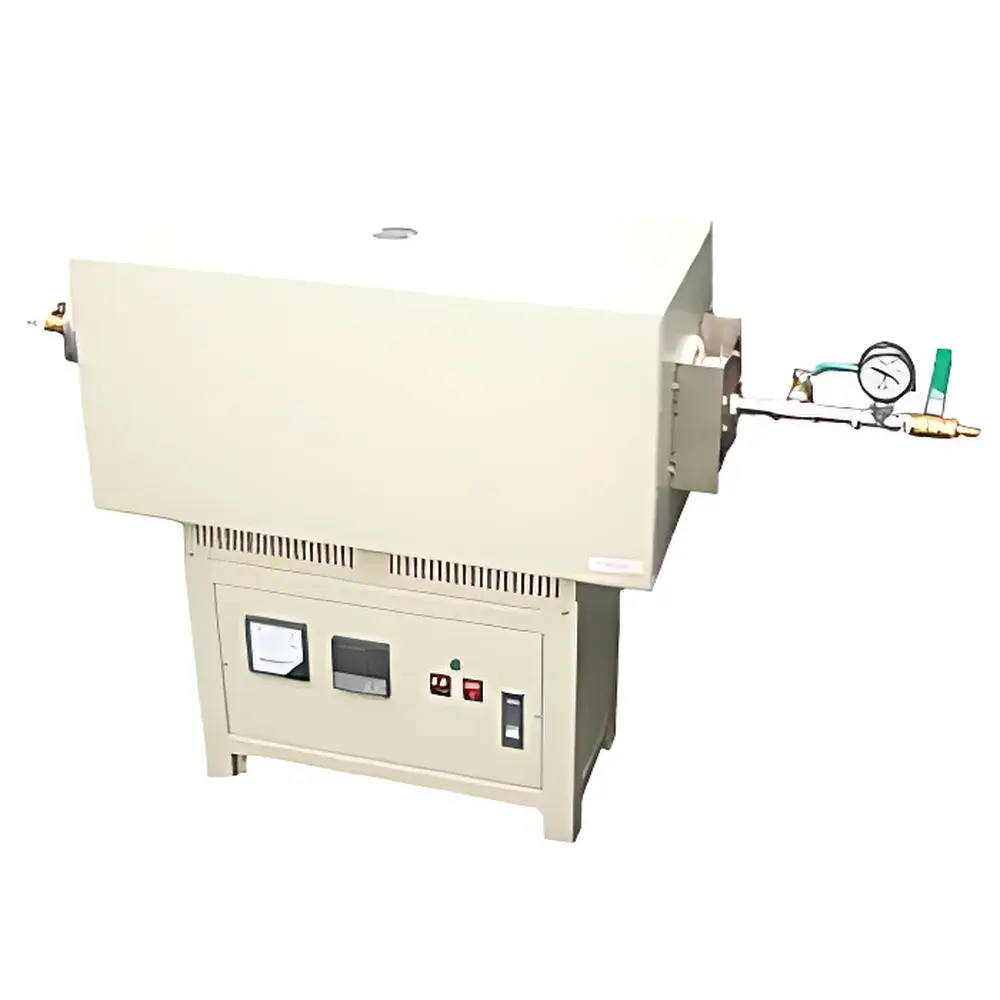
Zhuochi SK3-2-10-6 Energy-Efficient Programmable Vacuum Tube Furnace
| Brand | Zhuochi |
|---|---|
| Origin | Zhejiang, China |
| Model | SK3-2-10-6 |
| Chamber Dimensions | Ø60 × 400 mm |
| Max Operating Temperature | 1000 °C |
| Rated Power | 2 kW |
| Voltage | 200 V |
| Tube Material | Quartz (Ø60 × 600 mm) |
| Heating Rate | Adjustable from 15 to 999 min to reach 1000 °C |
| Control System | LTDE Programmable Temperature Controller |
| Vacuum Seal | Stainless Steel Flange, High-Temp Sealing Compound, Integrated Vacuum Gauge & Inlet Valve |
Overview
The Zhuochi SK3-2-10-6 is a laboratory-grade programmable vacuum tube furnace engineered for precise thermal processing under controlled atmospheric conditions. It operates on the principle of resistive heating via high-purity alloy heating elements embedded within a low-thermal-mass, ultra-lightweight ceramic fiber insulation chamber—enabling rapid thermal response and exceptional energy efficiency. Designed for applications requiring inert, reducing, or vacuum environments—including annealing, sintering, crystal growth, and precursor decomposition—the furnace integrates a sealed quartz tube (Ø60 × 600 mm) capable of sustaining continuous operation up to 1000 °C. Its modular vacuum interface supports base pressures down to 10⁻² mbar when paired with an external vacuum pump (not included), and optional mass flow controllers enable dynamic gas atmosphere management. The unit complies with IEC 61000-6-3 (EMC emission standards) and meets structural safety requirements per IEC 61010-1 for laboratory electrical equipment.
Key Features
- Programmable LTDE temperature controller with multi-segment ramp-soak profiles, supporting up to 30 programmable steps including heating, cooling, hold, and auto-shutdown sequences.
- Low-heat-capacity furnace chamber constructed from aerospace-grade ceramic fiber modules—reducing standby power consumption by >40% compared to conventional refractory brick designs.
- Vacuum-tight quartz tube assembly featuring a stainless steel end flange, high-temperature silicone-free sealing compound (rated to 1200 °C), analog vacuum gauge (0–760 Torr), and dual-purpose inlet valve for purge gas or vacuum line connection.
- Intelligent thermal protection architecture: independent over-temperature cutoff (OTC) circuit with redundant thermocouple input (K-type), real-time heater current monitoring, and automatic fault logging.
- Front-panel USB port for firmware updates and profile export; RS485 Modbus RTU interface standard for integration into centralized lab automation systems (e.g., LabVIEW, SCADA).
Sample Compatibility & Compliance
The SK3-2-10-6 accommodates cylindrical samples up to Ø58 mm × 380 mm in length within its quartz tube—suitable for powder compacts, rod-shaped catalysts, thin-film substrates, and small-volume crucibles (e.g., alumina, graphite, or platinum). Quartz tube compatibility ensures chemical inertness toward halides, oxides, and most organic precursors below 1000 °C. For elevated corrosion resistance or higher temperature use (>1100 °C), optional recrystallized alumina tubes (Ø60 × 600 mm) are available as field-replaceable components. The system conforms to ISO/IEC 17025 documentation requirements for calibration traceability and supports GLP-compliant operation through configurable audit trails, user access levels, and electronic signature support (when used with validated third-party software). It is not certified for Class I Div 1 hazardous locations but may be operated in ventilated fume hoods per ANSI/AIHA Z9.5 guidelines.
Software & Data Management
While the LTDE controller provides standalone profile execution and local data logging (up to 100 cycles, timestamped at 1-second intervals), full data integrity and regulatory compliance require integration with validated PC-based platforms. Zhuochi provides native drivers for Modbus TCP/IP and ASCII serial protocols, enabling seamless connectivity to commercial LIMS and ELN systems. When deployed with 21 CFR Part 11-compliant software (e.g., Siemens Desigo CC or Thermo Fisher SampleManager), the furnace supports electronic records with role-based permissions, immutable audit logs, and digital signature workflows. All temperature data are stored in CSV format with metadata headers (date, operator ID, profile name, thermocouple channel), facilitating direct import into MATLAB, Python (pandas), or JMP for statistical process analysis.
Applications
- Controlled-atmosphere synthesis of metal-organic frameworks (MOFs) and perovskite precursors under N₂ or Ar purge.
- Thermal gravimetric pre-treatment of battery electrode materials prior to XRD or SEM analysis.
- Low-pressure pyrolysis of polymer-derived ceramics in vacuum or forming gas (5% H₂/N₂).
- Post-deposition annealing of ALD-grown thin films on silicon wafers under repeatable thermal histories.
- Calibration verification of Type K thermocouples per ASTM E230/E230M using fixed-point reference materials (e.g., Al, Zn).
FAQ
What vacuum level can the SK3-2-10-6 achieve?
With a properly maintained O-ring seal and a two-stage rotary vane pump (e.g., Edwards RV8), typical base pressure is 5 × 10⁻² mbar. For lower pressures (<10⁻³ mbar), a turbomolecular pumping station is required and must be specified separately.
Is the quartz tube included with the furnace?
Yes—the standard configuration includes one fused quartz tube (Ø60 × 600 mm) with matching stainless steel end caps and high-temperature sealant. Replacement tubes are available as consumables (P/N: QT-SK3-60×600).
Can the furnace be operated under positive pressure?
No. The design is optimized for vacuum or near-atmospheric inert gas flow. Positive pressure exceeding 0.1 bar may compromise seal integrity and is not supported.
Does the LTDE controller support PID auto-tuning?
Yes—each channel features adaptive PID tuning with manual override, allowing optimization for specific load masses and thermal inertia profiles.
What maintenance is required for long-term reliability?
Annual inspection of furnace insulation integrity, thermocouple calibration verification (traceable to NIST standards), and replacement of quartz tube O-rings every 200 operating hours above 800 °C.



