
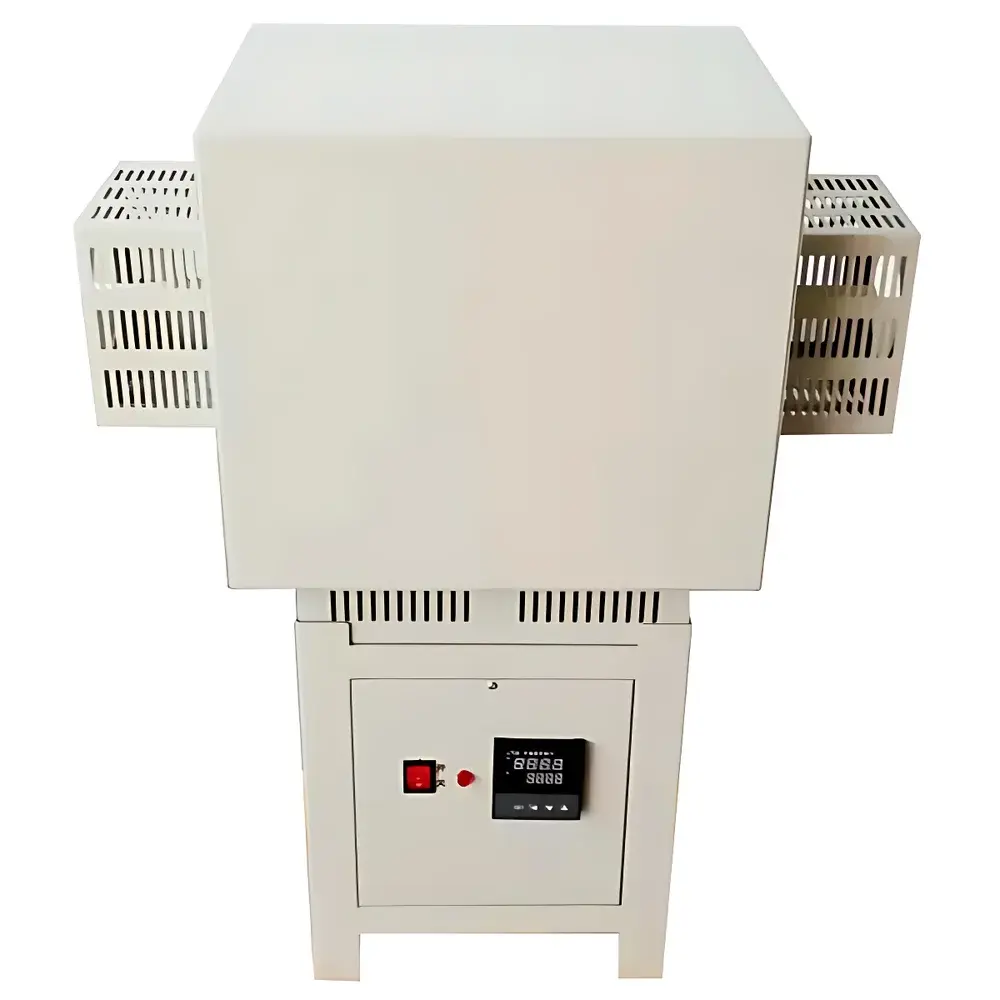
LYT 1255-1999 Standard Forest Soil Total Sulfur Analyzer (SK3-2.5-13 Combustion Furnace System)
| Brand | Zhuochi |
|---|---|
| Origin | Zhejiang, China |
| Type | Laboratory Benchtop Combustion-Based Total Sulfur Analyzer |
| Model | LYT 1255-1999 compliant SK3-2.5-13 |
| Temperature Range | 100–1300 °C |
| Temperature Stability | ±1 °C |
| Furnace Tube ID | φ22 mm |
| Heating Zone Length | 280 mm |
| Max Ramp Rate | ≤50 °C/min (adjustable) |
| Power | 2.5 kW |
| Voltage/Frequency | 220 V, 50 Hz |
| Weight | ~22 kg |
Overview
The LYT 1255-1999 Standard Forest Soil Total Sulfur Analyzer is a laboratory-grade combustion furnace system engineered for the quantitative determination of total sulfur content in forest soil samples in accordance with the Chinese forestry industry standard LYT 1255–1999. This method relies on high-temperature oxidative combustion (typically 1200–1300 °C) to convert all sulfur species—including sulfides, sulfates, organic sulfur, and elemental sulfur—into sulfur dioxide (SO₂), which is subsequently quantified via downstream detection (e.g., infrared absorption, coulometric titration, or UV fluorescence). The core hardware component—the SK3-2.5-13 programmable tube furnace—is purpose-built to deliver precise, reproducible thermal profiles essential for complete sulfur liberation and minimal matrix interference. Its design emphasizes thermal uniformity across the 280 mm active heating zone and stable isothermal operation at target temperatures, ensuring compliance with the procedural requirements outlined in LYT 1255–1999 for sample digestion, gas evolution control, and analytical repeatability.
Key Features
- High-efficiency ceramic fiber insulation architecture reducing energy consumption by up to 50% compared to conventional muffle furnaces.
- 1400 °C-rated heating element constructed from oxidation-resistant high-resistivity alloy wire—engineered for extended service life (>5× that of standard Kanthal or silicon carbide rods).
- LTDE-based programmable temperature controller with PID+SSR regulation, enabling user-defined ramp rates (0.1–50 °C/min), multi-step hold profiles, and automatic soak termination.
- Integrated dual-stage overtemperature protection: primary limit set via controller software, secondary hardware cutoff triggered independently at ≥1350 °C.
- Robust mechanical construction: cold-rolled steel enclosure with phosphate conversion coating and electrostatic powder finish; six-sided ultra-lightweight ceramic fiber chamber with rapid thermal response and low heat storage.
- Pre-wired electrical integration between furnace body and controller—no field wiring required beyond mains connection (220 V, 50 Hz).
Sample Compatibility & Compliance
This system is validated for use with solid-phase forest soil matrices as defined in LYT 1255–1999, including acidic, humus-rich, and clay-dominated samples typical of temperate and subtropical forest ecosystems. It accommodates standard quartz or ceramic combustion tubes (ID φ22 mm) and includes 20 reusable combustion boats and one spare tube. While LYT 1255–1999 is a national forestry standard, the underlying combustion–detection principle aligns with internationally recognized methodologies such as ASTM D3177 (Standard Test Method for Total Sulfur in Coal and Coke), ISO 10156 (Gas analysis — Determination of sulfur compounds), and EPA Method 5 (Determination of Particulate Emissions from Stationary Sources). When paired with an appropriate SO₂ detector meeting GLP data integrity requirements (e.g., 21 CFR Part 11-compliant readout), the full workflow supports auditable environmental monitoring and regulatory reporting.
Software & Data Management
The LTDE programmable controller provides local data logging of time–temperature profiles with 1 °C resolution and timestamped event markers (start, ramp, hold, cool-down). All programs are stored in non-volatile memory and support up to 30 segmented ramps per profile. While the furnace itself does not include Ethernet or USB connectivity, its analog output (4–20 mA or 0–5 V) can be interfaced with external DAQ systems or LIMS platforms for centralized calibration tracking, audit trail generation, and electronic record retention. Optional firmware upgrades may extend CSV export capability via RS485 interface—consult technical documentation for compatibility with third-party SCADA or ELN environments.
Applications
- Quantitative assessment of total sulfur concentration in forest floor litter, mineral soil horizons (A/B/C), and rhizosphere samples for ecological sulfur cycling studies.
- Baseline monitoring and long-term trend analysis in acid rain impact assessments across protected woodland areas.
- Validation of sulfur immobilization or volatilization during composting or biochar amendment trials.
- Supporting ISO/IEC 17025-accredited environmental testing laboratories requiring documented traceability to national standards (LYT 1255–1999) and metrological control of thermal parameters.
- Method development for speciation workflows where total sulfur serves as a mass-balance constraint prior to sequential extraction or XANES analysis.
FAQ
What detection method is required downstream of this furnace for sulfur quantification?
This instrument is a combustion source only—it does not include an integrated detector. Users must pair it with a compatible SO₂ analyzer (e.g., NDIR, UV fluorescence, or microcoulometric cell) meeting detection limits appropriate for soil sulfur (typically 10–500 mg/kg range).
Is the SK3-2.5-13 furnace suitable for other ASTM or ISO sulfur methods?
Yes—its temperature range, stability, and programmability meet the thermal requirements of ASTM D3177, ISO 10156, and EN 15407, provided sample introduction and gas handling are adapted per method specifications.
Can the furnace operate continuously at 1300 °C?
Rated continuous duty is specified at ≤1250 °C for optimal heater longevity; 1300 °C operation is permissible for short-duration (<30 min) analytical cycles as defined in LYT 1255–1999.
Does the system include GLP-compliant audit trail functionality?
The base LTDE controller logs run parameters and timestamps but lacks electronic signature or user-access logging. Full 21 CFR Part 11 compliance requires integration with external validated software or a certified LIMS.
What maintenance intervals are recommended for the heating element and insulation?
Under normal usage (≤8 h/day, <1250 °C), inspect heating element continuity and ceramic fiber integrity every 6 months; replace combustion tubes after ~200 cycles or upon visible cracking or deformation.







