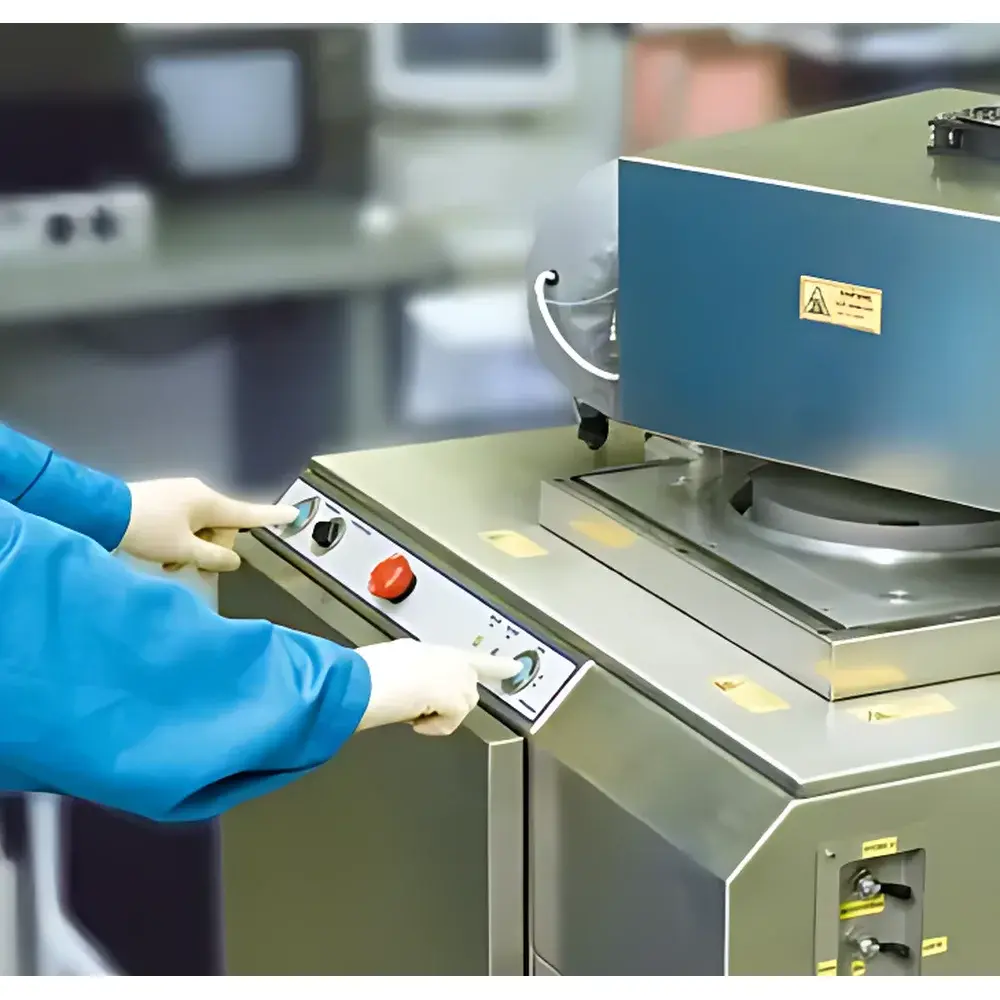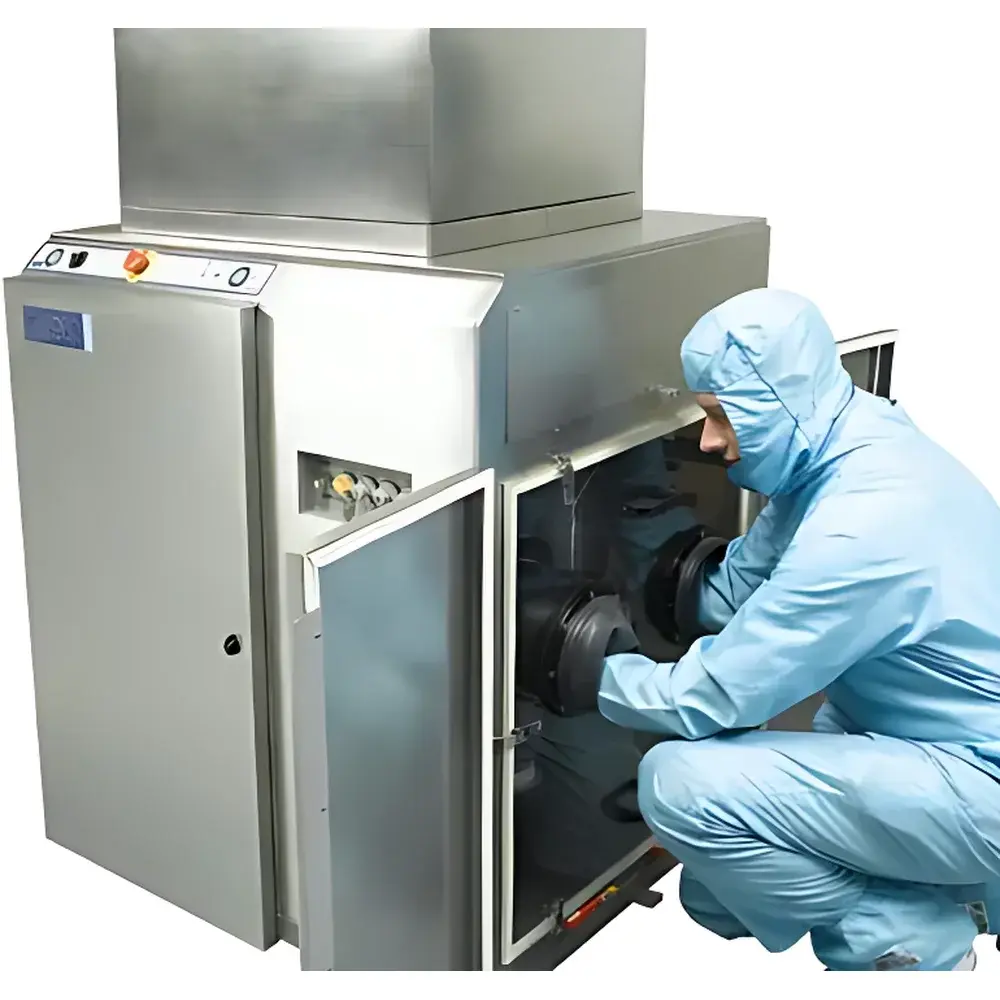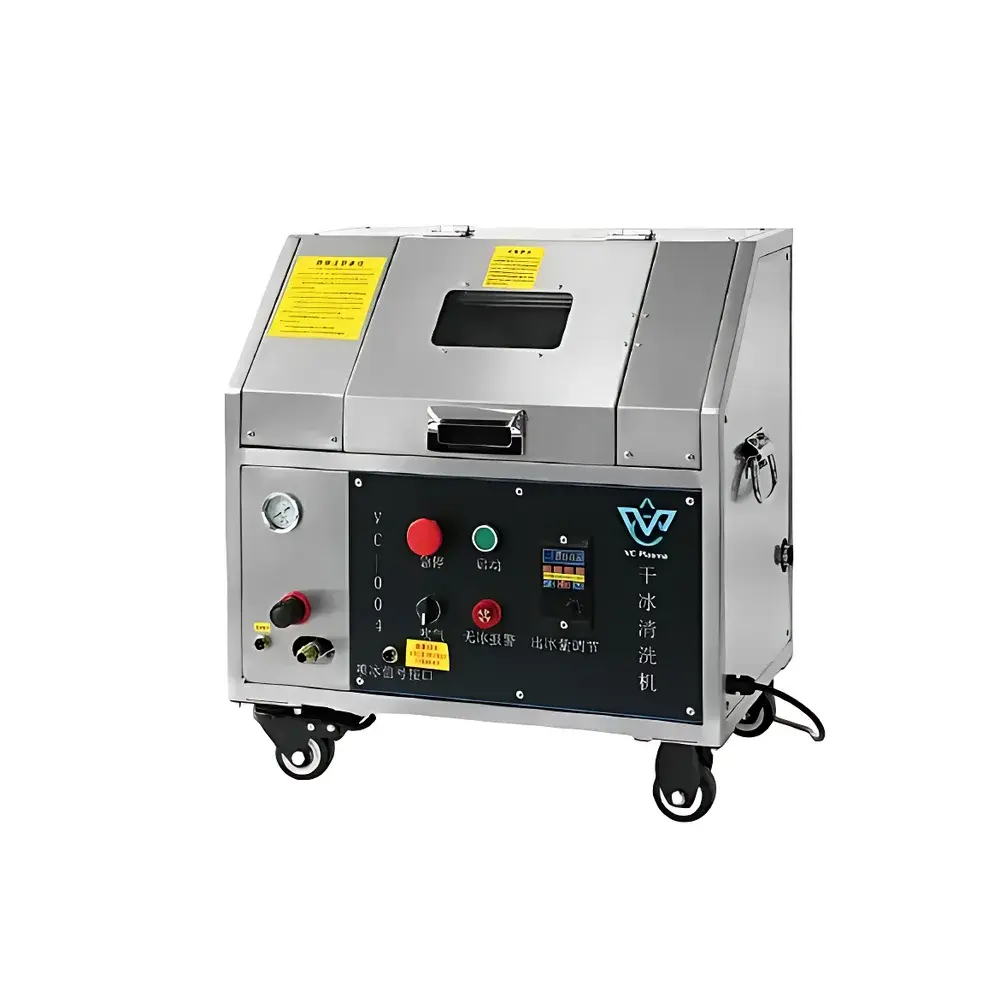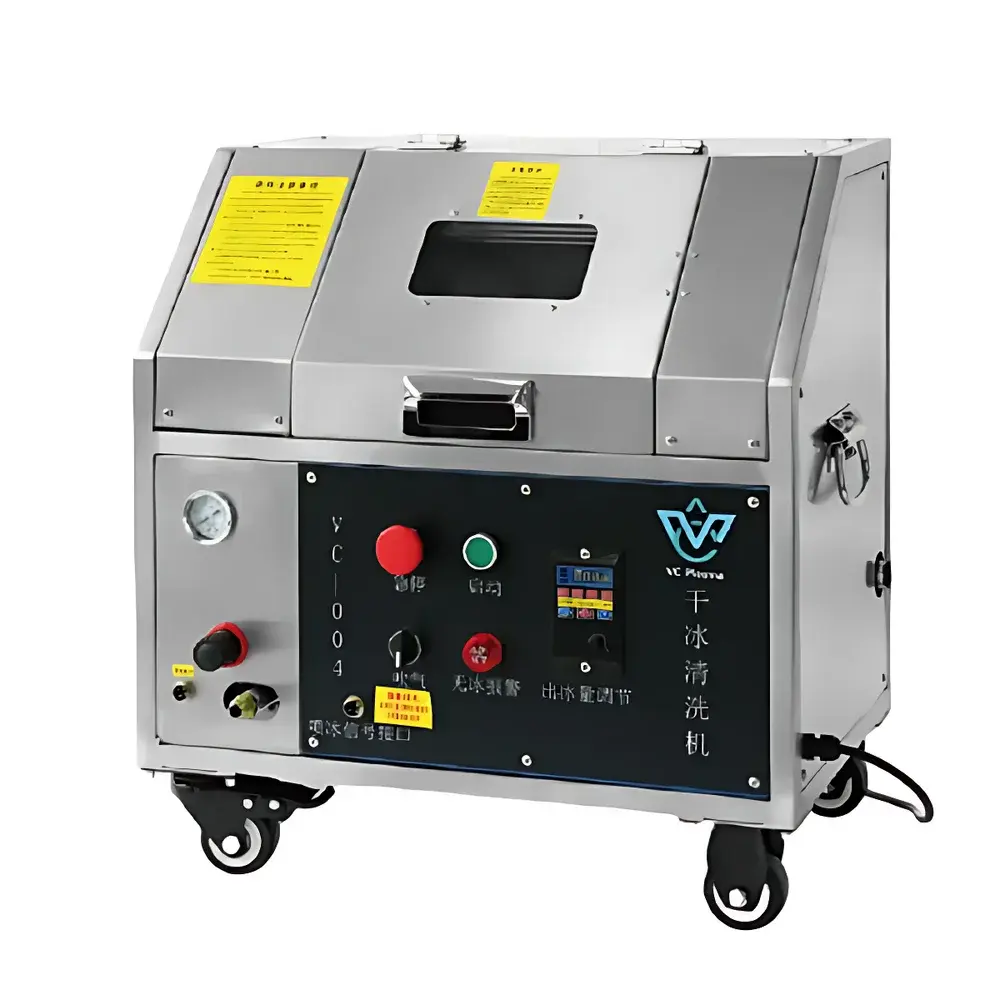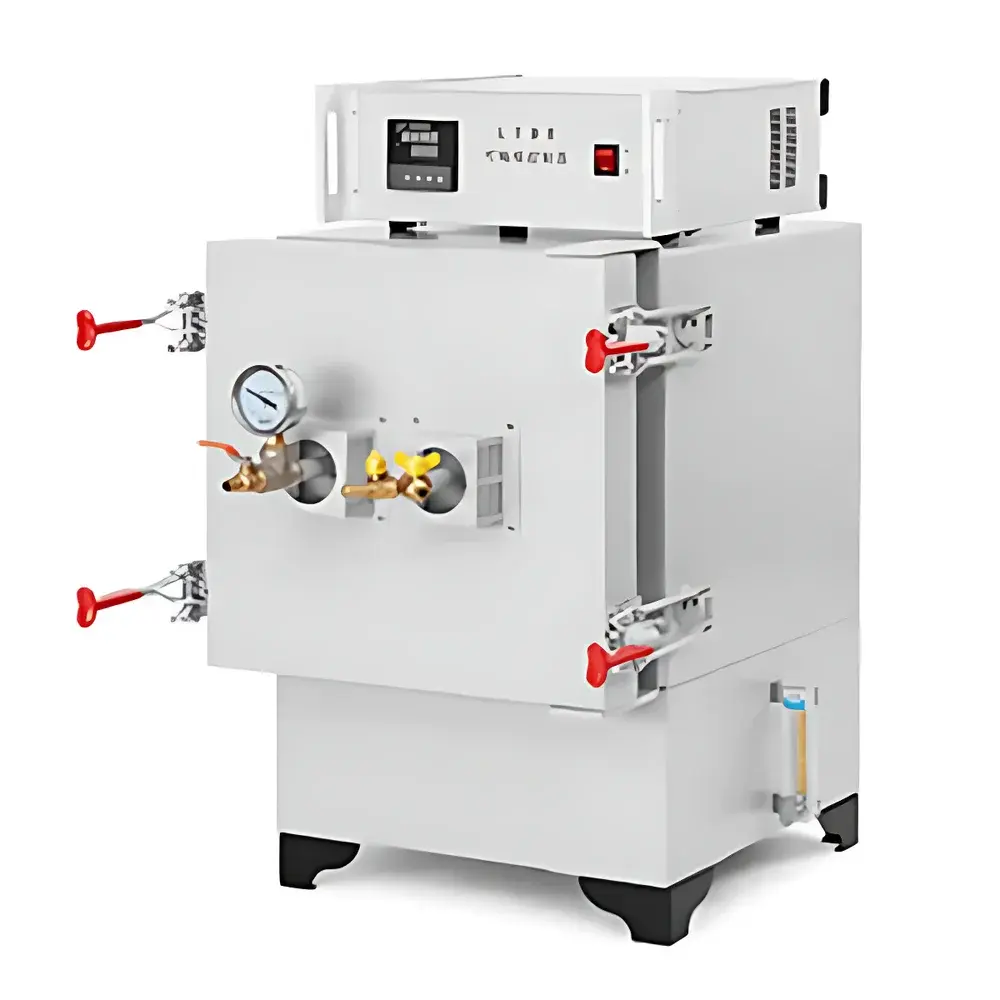
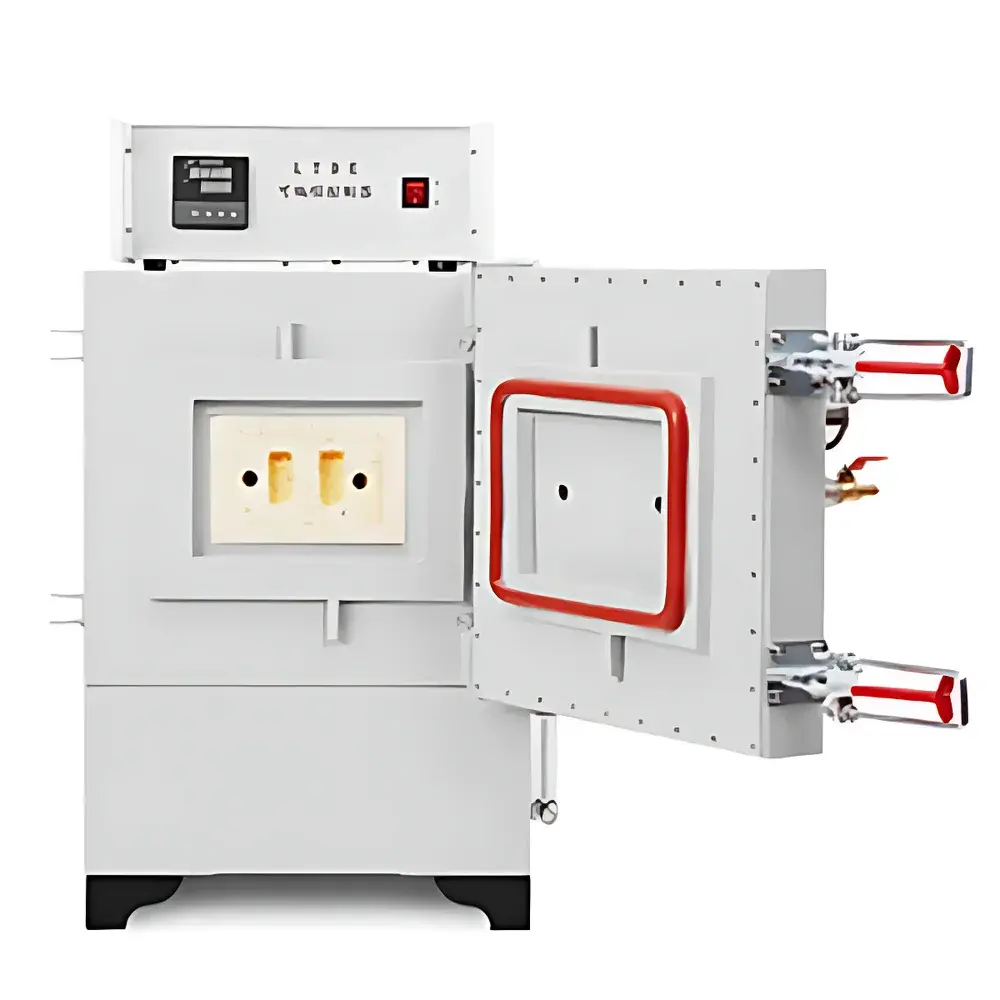
Zhuochi KSX3-5-12 Vacuum Box-Type Atmosphere Annealing Furnace
| Brand | Zhuochi |
|---|---|
| Origin | Zhejiang, China |
| Model | KSX3-5-12 |
| Instrument Type | Standard Vacuum Rapid Thermal Annealing Furnace |
| Sample Chamber Dimensions | 300 × 300 × 300 mm (L×W×H) |
| External Dimensions | 620 × 660 × 920 mm |
| Temperature Range | Ambient to 1200 °C |
| Max. Heating Rate | ≤50 °C/min |
| Cooling Rate | ≤20 °C/min |
| Temperature Uniformity | ±1 °C |
| Display Resolution | 1 °C |
| Heating Element | High-Temperature Resistance Wire |
| Insulation | Lightweight Refractory Fiber Board + Insulating Bricks & Ceramic Fiber Blanket |
| Thermocouple Type | K-Type |
| Power Supply | 220 V, 50 Hz |
| Total Power | 5 kW |
| Cooling Method | Water-Cooled Flange with External Chiller Interface |
| Atmosphere Options | Vacuum (≤10⁻² Pa) or Inert Gas (N₂, Ar, forming gas) via Dual-Valve Inlet/Outlet Ports |
| Safety | Dual-Stage Over-Temperature Protection, LTDE Programmable Controller (50-Step Ramp-Soak Profile) |
Overview
The Zhuochi KSX3-5-12 Vacuum Box-Type Atmosphere Annealing Furnace is a benchtop-scale thermal processing system engineered for precision annealing, sintering, and heat treatment of semiconductor wafers, thin-film substrates, and advanced ceramic or metallic samples under controlled vacuum or inert-gas environments. It operates on resistive heating principles, utilizing high-purity resistance wire embedded within a multi-layer insulation architecture composed of lightweight refractory fiber board, insulating bricks, and ceramic fiber blanket—ensuring minimal thermal mass, rapid response, and stable temperature distribution across the 300 × 300 × 300 mm isothermal chamber. The furnace achieves ambient-to-1200 °C operation with ±1 °C temperature uniformity and programmable ramp-soak profiles up to 50 segments, enabling reproducible thermal cycles required for dopant activation, oxide densification, metal silicide formation, and stress relief in microelectronic fabrication workflows.
Key Features
- Robust dual-mode operation: fully programmable vacuum annealing (down to 10⁻² Pa) or inert-atmosphere processing (N₂, Ar, or forming gas) with integrated dual-valve gas inlet/outlet ports and calibrated mass flow control capability.
- Water-cooled flange design at the furnace door interface, compatible with external chillers or tap-water cooling circuits—critical for maintaining structural integrity during rapid thermal cycling and preventing gasket degradation.
- LTDE-based 50-step programmable controller with real-time temperature logging, ramp/soak parameter flexibility, and dual-stage over-temperature cut-off (primary setpoint + independent hardware limiter) compliant with IEC 61000-6-2 EMC and Class I electrical safety standards.
- High-integrity sealing architecture: double O-ring flanged door with mechanical clamping, vacuum-tight stainless steel inner chamber, and pressure-rated viewing window (optional); validated leak rate <5 × 10⁻³ Pa·m³/s under static vacuum conditions.
- Modular utility interfaces: dedicated ports for thermocouple feedthrough (K-type), gas line connections (1/4″ VCR-compatible), vacuum pump coupling (KF25), and external chiller loop integration.
Sample Compatibility & Compliance
The KSX3-5-12 accommodates standard 4″–6″ semiconductor wafers, diced die stacks, MEMS packages, and small-volume powder compacts (up to 3 L volume). Its chamber geometry supports horizontal sample placement with optional quartz or alumina boats. All wetted materials—including furnace lining, heating elements, and gas path components—are selected for low outgassing and minimal metallic contamination, meeting SEMI F57 specifications for trace metal content in thermal processing tools. The system complies with ISO 9001-certified manufacturing protocols and supports GLP/GMP documentation requirements through optional audit-trail-enabled data export (CSV/TXT) and time-stamped event logging. While not FDA 21 CFR Part 11–certified out-of-the-box, its controller firmware architecture permits third-party validation for regulated R&D environments.
Software & Data Management
The LTDE controller provides local touchscreen operation with password-protected user levels (Operator, Engineer, Administrator). Temperature profiles, real-time curves, and alarm histories are stored internally (≥10,000 records) and exportable via USB flash drive. Optional RS485/Modbus RTU interface enables integration into SCADA or MES platforms for centralized process monitoring. Data files include timestamped thermocouple readings, setpoint trajectories, gas valve status, and vacuum pressure logs—structured for post-processing in MATLAB, Python (Pandas), or JMP. No cloud connectivity or proprietary software installation is required; all configuration remains self-contained within the embedded controller.
Applications
- Semiconductor process development: rapid thermal annealing (RTA) of ion-implanted Si wafers, TiN/Ta barrier layer crystallization, and low-k dielectric curing.
- Advanced packaging: reflow simulation for solder bumps, underfill curing kinetics, and wafer-level encapsulation stress analysis.
- Materials science: solid-state reaction studies of perovskite precursors, Li-ion cathode material calcination, and nanostructured oxide sintering under reducing atmospheres.
- Quality assurance labs: ASTM E29–compliant thermal calibration verification, ISO 17025 traceable temperature uniformity mapping, and failure analysis bake-out protocols.
- Research-scale metallurgy: precipitation-hardening heat treatments of aluminum alloys and oxidation-resistant annealing of Ni-based superalloy foils.
FAQ
What vacuum level can the KSX3-5-12 achieve, and which pump is recommended?
The furnace achieves ≤10⁻² Pa using a standard two-stage rotary vane pump (e.g., Edwards RV8) or a dry scroll pump (e.g., Agilent IDP-10); ultimate vacuum may improve to 10⁻³ Pa with optional turbomolecular pumping.
Is the furnace suitable for hydrogen-containing atmospheres?
Yes—when configured with H₂-compatible seals, stainless steel gas lines, and explosion-proof venting (per IEC 60079-14), it supports forming gas (5% H₂/95% N₂) annealing up to 1000 °C.
Can the temperature uniformity be verified per AMS2750E or CQI-9?
Yes—the 300 mm cubic chamber allows full 9-point SAT (System Accuracy Tests) per AMS2750E Table 10; certified calibration reports and TUS (Temperature Uniformity Survey) templates are available upon request.
Does the unit include vacuum and gas instrumentation by default?
Standard configuration includes analog vacuum gauge (0–10⁵ Pa range), dual needle valves, rotameter-based gas flow meter (0–10 L/min), and K-type thermocouple; digital pressure transducers and mass flow controllers are optional upgrades.
What maintenance intervals are recommended for long-term reliability?
Furnace insulation inspection every 500 operating hours; thermocouple recalibration annually or after 100 thermal cycles above 1000 °C; O-ring replacement every 2 years or following 50 vacuum cycles with aggressive gases.