
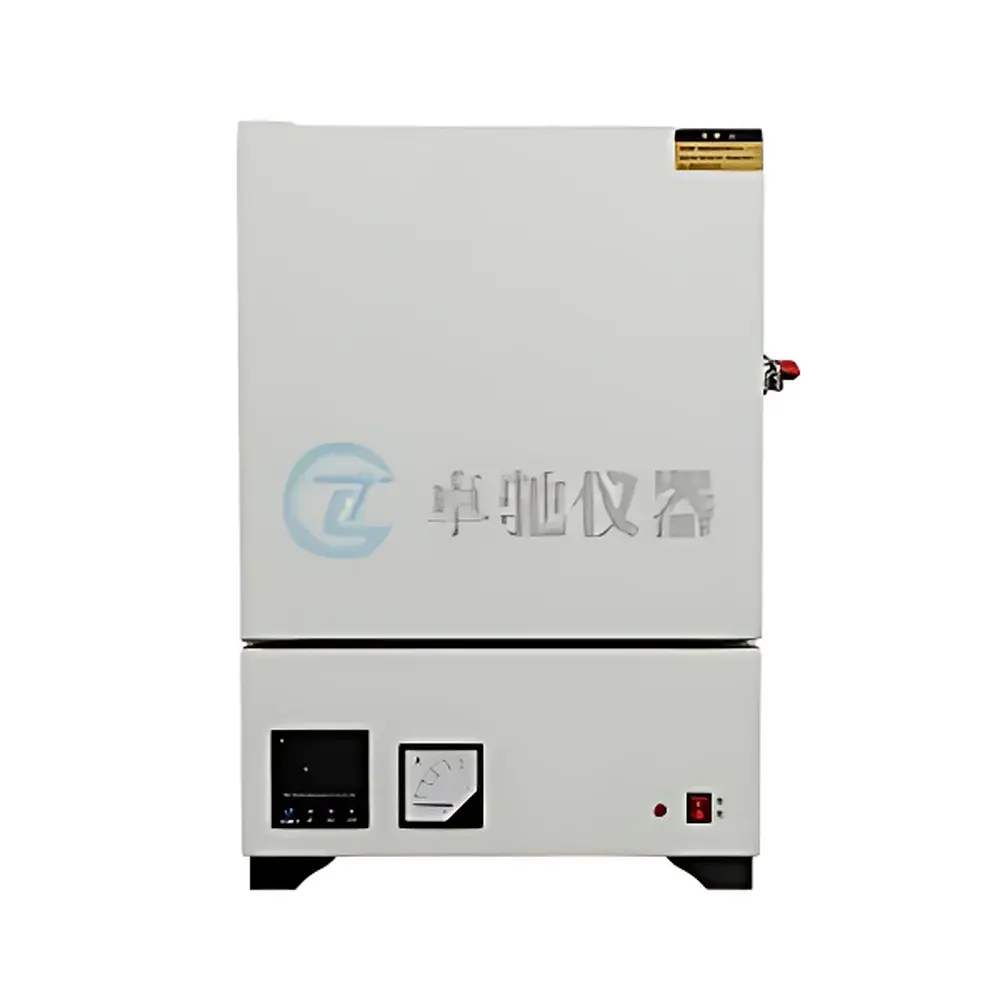
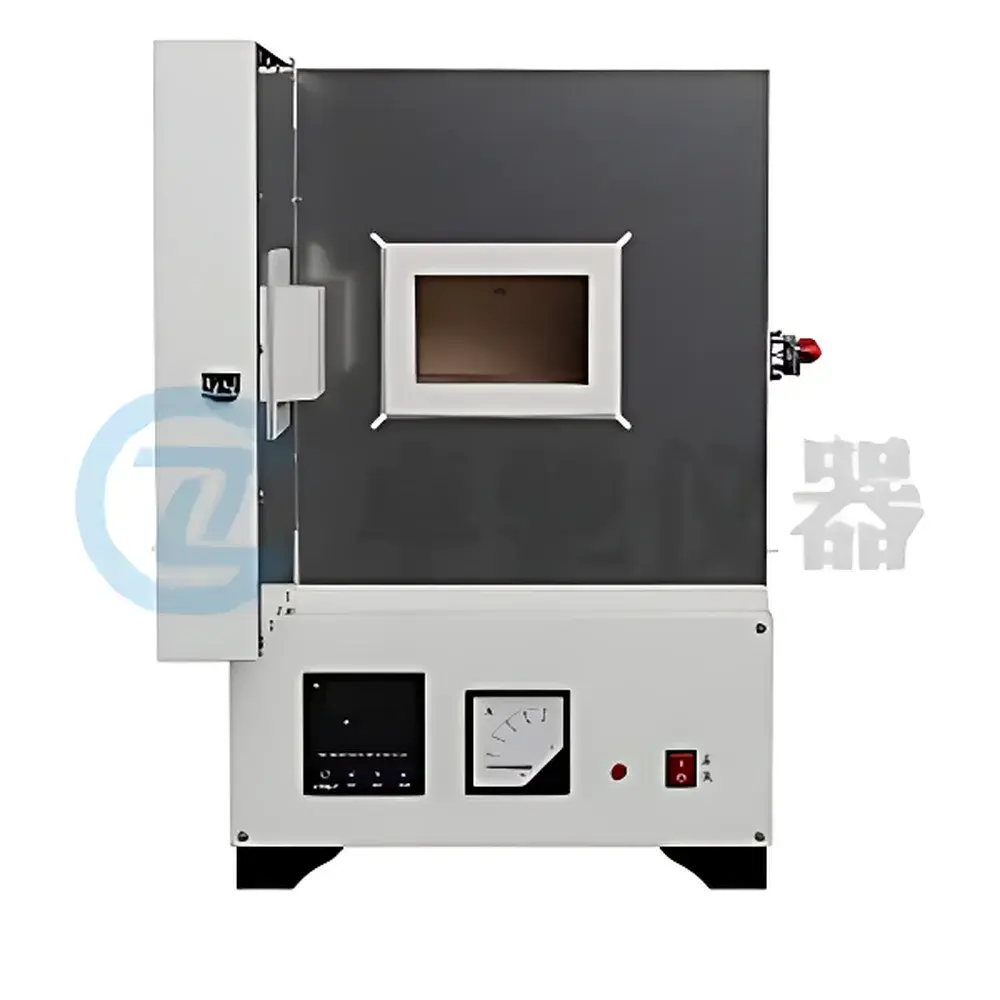
Zhuochi XL-2A Intelligent Programmable Muffle Furnace
| Brand | Zhuochi |
|---|---|
| Origin | Zhejiang, China |
| Model | XL-2A |
| Instrument Type | Box-Type Muffle Furnace |
| Maximum Temperature | 1000 °C |
| Temperature Control Accuracy | ±1 °C (in steady-state) |
| Temperature Uniformity | ±2 °C (at 1000 °C) |
| Display Resolution | 1 °C |
| Heating Rate | Adjustable up to 10 °C/min |
| Programmable Segments | 30-step ramp-soak profile |
| Internal Chamber Dimensions | 300 × 200 × 120 mm |
| Nominal Volume | 8 L |
| Power Rating | 4 kW |
| Supply Voltage | 220 V, 50 Hz |
| Net Weight | ~110 kg |
| Heating Element | High-Temperature Resistance Wire |
| Insulation | Refractory Brick + Ceramic Fiber Insulation |
| Thermocouple Type | K-type, rear-mounted |
| Safety Features | Dual-stage overtemperature protection, earth leakage circuit breaker (ELCB), insulated enclosure with powder-coated cold-rolled steel casing |
Overview
The Zhuochi XL-2A Intelligent Programmable Muffle Furnace is a precision-engineered box-type high-temperature furnace designed for controlled thermal processing in academic, industrial, and quality control laboratories. Operating on the principle of resistive heating via high-stability resistance wire elements embedded in all four chamber walls, it delivers exceptional temperature uniformity across its 8-liter chamber—critical for reproducible ashing, calcination, heat treatment, and thermal decomposition protocols. The furnace achieves a maximum operating temperature of 1000 °C and maintains steady-state control accuracy within ±1 °C, with spatial uniformity verified at ±2 °C at peak temperature. Its robust construction includes a high-alumina refractory chamber lining, dual-layer insulation (refractory brick + ceramic fiber), and a fully insulated cold-rolled steel outer shell finished with corrosion-resistant phosphate-treated and powder-coated matte gray finish.
Key Features
- 30-segment programmable controller based on LTDE architecture, enabling precise ramp-soak profiles with independent control of heating rate, dwell time, and cooling parameters
- Four-wall heating configuration ensures radial and axial thermal homogeneity—validated per ASTM E220 and ISO/IEC 17025 calibration practices
- Dual-stage overtemperature protection: primary control loop cutoff at user-defined limit; secondary independent safety limiter prevents thermal runaway
- Integrated earth leakage circuit breaker (ELCB) and grounded chassis design compliant with IEC 61010-1 for laboratory electrical safety
- Front-accessible thermocouple port (K-type) with compensation wiring for traceable temperature monitoring and external data logging
- Modular controller housed beneath the furnace base for service accessibility and electromagnetic interference (EMI) isolation
- Surface temperature of exterior casing remains below 55 °C under continuous operation at 1000 °C, meeting EN 60519-2 surface safety requirements
Sample Compatibility & Compliance
The XL-2A accommodates standard crucibles (alumina, quartz, platinum), ceramic boats, and small metallurgical specimens up to 300 mm in length. Its muffle design isolates samples from combustion byproducts and heating element emissions, making it suitable for ASTM D3174 (ash content in coal), ISO 1171 (ash determination in solid mineral fuels), and USP <231> heavy metals testing. The furnace supports GLP-compliant workflows through optional RS485 or USB interface modules, enabling audit-trail-capable temperature recording when paired with validated third-party software (e.g., LabVIEW or custom SCADA). All materials in contact with the hot zone conform to RoHS Directive 2011/65/EU restrictions on hazardous substances.
Software & Data Management
While the XL-2A operates autonomously via its built-in microcontroller, optional communication interfaces allow integration into centralized lab data systems. With the optional PC connectivity module, users can upload/download programs, monitor real-time temperature curves, and export CSV-formatted logs timestamped to ±1 second resolution. Software-generated reports include operator ID, program ID, start/end timestamps, deviation alerts, and thermocouple calibration offset entries—supporting FDA 21 CFR Part 11 compliance when deployed with appropriate electronic signature and audit trail configurations. Firmware updates are performed via secure USB dongle to maintain system integrity and version traceability.
Applications
- Quantitative ash residue analysis in food, pharmaceuticals, and environmental samples per AOAC 942.05 and EPA Method 1694
- Thermal pre-treatment of catalyst supports and battery electrode materials prior to BET surface area measurement
- Controlled annealing and stress-relief heat treatment of small tool steels and dental alloys
- Crystallization studies of optical coatings (e.g., TiO₂, SiO₂ thin films) requiring multi-step thermal cycling
- Calibration verification of thermocouples and RTDs using fixed-point reference materials (e.g., Al, Zn, Sn ITS-90 points)
- Residue-on-ignition (ROI) determination in water and wastewater solids analysis (Standard Methods 2540 F)
FAQ
What is the recommended maintenance interval for the XL-2A furnace?
Annual inspection of thermocouple integrity, insulation compression, and electrical grounding continuity is advised. Refractory lining visual checks should occur after every 200 h of operation above 800 °C.
Can the XL-2A be used under inert atmosphere conditions?
No—the standard model lacks gas inlet/outlet ports or sealed purge capability. For inert or reducing atmospheres, a dedicated tube furnace or modified muffle variant with flanged gas fittings is required.
Is the 30-segment program stored in non-volatile memory?
Yes—programs persist through power cycles and retain settings for ≥10 years without battery backup, per EEPROM endurance specifications.
Does the furnace meet CE marking requirements for export to the EU?
The XL-2A complies with the essential health and safety requirements of the Low Voltage Directive (2014/35/EU) and EMC Directive (2014/30/EU); however, CE marking requires end-user responsibility for conformity assessment under applicable national transposition laws.
What is the typical warm-up time to reach 1000 °C from ambient?
Approximately 120 minutes when operating at maximum heating rate (≤10 °C/min), consistent with thermal mass and insulation performance per IEC 60068-2-2 test methodology.



