
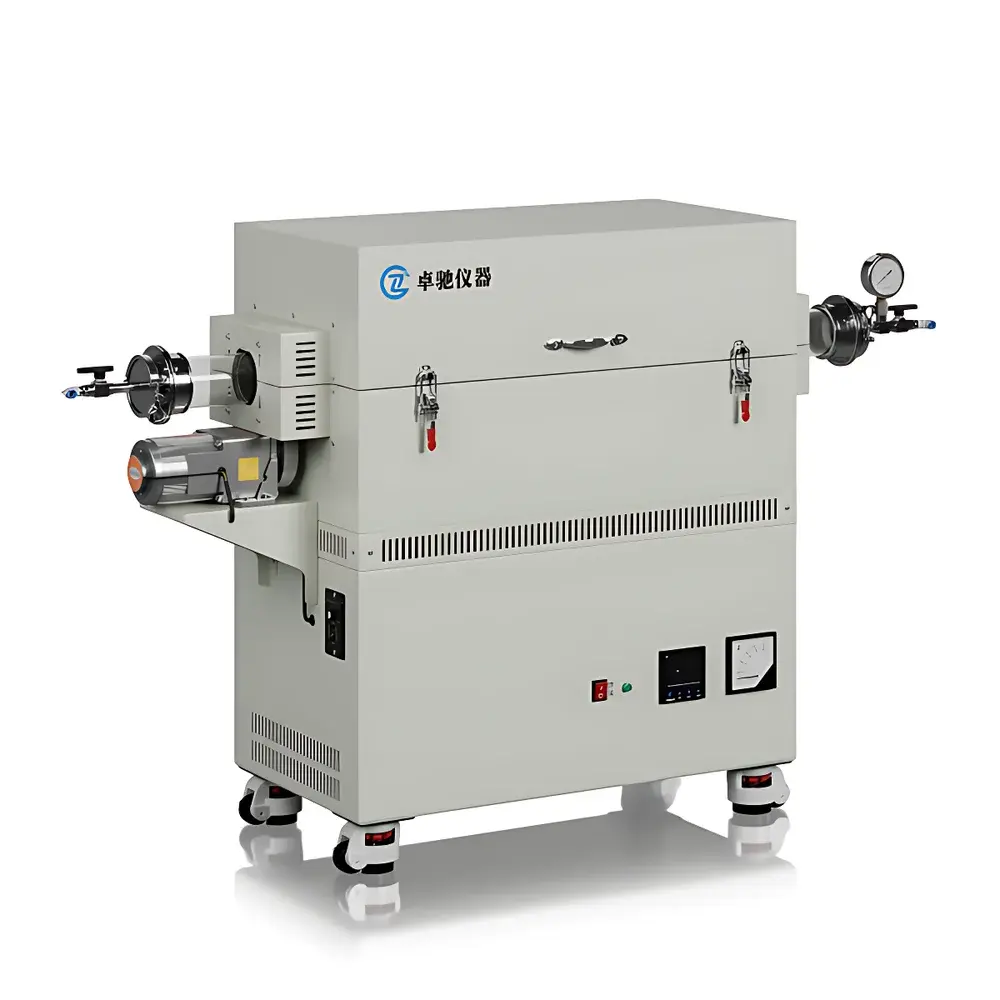
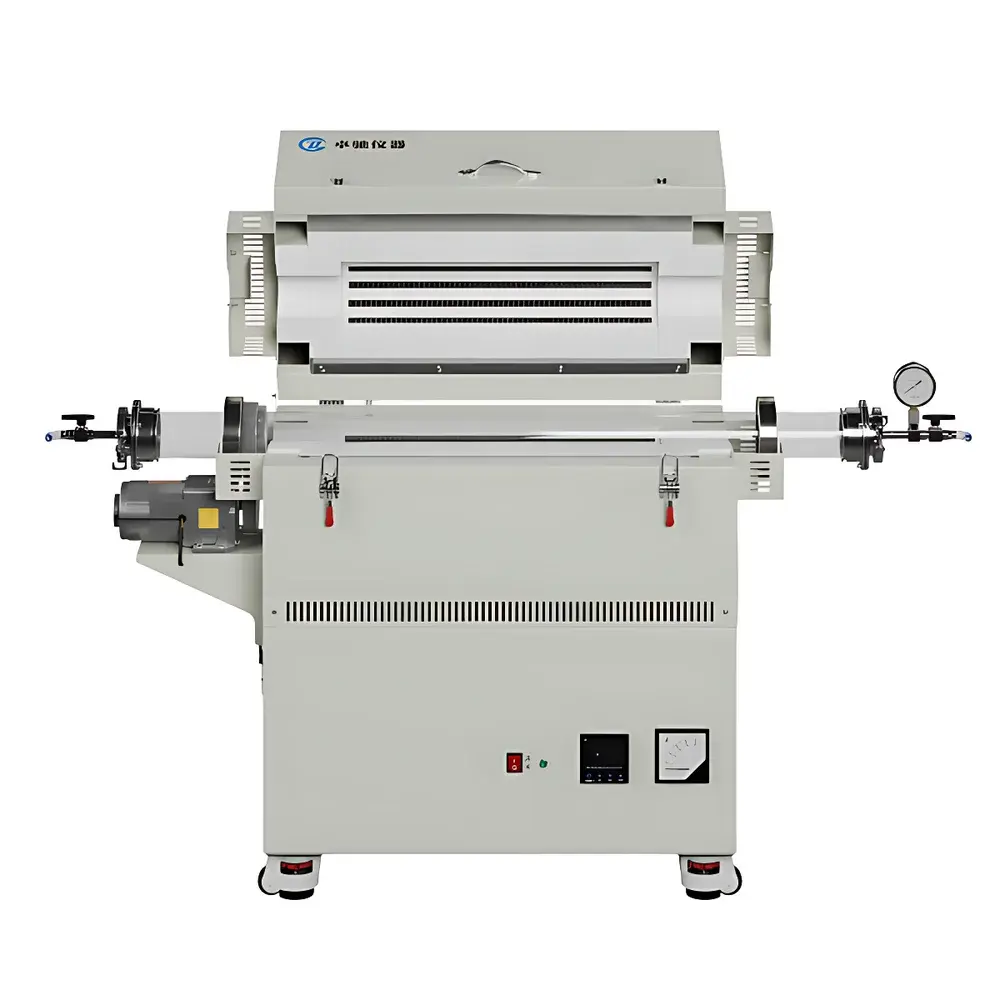
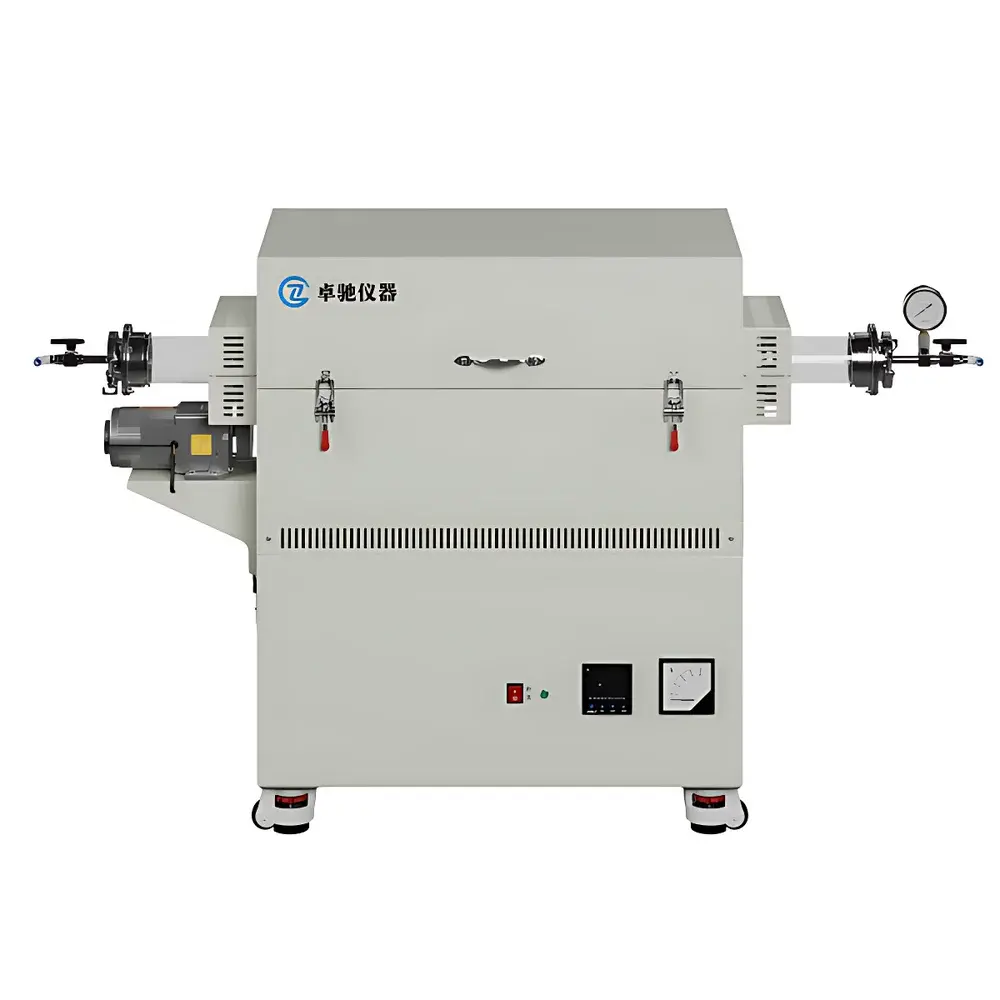
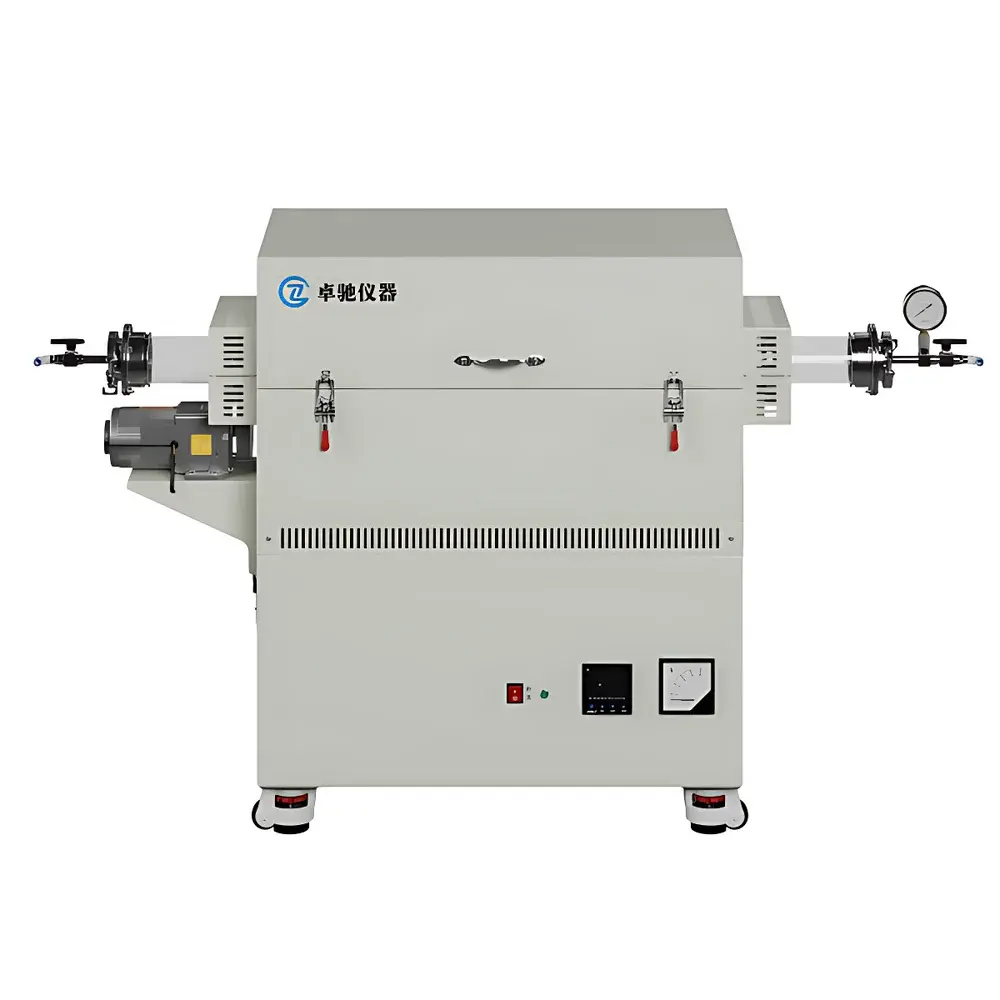
ZC1200KX Rotary Tube Furnace by Zhuochi
| Brand | Zhuochi |
|---|---|
| Origin | Zhejiang, China |
| Model | ZC1200KX |
| Max Temperature | 1200 °C |
| Temperature Uniformity | ±1 °C |
| Max Power | 2.5 kW |
| Heating Rate | ≤30 °C/min |
| Heating Method | Resistance Wire (0Cr27Al7Mo2) |
| Internal Chamber Dimensions | 60 mm (ID) × 400 mm (L) |
| Effective Heating Zone Length | 400 mm |
| Tube Configuration | Straight quartz tube (60 mm OD), optional tapered quartz tube (60 mm → 100 mm → 60 mm) |
| Sealing | Stainless steel flanges with float-type mass flow meters |
| Tilt Angle | 0–15° adjustable |
| Rotation Capability | Motor-driven continuous or intermittent tube rotation |
| Vacuum Rating | –0.1 MPa |
| Temperature Sensor | S-type platinum-rhodium thermocouple |
| Control System | LTDE 50-segment programmable PID controller |
| Compliance | Designed for GLP-compliant thermal processing environments |
Overview
The ZC1200KX Rotary Tube Furnace is a precision-engineered laboratory thermal processing system designed for controlled high-temperature synthesis, annealing, calcination, and chemical vapor deposition (CVD) under dynamic atmospheric conditions. Unlike static tube furnaces, this unit integrates motorized tube rotation, adjustable tilt (0–15°), and programmable multi-zone thermal profiles to ensure uniform exposure of solid or powder samples to heat and reactive gases. Its core architecture employs a dual-layer cold-rolled steel housing with phosphate conversion coating and high-temp electrostatic powder coating (computer gray), combined with a low-thermal-mass alumina polycrystalline fiber furnace chamber—enabling rapid heating/cooling cycles and minimizing energy consumption. The furnace operates on resistive heating via high-stability 0Cr27Al7Mo2 alloy wire elements embedded within the fiber insulation, delivering stable thermal fields across a 400 mm active heating zone. Temperature is monitored in real time using an S-type platinum-rhodium thermocouple inserted from the bottom, ensuring minimal thermal lag and traceable calibration paths.
Key Features
- Motor-driven continuous or stepwise rotation of the quartz tube (60 mm ID standard; optional tapered configuration: 60 mm → 100 mm → 60 mm) to enhance sample homogeneity during thermal treatment
- Adjustable tilt mechanism (0–15°) facilitating gravity-assisted powder mixing, melt spreading, or directional solidification experiments
- 50-segment programmable temperature controller (LTDE series) with PID algorithm, enabling precise ramp-hold-cool sequences and repeatable thermal histories
- Dual-stage over-temperature protection: hardware-based limit switch + software-triggered shutdown, compliant with IEC 61000-4-2 ESD immunity standards
- Integrated gas management interface: stainless steel flanged ports with calibrated float-type mass flow meters for single- or multi-gas introduction (N₂, Ar, H₂, NH₃, O₂); optional external gas mixing manifold available
- Quick-access hinged front door and removable fiber insulation panels for routine maintenance and furnace chamber inspection
- Low surface temperature design (<60 °C at ambient +25 °C) achieved through optimized fiber blanket thickness (≥60 mm) and air-gap thermal isolation
Sample Compatibility & Compliance
The ZC1200KX accommodates powdered, granular, or pelletized specimens up to 400 mm in length and compatible with inert, reducing, oxidizing, or vacuum atmospheres (down to –0.1 MPa). Standard quartz tubing (99.99% SiO₂) supports operation up to 1100 °C continuously; optional high-purity alumina or silicon carbide tubes extend usability to 1300 °C. All electrical components—including contactors, solid-state relays, and cooling fans—meet CE and RoHS directives. The control architecture supports audit-ready operation: event logs (temperature setpoint changes, alarm triggers, power interruptions) are timestamped and stored locally, aligning with GLP documentation requirements. While not certified to FDA 21 CFR Part 11 out-of-the-box, the system’s deterministic control logic and non-volatile parameter storage facilitate validation protocols for regulated QC/QA labs.
Software & Data Management
The LTDE controller features a backlit LCD interface with intuitive navigation and real-time graphing of actual vs. setpoint temperature curves. All programs (up to 10 user-defined profiles) are saved in non-volatile memory and can be exported via RS485 serial interface (Modbus RTU protocol) for integration into lab-wide SCADA or LIMS platforms. Optional USB data logger modules enable continuous CSV export of temperature, power draw, and alarm status at configurable intervals (1–60 s). Firmware updates are performed via SD card, ensuring long-term maintainability without proprietary software dependencies.
Applications
- Controlled atmosphere annealing of semiconductor wafers and thin-film substrates
- CVD precursor decomposition for nanomaterial synthesis (e.g., graphene, MoS₂, carbon nanotubes)
- Thermal reduction of metal oxides (e.g., CuO → Cu, Fe₂O₃ → Fe) under H₂/N₂ mixtures
- High-temperature purification of battery cathode materials (LiCoO₂, NMC)
- Grain growth studies in ceramic powders under rotating shear conditions
- Thermogravimetric pre-treatment prior to XRD or SEM analysis
FAQ
What tube materials are compatible with the ZC1200KX?
Standard configuration uses fused quartz (60 mm OD); optional replacements include high-purity alumina (Al₂O₃), silicon carbide (SiC), or recrystallized alumina tubes—each requiring matching flange gasketing and pressure rating verification.
Can the furnace operate under vacuum without gas flow?
Yes—the system achieves –0.1 MPa base vacuum when paired with a two-stage rotary vane pump and appropriate vacuum-rated seals; residual gas composition must be verified via residual gas analyzer for sensitive reactions.
Is remote monitoring supported?
Via optional RS485-to-Ethernet gateway, the furnace integrates with Modbus TCP-enabled building management systems or custom Python/Node-RED dashboards for real-time telemetry and alarm notification.
How is temperature uniformity validated?
Uniformity is characterized per ASTM E220 using three calibrated S-type thermocouples placed axially at 0%, 50%, and 100% of the heating zone length; typical deviation across the 400 mm zone is ≤±3 °C at 1200 °C.
What maintenance intervals are recommended?
Fiber insulation integrity should be inspected every 200 operating hours; thermocouple calibration verified quarterly; gas line filters replaced biannually; drive belt tension adjusted annually per manufacturer torque specifications.



