
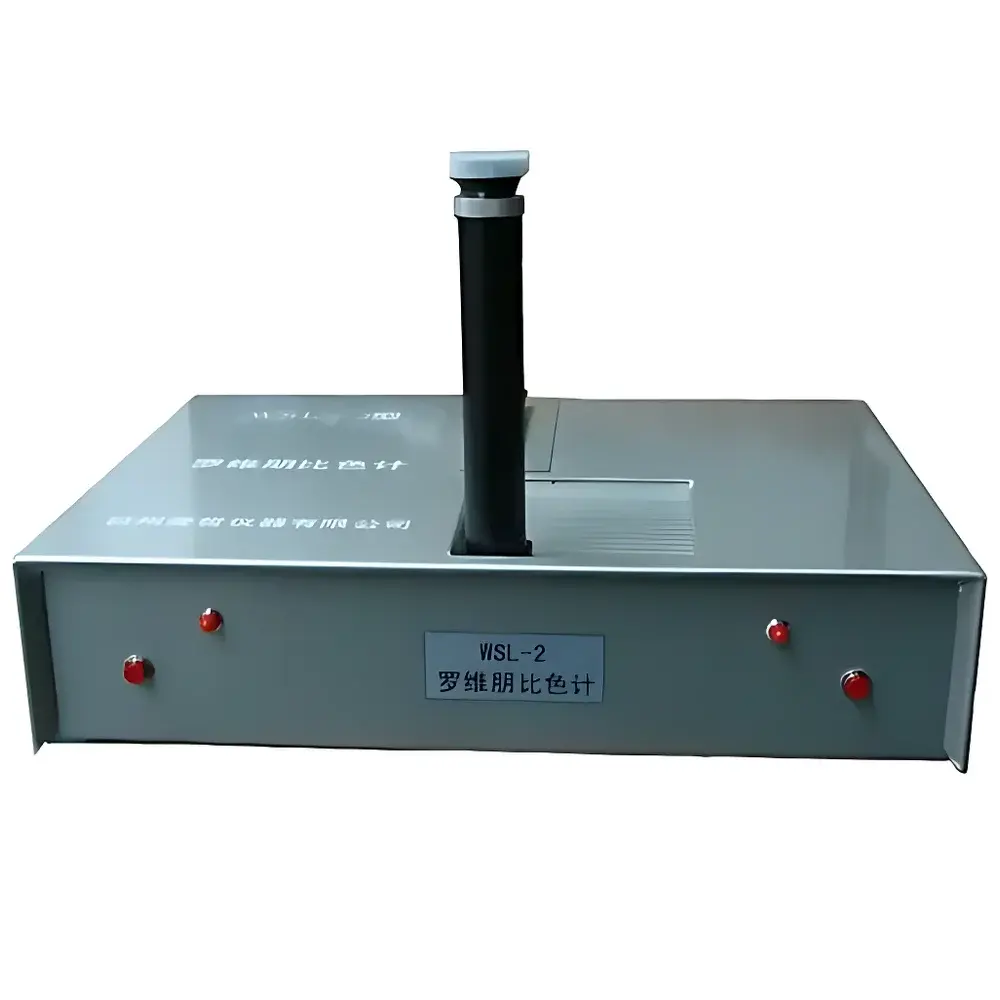
Top Cloud-agri WSL-2 Lovibond Tintometer
| Brand | Top Cloud-agri |
|---|---|
| Origin | Zhejiang, China |
| Manufacturer Type | Direct Manufacturer |
| Country of Origin | China |
| Model | WSL-2 |
| Product Category | Spectrophotometric Colorimeter |
| Instrument Type | Benchtop |
| Optical Geometry | 0°/45° Integrating Sphere |
| Light Source | Tungsten Filament Lamp |
| Spectral Range | 380–750 nm |
| Repeatability | ΔE* ≤ 0.08 (CIELAB, within same sample, 10 measurements) |
Overview
The Top Cloud-agri WSL-2 Lovibond Tintometer is a benchtop visual color measurement instrument engineered for precise, standardized assessment of color in translucent and opaque materials using the internationally recognized Lovibond® color scale system. Unlike spectrophotometers that output tristimulus or spectral data, the WSL-2 operates on the principle of visual color matching under controlled illumination—leveraging human observer-based psychophysical evaluation calibrated to the Lovibond color standard. This method remains widely specified in industrial quality control protocols for edible oils, resins, waxes, pharmaceutical excipients, and food-grade syrups where regulatory or trade specifications are defined in Lovibond units (R, Y, B, N). The instrument employs a tungsten-filament light source with stable CCT (~2856 K) and a 0°/45° integrating sphere optical geometry to ensure uniform illumination and minimize specular reflectance artifacts during transmission or reflection measurements.
Key Features
- Compliant with the official Lovibond® color scale definition per ASTM D1500 (Standard Test Method for ASTM Color of Petroleum Products) and ISO 2049 (Rubber—Determination of color), enabling direct comparability with legacy reference data and industry benchmarks.
- Dual-mode operation: Transmission mode for clear liquids (e.g., vegetable oils, solvents, syrups) using standardized pathlength cells (10 mm, 25.4 mm, 133.4 mm); reflection mode for semi-opaque or solid samples (e.g., plastic pellets, ground spices, powdered dairy) via integrated white reference plate (≥80% diffuse reflectance).
- High-sensitivity split-field viewing system with achromatic optics, enabling accurate hue discrimination at ±0.1 Lovibond unit resolution across all four color dimensions (Red: 0.1–79.9; Yellow: 0.1–79.9; Blue: 0.1–49.9; Neutral Gray: 0.1–3.9).
- Benchtop mechanical architecture with robust aluminum housing, precision-machined filter wheels, and tactile calibration dials—designed for long-term stability in QC laboratories without active temperature or humidity control.
- No software dependency: All measurements are performed manually by trained operators following documented SOPs, supporting GLP-compliant environments where audit trails rely on paper-based or LIMS-integrated manual entry rather than embedded firmware logs.
Sample Compatibility & Compliance
The WSL-2 supports a broad range of industrial samples compliant with established material-specific test methods. Transmission applications include edible oils (AOCS Cd 13b-92), petroleum distillates (ASTM D1500), and pharmaceutical glycerin (USP ). Reflection mode accommodates granular foods (e.g., ground coffee, cocoa powder per AOCS Ja 12-05), polymer chips (ISO 11477), and natural resins (e.g., rosin per GB/T 8086). All measurements adhere to CIE 1931 2° standard observer conditions under illuminant A. The instrument does not require electrical calibration certification but must be verified periodically using NIST-traceable Lovibond reference standards (e.g., Lovibond Reference Set No. 1000 Series) to maintain metrological traceability per ISO/IEC 17025 requirements.
Software & Data Management
The WSL-2 is a standalone optical comparator with no embedded microprocessor or digital interface. Consequently, it generates no native electronic data files. Color results are recorded manually as integer or decimal Lovibond values (e.g., “R 22.5, Y 38.0, B 1.2”) in laboratory notebooks or LIMS templates. For laboratories requiring digital traceability, integration is achieved through structured manual entry into validated systems supporting 21 CFR Part 11 compliance—including electronic signatures, change history, and audit trail generation for all recorded observations. No firmware updates, cloud connectivity, or proprietary drivers are involved, minimizing validation burden in regulated manufacturing (e.g., food safety HACCP plans, GMP-compliant excipient release testing).
Applications
- Quality assurance of refined vegetable oils (soybean, palm, sunflower) against national standards (e.g., GB 1535–2017, GB 1534–2017) specifying maximum R/Y thresholds.
- Batch-to-batch consistency verification for natural colorants (e.g., annatto, paprika oleoresin) used in dairy and meat processing.
- Raw material inspection of rosin, turpentine, and gum arabic in adhesive and coating formulations.
- Stability monitoring of heat-sensitive products (e.g., caramelized syrups, fruit concentrates) during thermal processing and shelf-life studies.
- Supplier qualification testing for textile dyes and pigment dispersions where Lovibond-scale correlation to CIELAB is established via empirical conversion tables.
FAQ
Is the WSL-2 compliant with ASTM D1500?
Yes—the optical design, illuminant spectrum, and observer geometry meet the essential requirements of ASTM D1500 for visual color grading of petroleum products.
Can the WSL-2 measure samples in CIELAB or RGB format?
No—it reports exclusively in Lovibond units (R, Y, B, N). Conversion to CIELAB requires empirical correlation using certified reference materials and is not instrument-supported.
What pathlength cells are included with the WSL-2?
The standard configuration includes three matched glass cells: 10 mm, 25.4 mm (1 inch), and 133.4 mm (5.25 inches), each calibrated for nominal pathlength accuracy per ISO 6425.
Does the instrument require annual recalibration by an accredited lab?
Not inherently—the WSL-2 has no drift-prone electronics. However, periodic verification against certified Lovibond standards is recommended every 6–12 months per internal QA policy or ISO/IEC 17025 clause 6.6.
Is training provided for operator qualification?
Yes—Top Cloud-agri offers documented operator competency assessments aligned with ISO 9001 clause 7.2, including pass/fail criteria for inter-operator repeatability (≤0.08 ΔE* between two trained users on identical samples).





