
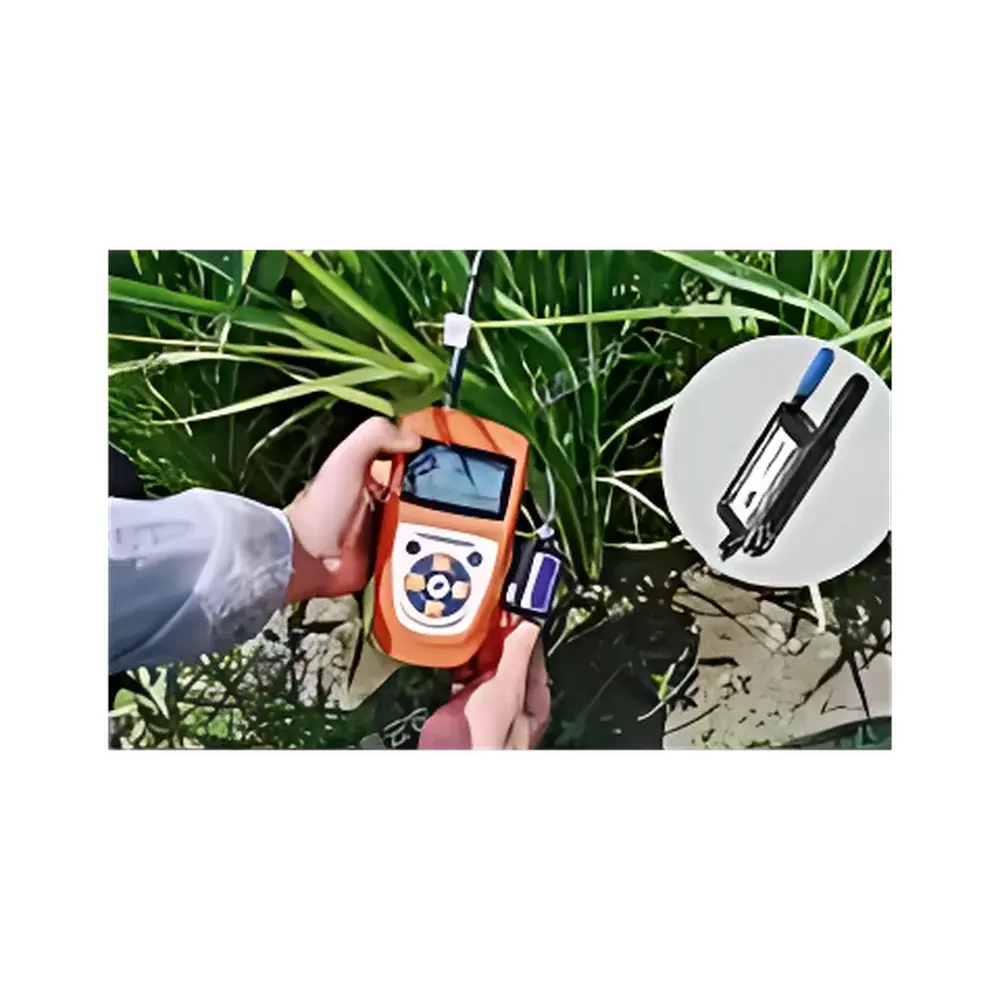
Top Cloud-agri TZS-pH-IIG Soil pH and Temperature Analyzer
| Brand | Top Cloud-agri |
|---|---|
| Origin | Zhejiang, China |
| Manufacturer Type | Manufacturer |
| Country of Origin | Domestic (China) |
| Model | TZS-pH-IIG |
| Instrument Type | Soil pH Meter |
| Measurement Parameters | pH (0.0–14.0, ±0.1 accuracy, 0.1 resolution, single-point calibration) and Soil Temperature (−5°C to 70°C, ±0.5°C accuracy, 0.1°C resolution, automatic temperature compensation) |
| Operating Environment | −10°C to 55°C, 0–95% RH (non-condensing) |
| Power | Built-in 7.4 V / 2 Ah Li-ion battery |
| Standby Current | <20 mA |
| Max Operating Current | 300 mA |
| Onboard Storage | 30,000 records (Flash) +标配 4 GB TF card (expandable to 64 GB) |
| Data Logging Interval | 5 min – 99 h (user-configurable) |
| Connectivity | 2G/4G cellular, mini-USB, GPS positioning |
| Display | Chinese LCD with real-time clock, battery level, sensor values, storage status, voice status |
| Audio Alert | Mandarin voice播报 for threshold violations |
| Platform Integration | Cloud-based management platform with web & mobile access, data visualization, export (CSV/PDF), alarm configuration, crop-specific presets, audit-ready data history, remote firmware updates |
Overview
The Top Cloud-agri TZS-pH-IIG is a field-deployable, dual-parameter soil analyzer engineered for continuous, in-situ monitoring of soil acidity (pH) and temperature. It operates on direct-insertion electrochemical sensing principles: the pH measurement relies on a glass electrode-based potentiometric cell calibrated against standard buffer solutions, while soil temperature is acquired via a precision NTC thermistor embedded within the same probe assembly. Automatic temperature compensation (ATC) is applied in real time to correct pH readings per the Nernst equation, ensuring metrological consistency across variable thermal conditions. Designed for unattended operation in agricultural and ecological monitoring contexts—including greenhouses, orchards, tea plantations, grassland stations, and cultivated farmland—the device meets functional requirements for long-term environmental observation networks, such as those deployed under China’s national “Four Conditions” (soil moisture, fertility, pests, and seedling health) and arable land protection monitoring programs.
Key Features
- Integrated dual-sensor probe: Simultaneously acquires soil pH and temperature with co-located measurement geometry to minimize spatial sampling error.
- Cellular telemetry: Embedded 2G/4G module enables autonomous transmission of timestamped, georeferenced datasets to a secure cloud server—no local gateway or PC required.
- GPS-enabled spatial metadata: Each record includes WGS84 latitude/longitude coordinates, supporting GIS integration and spatial trend analysis.
- Configurable logging strategy: Supports both scheduled interval acquisition (5 minutes to 99 hours) and manual trigger mode; ideal for both routine surveillance and event-driven sampling.
- On-device intelligence: Chinese-language LCD interface displays real-time values, battery status, memory utilization, and system alerts; voice feedback provides audible confirmation of out-of-range conditions in Mandarin.
- Expandable local storage: 30,000 internal Flash records plus microSD support up to 64 GB ensures data continuity during network outages or extended offline deployments.
Sample Compatibility & Compliance
The TZS-pH-IIG is validated for use in mineral soils, loams, sandy substrates, and organic-rich media typical of horticultural and agronomic systems. Its stainless-steel probe housing and epoxy-sealed electronics provide resistance to corrosion and mechanical abrasion in field environments. While not certified to ISO/IEC 17025 or ASTM D4972 (Standard Test Method for pH of Soils), the instrument adheres to fundamental electrochemical measurement practices recommended by the USDA Natural Resources Conservation Service (NRCS) and FAO guidelines for soil pH field assessment. Calibration follows single-point verification using pH 7.00 buffer solution at ambient temperature—a procedure aligned with common laboratory pre-screening workflows prior to deployment.
Software & Data Management
The proprietary cloud platform supports role-based access control, time-series visualization (zoomable line charts), statistical summaries (min/max/mean), and export to CSV, PDF, or Excel formats. Data integrity is maintained through immutable timestamps, GPS-derived location stamps, and sequential record numbering. Alarm logic allows users to define upper/lower thresholds per parameter and assign crop-specific alert profiles (e.g., “Blueberry – pH 4.5–5.5”). All platform interactions—including configuration changes, alarm triggers, and firmware updates—are logged with user ID and timestamp, satisfying basic GLP traceability expectations. Remote OTA (over-the-air) updates ensure sustained compatibility with evolving data protocols and security standards.
Applications
- Smart greenhouse management: Real-time pH tracking informs lime or sulfur amendment scheduling to maintain optimal rhizosphere chemistry for high-value crops.
- Orchard and vineyard soil health monitoring: Longitudinal pH trends assist in diagnosing nutrient lock-up, aluminum toxicity, or carbonate accumulation in perennial systems.
- National monitoring infrastructure: Deployed at fixed-point “soil conservation monitoring stations” and “four-condition” observation nodes to feed provincial and national agro-environmental databases.
- Research-grade field trials: Enables replicated, spatially referenced pH profiling across treatment plots without requiring repeated lab-based extraction methods (e.g., 1:1 water or CaCl₂ suspensions).
- Educational extension services: Portable design and intuitive interface facilitate participatory soil testing workshops with farmers and extension agents.
FAQ
How often must the pH sensor be calibrated?
Calibration is recommended before each field session or after every 20–30 measurements in heterogeneous soils. A single-point check using pH 7.00 buffer is sufficient for most agricultural applications; two-point calibration (pH 4.01 and 7.00) is advised when measuring highly acidic or alkaline soils.
Does the device require soil moisture to obtain valid pH readings?
Yes. The sensor requires adequate soil moisture (≥15% v/v) to establish stable electrochemical contact. Dry or gravelly soils may yield unstable or non-reproducible results; pre-moistening or using the 1:1 slurry method is recommended in low-moisture conditions.
Can historical data be exported for third-party statistical analysis?
Yes. Raw datasets—including timestamp, GPS coordinates, pH, temperature, and battery voltage—are downloadable as timestamped CSV files compatible with R, Python (pandas), MATLAB, and SPSS.
Is the cloud platform compliant with data sovereignty regulations?
Data residency is configurable; customers may opt for domestic (China-based) server hosting to meet local regulatory requirements. All transmissions are encrypted via TLS 1.2+; authentication uses password + optional two-factor verification.
What maintenance is required for long-term field deployment?
The pH electrode should be rinsed with deionized water after each use and stored moist in pH 4.01 or 7.00 buffer. Annual replacement of the probe assembly is recommended under continuous operation to maintain accuracy specifications.







