
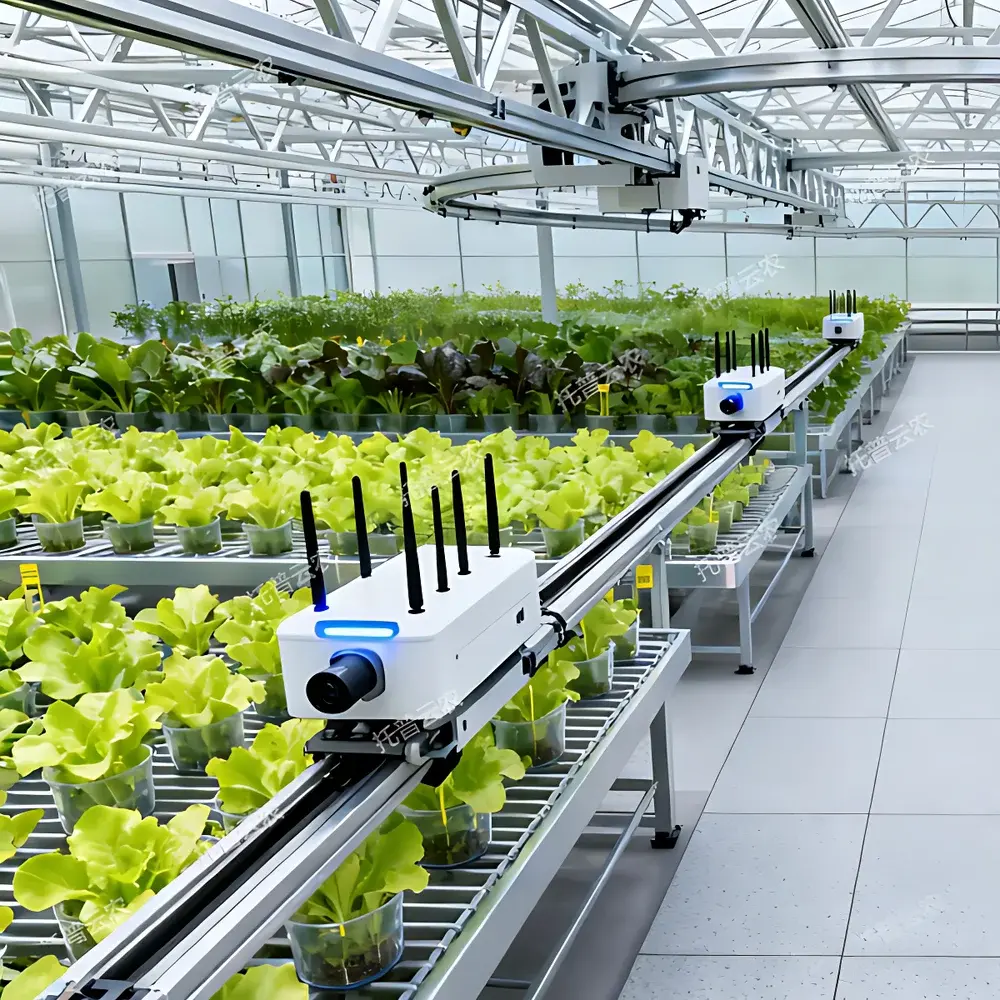
Top Cloud-agri TP-DG-1 / TP-DG-3 Greenhouse Overhead Rail-Based High-Throughput Plant Phenotyping System
| Brand | Top Cloud-agri |
|---|---|
| Origin | Zhejiang, China |
| Manufacturer Type | Direct Manufacturer |
| Product Origin | Domestic (China) |
| Model | TP-DG-1 / TP-DG-3 |
| Pricing | Available Upon Request |
Overview
The Top Cloud-agri TP-DG-1 and TP-DG-3 Greenhouse Overhead Rail-Based High-Throughput Plant Phenotyping Systems are engineered for non-destructive, longitudinal monitoring of plant morphological and physiological traits under controlled environment conditions. These systems operate on a ceiling-mounted precision rail infrastructure, enabling repeatable spatial navigation of an integrated imaging payload across defined cultivation zones. The core measurement principle combines structured visible-light photogrammetry with optional time-of-flight (ToF) LiDAR scanning—enabling synchronized acquisition of 2D spectral and 3D structural phenotypic data. Designed specifically for greenhouse and growth chamber deployments, the platform supports standardized experimental workflows aligned with FAO, CGIAR, and Plant Phenomics Consortium best practices for scalable trait quantification.
Key Features
- Overhead rail architecture with ±0.5 mm positional repeatability, supporting stable traversal at speeds up to 0.3 m/s across spans up to 30 m (customizable)
- Modular sensor payload: TP-DG-1 integrates a high-resolution RGB industrial camera (≥12 MP, global shutter, adjustable white balance and exposure); TP-DG-3 adds a Class 1 safety-certified LiDAR module (360° horizontal × 300° vertical FoV, 0.1–20 m range, <3 mm depth accuracy at 1 m)
- Autonomous mission scheduling: Predefined scan paths, time-triggered or event-driven acquisition, multi-angle image capture per plant position
- Onboard robot self-diagnostic system: Real-time monitoring of motor current, rail alignment status, battery level, and communication integrity
- Embedded edge computing unit: Executes pre-trained deep learning models for real-time segmentation and feature extraction without cloud dependency
- Environmental synchronization interface: Optional integration of calibrated sensors for air temperature, relative humidity, PAR (photosynthetically active radiation), and CO₂ concentration—timestamp-aligned with imaging data
Sample Compatibility & Compliance
The system accommodates a broad spectrum of herbaceous and semi-woody crop species—including Arabidopsis, tomato, maize, wheat, rice, lettuce, and pepper—grown in standard trays, pots, or hydroponic channels. Imaging geometry is optimized for canopy-level analysis at heights between 0.5 m and 3.0 m above substrate. All hardware complies with IEC 60825-1:2014 (laser safety), CE marking requirements for low-voltage equipment, and RoHS Directive 2011/65/EU. Data handling protocols support audit readiness for GLP-compliant trials; metadata tagging includes ISO 11783-10 compliant ontologies for plant trait descriptors.
Software & Data Management
Acquired images and point clouds are stored locally in vendor-agnostic formats: TIFF (RGB), LAS/LAZ (LiDAR), and CSV (derived metrics). The proprietary Phenolink™ software suite provides batch processing pipelines for geometric calibration, radiometric normalization, and trait extraction. Export options include Excel-compatible reports, SVG vector overlays, and HDF5 datasets for downstream integration with R (plantSeg), Python (OpenCV, scikit-image, PyTorch), or MATLAB. Role-based user access control, encrypted local storage, and configurable auto-backup intervals ensure data integrity. Audit trails record all parameter modifications, algorithm versioning, and operator login events—supporting compliance with FDA 21 CFR Part 11 requirements for electronic records.
Applications
- Quantitative assessment of growth dynamics: daily changes in projected leaf area, canopy height progression, and green fraction kinetics
- Stress phenotyping: early detection of drought-induced chlorosis via RGB hue-saturation-value (HSV) shifts or salinity-related canopy compactness loss via LiDAR-derived convex hull metrics
- Varietal screening: high-throughput comparison of architectural traits (e.g., leaf angle distribution, stem elongation rate, branching density) across mapping populations
- Controlled-environment QTL mapping: spatiotemporally resolved trait data synchronized with environmental logs for genotype × environment interaction modeling
- Algorithm validation benchmarking: ground-truth dataset generation for training and testing computer vision models targeting specific crops or stress responses
FAQ
What is the minimum and maximum operational height for the rail-mounted robot?
The system is calibrated for installation heights ranging from 0.5 m to 3.0 m above the growing surface. Final configuration requires site-specific structural assessment and rail sag compensation.
Can the TP-DG-1 be upgraded to TP-DG-3 functionality post-purchase?
Yes—hardware retrofitting is supported through certified field service. This includes mechanical mounting bracket adaptation, LiDAR power/data interface integration, and firmware/software license activation.
Does the system support integration with third-party LIMS or ELN platforms?
Yes—via RESTful API endpoints and configurable JSON/XML export templates. Pre-built connectors are available for LabVantage, Thermo Fisher SampleManager, and Benchling.
How is lighting consistency managed during RGB imaging?
The system includes programmable LED illumination modules with CCT (correlated color temperature) and intensity control, synchronized with camera exposure timing to minimize shadow artifacts and spectral drift.
Is remote monitoring and intervention possible during autonomous runs?
Yes—WIFI-enabled remote dashboard access allows live telemetry viewing, emergency stop initiation, and on-the-fly mission adjustment using any HTML5-compliant browser or dedicated mobile application.





