
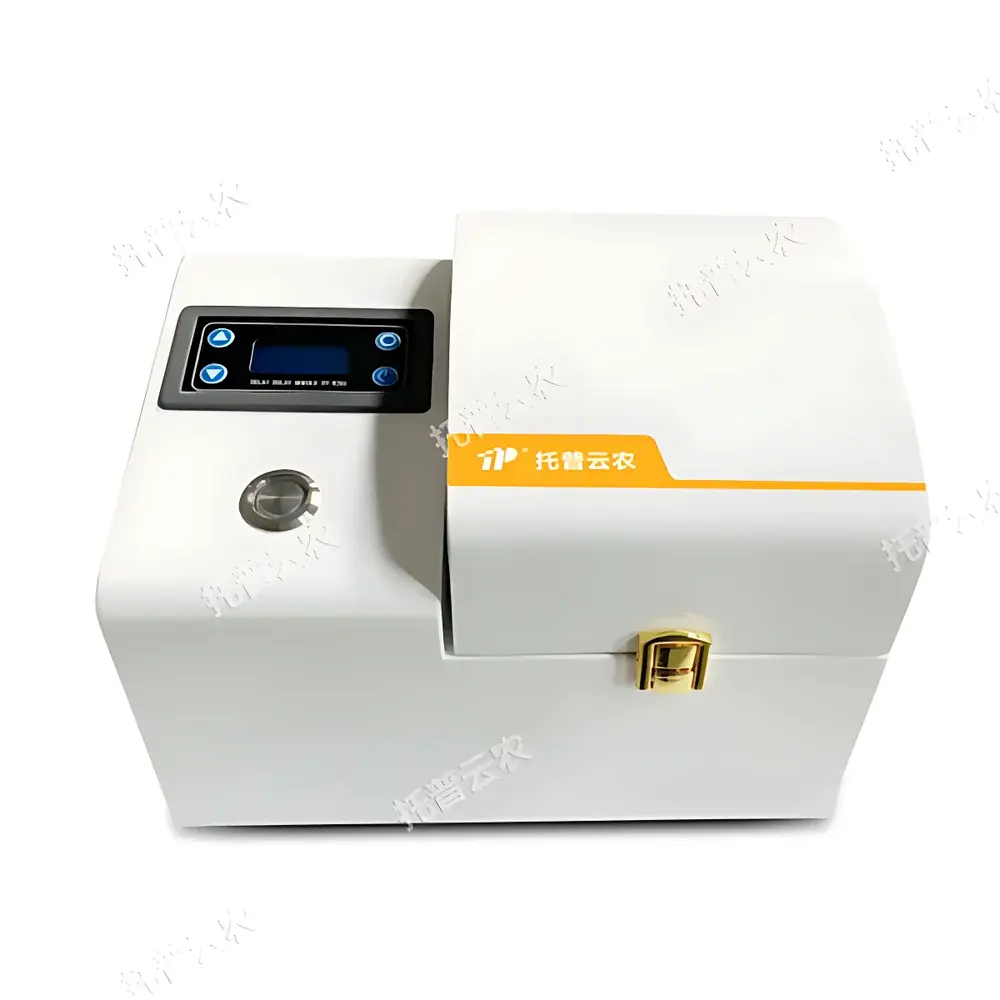
Top Cloud-agri TPD-4L Single-Seed Grinder
| Brand | Top Cloud-agri |
|---|---|
| Origin | Zhejiang, China |
| Manufacturer Type | Direct Manufacturer |
| Equipment Category | Domestic |
| Model | TPD-4L |
| Instrument Type | Benchtop Vibratory Grinder |
| Sample Applicability | Hard, Dry Biological Seeds |
| Output Particle Size | < 0.01 mm (10 µm) |
| Input Sample Size | Single seed per tube |
| Batch Capacity | 1 seed per grinding cycle |
| Dimensions | 215 × 160 × 175 mm |
| Net Weight | 2 kg |
| Grinding Time Range | 1–9999 s (adjustable in 1-s increments) |
| Tube Configurations | 6 × 2 mL or 2 × 5 mL (interchangeable fixtures included) |
| Grinding Modes | Dry grinding and wet grinding supported |
| Power Options | AC adapter (100–240 V, 50/60 Hz) and optional DC input for vehicle/mobility use |
| Standard Accessories | 200 grinding tubes + matched grinding beads (zirconia or stainless steel, size-matched to fixture) |
Overview
The Top Cloud-agri TPD-4L Single-Seed Grinder is a compact, high-precision vibratory benchtop grinder engineered specifically for the homogenization of individual intact seeds—such as rice, wheat, maize, soybean, and vegetable seeds—without cross-contamination between samples. It operates on the principle of horizontal reciprocating vibration, generating controlled mechanical energy through rapid lateral oscillation of the sample holder. This motion induces intense impact and shear forces between the seed and inert grinding media (e.g., zirconia or stainless-steel beads), resulting in efficient, reproducible cell disruption and particle size reduction down to sub-10 µm. Unlike rotary or rotor-stator grinders, the TPD-4L eliminates thermal buildup during short-duration cycles (30–120 s typical), preserving heat-sensitive biomolecules such as DNA, RNA, proteins, and metabolites. Its single-seed-per-tube architecture aligns with ISO 22000 and GLP-compliant workflows where traceability, sample integrity, and analytical repeatability are critical.
Key Features
- Single-seed processing architecture ensures absolute sample isolation—no carryover or cross-contamination between genotypes or treatment groups.
- Modular fixture system supports two standard configurations: six 2 mL tubes (optimized for small seeds like rice and barley) or two 5 mL tubes (designed for larger seeds including maize and soybean).
- Programmable grinding time (1–9999 s) with 1-second resolution enables precise method development across diverse seed hardness, moisture content, and endosperm structure.
- Integrated LCD interface with intuitive button-based navigation allows parameter setup and immediate start without software dependency—ideal for field-deployable or resource-limited lab environments.
- Dual-mode operation: dry grinding for genomic DNA extraction and wet grinding (with liquid nitrogen or buffer) for proteomic or transcriptomic applications.
- Lightweight (2 kg) and compact footprint (215 × 160 × 175 mm) facilitates transport; optional DC power input enables direct connection to vehicle batteries or portable power stations for on-site sampling in agricultural field trials.
Sample Compatibility & Compliance
The TPD-4L accommodates a broad spectrum of botanical seeds with varying physical properties—including hull thickness, starch-to-protein ratio, and moisture content—while maintaining consistent comminution efficiency. It complies with foundational requirements for sample preparation in accredited seed testing laboratories under ISTA (International Seed Testing Association) guidelines and supports upstream processing for methods aligned with AOAC 991.27 (DNA extraction from plant tissues) and ISO 20387:2018 (biobanking). All grinding tubes and beads are autoclavable and chemically inert, ensuring compatibility with downstream nucleic acid purification kits (e.g., Qiagen DNeasy, Thermo Fisher PureLink) and HPLC/GC-MS analysis. No moving parts contact the sample directly—only disposable tubes and reusable beads—minimizing maintenance and enabling full traceability per sample ID.
Software & Data Management
The TPD-4L operates as a standalone instrument with no embedded firmware requiring external software or network connectivity. All operational parameters—including time, cycle count, and fixture type—are stored locally on the device’s non-volatile memory and displayed in real time on the LCD panel. While it does not generate digital audit trails or support FDA 21 CFR Part 11–compliant electronic signatures, its deterministic manual control interface meets minimal ALCOA+ principles (Attributable, Legible, Contemporaneous, Original, Accurate) when paired with laboratory notebooks or LIMS-integrated sample tracking logs. For high-throughput environments, users may integrate the grinder into automated workflows via external programmable logic controllers (PLCs) using its TTL-level trigger port (optional accessory).
Applications
- High-fidelity genomic DNA isolation from single cereal grains for SNP genotyping and marker-assisted selection (MAS) in breeding programs.
- RNA stabilization and extraction from individual seeds prior to qRT-PCR or RNA-Seq, minimizing batch effects caused by pooled homogenization.
- Preparation of homogeneous powder for near-infrared (NIR) spectroscopy calibration models used in grain quality prediction (protein, moisture, oil content).
- Metabolite profiling via LC-MS where inter-sample contamination would compromise multivariate statistical discrimination (e.g., PCA, OPLS-DA).
- Seed health testing—grinding pathogen-infected kernels individually to isolate fungal DNA or mycotoxin residues without dilution from healthy neighbors.
FAQ
What types of seeds have been validated for use with the TPD-4L?
Rice, wheat, barley, maize, soybean, sorghum, and common vegetable seeds (e.g., tomato, pepper, lettuce) have been successfully processed. Kernel hardness and moisture content should be within natural field-harvested ranges (10–15% w.b.).
Can the TPD-4L be used for cryogenic grinding?
Yes—when equipped with pre-chilled grinding tubes and beads, and operated in ambient temperatures below 15°C, it supports low-temperature grinding. Liquid nitrogen immersion is not recommended due to condensation risks inside the chamber.
Is cleaning validation documentation available?
Cleaning procedures (tube washing, bead sonication, UV irradiation) are provided in the user manual. Full cleaning validation reports must be generated internally per ISO/IEC 17025 requirements.
Does the instrument meet electromagnetic compatibility (EMC) standards for laboratory use?
It conforms to IEC 61326-1:2013 Class B emission limits for industrial scientific equipment and has passed basic immunity testing per EN 61326-2-1.
How is calibration verified?
No periodic calibration is required—the timer accuracy is traceable to internal quartz oscillator (±0.5 s/day drift). Performance verification is conducted using reference seed batches and particle size distribution analysis (e.g., laser diffraction on ground aliquots).



