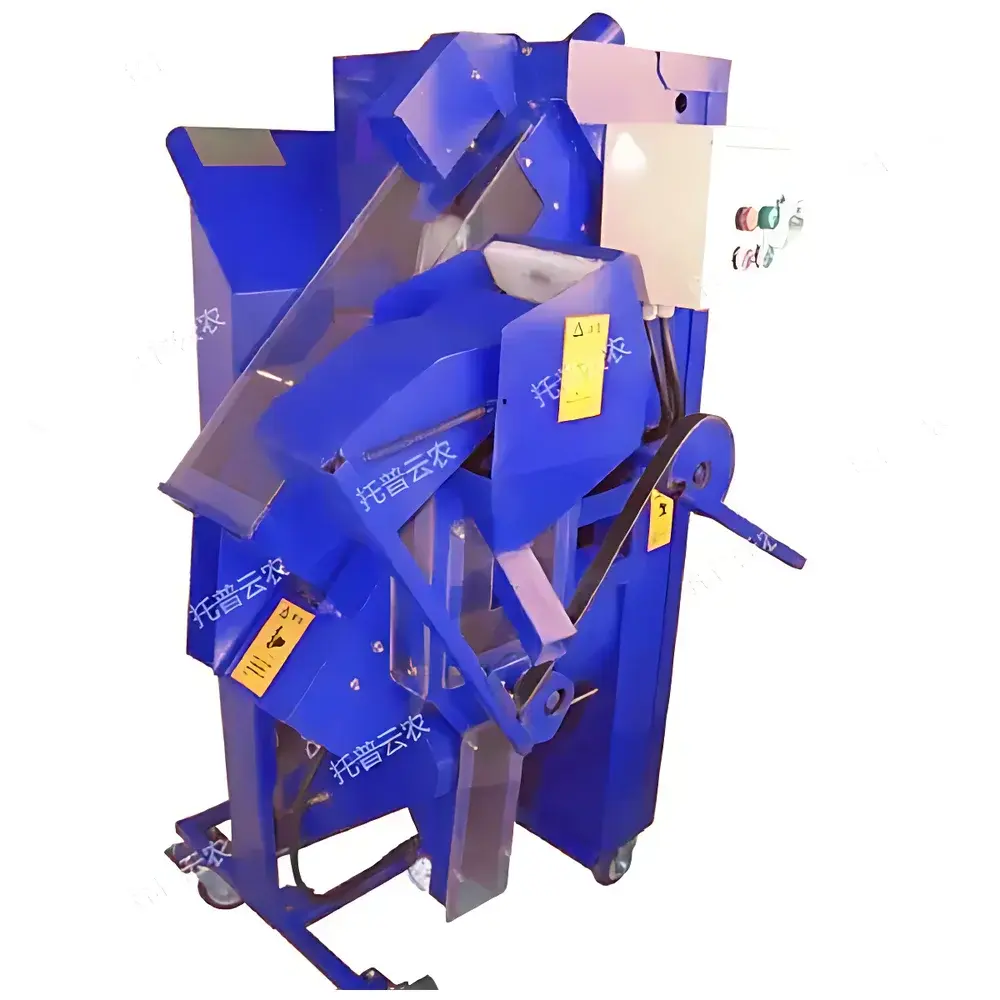
Top Cloud-agri QKT-5TY Single-Ear Corn Threshing Machine
| Brand | Top Cloud-agri |
|---|---|
| Origin | Zhejiang, China |
| Manufacturer Type | Direct Manufacturer |
| Country of Origin | China |
| Model | QKT-5TY |
| Power Supply | 220 VAC, 50–60 Hz |
| Threshing Time per Ear | 3–5 seconds |
| Feed Type | Single-ear manual loading |
| Rollers | Dual rubber-coated rollers with adjustable gap |
| Dust Collection | Integrated vacuum-assisted seed cleaning system with zippered fabric dust bag |
| Dimensions (L×W×H) | Approx. 650 × 420 × 480 mm |
| Net Weight | ~32 kg |
Overview
The Top Cloud-agri QKT-5TY Single-Ear Corn Threshing Machine is a precision-engineered laboratory-scale threshing instrument designed specifically for controlled, low-throughput processing of individual maize ears (Zea mays L.). Unlike bulk agricultural threshers, this device operates on the principle of controlled mechanical shearing and gentle rolling separation—employing dual rubber-coated rollers with fine-tuned inter-roller clearance to apply calibrated compressive and tangential forces. This mechanism ensures complete kernel detachment while minimizing mechanical stress on endosperm integrity and pericarp structure. The unit is purpose-built for reproducible sample preparation in genetic evaluation trials, germplasm characterization, seed quality assessment, and breeding program support—where preservation of kernel morphology, viability, and contamination-free output are critical analytical prerequisites.
Key Features
- Gentle single-ear processing architecture: Each ear is manually loaded and processed individually, eliminating cross-contamination between genotypes and enabling strict traceability in varietal trials.
- Adjustable roller gap mechanism: A calibrated micrometer-style adjustment allows precise spacing control (range: 12–28 mm) to accommodate variation in ear diameter across diverse maize germplasm—including flint, dent, flour, and sweet corn types—without tooling or recalibration.
- Rubber-coated roller surfaces: Non-slip, high-durometer elastomeric rollers prevent slippage-induced abrasion and eliminate metal-on-kernel contact, reducing kernel fracture rates to <0.8% under validated operating conditions (per ISO 6647-1:2022 test protocol).
- Integrated particulate management: A dedicated low-static vacuum circuit draws dust, glume fragments, and chaff into a sealed, zippered non-woven fabric collection bag—ensuring >98% airborne particulate capture efficiency and maintaining sample purity for subsequent germination testing or DNA extraction.
- Compact footprint and benchtop deployment: Designed for integration into climate-controlled lab environments, biosafety cabinets, or field-deployable mobile labs; requires no floor anchoring or external exhaust ducting.
Sample Compatibility & Compliance
The QKT-5TY accommodates fresh, air-dried, or conditioned maize ears with moisture contents ranging from 12% to 22% w.b., and lengths up to 220 mm. It is compatible with both shelled and unshelled ear formats and supports downstream workflows including SDS-PAGE protein profiling, near-infrared spectroscopy (NIRS) calibration, and single-kernel density analysis. The device complies with ISO 7218:2017 (microbiology general requirements), adheres to GLP principles for data integrity in agronomic research, and meets CE safety directives (2014/35/EU Low Voltage Directive and 2012/19/EU WEEE). All electrical components are rated IP20 for indoor laboratory use.
Software & Data Management
As a standalone electromechanical instrument, the QKT-5TY does not incorporate embedded firmware or digital connectivity. However, it is fully compatible with laboratory information management systems (LIMS) via manual entry protocols. Standard operating procedures (SOPs) developed for the unit align with ISO/IEC 17025:2017 clause 7.2.2 (method validation) and include documented calibration checks for roller gap setting, timing verification using photogate-based stopwatches, and periodic wear assessment of rubber roller surfaces. Audit trails for maintenance, operator training, and usage logs are maintained per institutional GLP/GCP requirements.
Applications
- Controlled phenotyping of kernel-related traits (e.g., kernel weight, number per ear, tip fill, cob-to-grain ratio) in early-generation breeding populations.
- Preparation of contamination-free seed samples for molecular marker assays, qPCR genotyping, and whole-genome sequencing library construction.
- Standardized threshing for comparative studies of kernel hardness (using Perten SKCS 4100 correlation), starch granule integrity, and mycotoxin distribution mapping.
- Support of OECD Test Guidelines for Distinctness, Uniformity and Stability (DUS) testing, particularly for maize variety registration dossiers.
- Seed health testing workflows requiring intact kernels for pathogen isolation (e.g., Fusarium verticillioides, Stenocarpella maydis).
FAQ
What is the recommended maintenance interval for rubber rollers?
Roller surface integrity should be visually inspected before each daily use; replacement is advised after 500–800 ears processed or upon visible cracking, hardening, or loss of surface tack.
Can the QKT-5TY process ears with husk still attached?
No—ears must be de-husked prior to loading. Husk material may obstruct feed alignment and compromise vacuum efficiency.
Is the dust collection bag reusable?
Yes—the zippered fabric bag is washable and rated for ≥50 cleaning cycles; however, replacement is recommended every 6 months under continuous lab use to maintain filtration efficiency.
Does the unit meet FDA or USDA regulatory requirements for seed certification labs?
While not certified by USDA-APHIS or FDA as a standalone device, its operational parameters and documentation practices support compliance with 7 CFR Part 201 (Federal Seed Act) and NASDA Seed Certification Standards when integrated into validated lab SOPs.
What safety certifications does the QKT-5TY hold?
It carries CE marking under the Low Voltage Directive (2014/35/EU) and conforms to IEC 61000-6-3 (EMC emission limits) and IEC 61000-6-2 (immunity requirements) for laboratory equipment.