
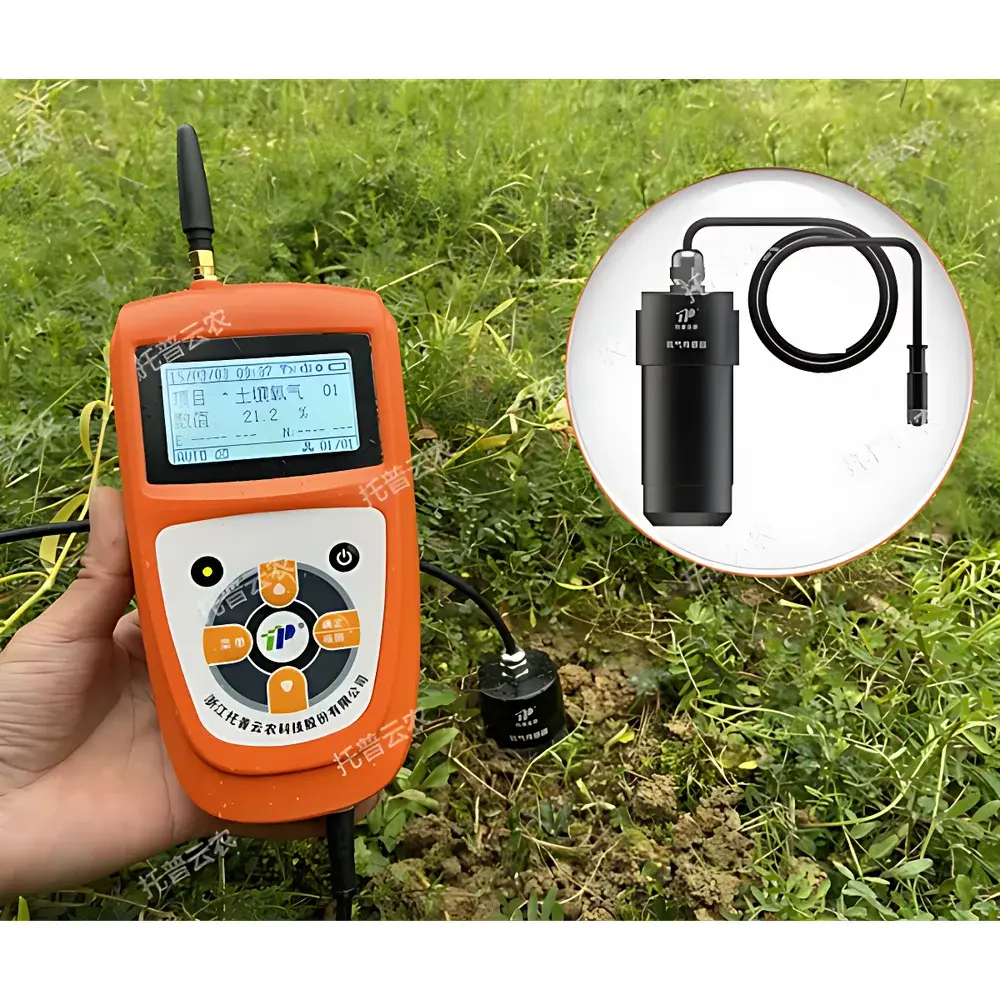
Top Cloud-agri TP-TRY Soil Oxygen Analyzer
| Brand | Top Cloud-agri |
|---|---|
| Origin | Zhejiang, China |
| Manufacturer Type | Manufacturer |
| Country of Origin | Domestic (China) |
| Model | TP-TRY |
| Instrument Type | Multi-parameter Soil Analyzer |
| Measurement Range | 0–25.00% O₂ |
| Resolution | 0.01% |
| Accuracy | ±2% FS |
| Sensor Cable Length | 2.5 m |
| Operating Temperature | −10°C to +55°C |
| Operating Humidity | 5%–98% RH |
| Data Storage | ≥30,000 entries in internal Flash |
| Logging Interval | 5 min – 99 h (user-configurable) |
| Power Supply | AC/DC dual-mode |
| Standby Current | 19 mA |
| Max Operating Current | 300 mA |
| Standby Duration | ≥18 days (with标配 battery) |
| GPS Positioning | Integrated, outputs WGS84 latitude/longitude |
| Communication | USB 2.0, 4G/5G cellular module (LTE Cat-1 or higher), Bluetooth 5.0 (optional) |
| Display | Backlit LCD with Chinese/English UI |
| IP Rating | IP68 (sensor probe) |
| Expandability | Up to 32 external sensors via IP68-rated daisy-chain interface |
| Alarm | Voice prompt (Mandarin), configurable threshold alerts |
Overview
The Top Cloud-agri TP-TRY Soil Oxygen Analyzer is a field-deployable, multi-parameter environmental monitoring instrument engineered for continuous, in-situ quantification of dissolved and gaseous oxygen concentration within the soil matrix. It operates on the principle of electrochemical amperometric sensing—utilizing a stabilized Clark-type oxygen sensor with a gas-permeable membrane and polarized cathode to generate a current proportional to partial pressure of O₂ in the surrounding soil pore space. This enables direct measurement of volumetric oxygen concentration (0–25.00% v/v), not inferred or modeled values, ensuring high reproducibility across heterogeneous soil profiles. Designed for long-term unattended operation in agroecological, ecological restoration, and biogeochemical research settings, the TP-TRY delivers real-time, time-stamped O₂ data synchronized with geospatial coordinates (WGS84), thereby enriching soil respiration datasets, validating aerobic/anaerobic boundary models, and supporting precision irrigation and carbon sequestration studies.
Key Features
- Field-rugged handheld host with backlit bilingual (Chinese/English) LCD interface displaying real-time O₂ %, timestamp, GPS coordinates, storage status, and system diagnostics.
- Configurable data logging intervals from 5 minutes to 99 hours—enabling adaptive temporal resolution for diurnal respiration cycles or seasonal monitoring campaigns.
- Integrated 4G/5G cellular telemetry module supporting automatic, encrypted data upload to cloud platform; compatible with iOS and Android mobile applications for remote access and alert notifications.
- Dual-power architecture: rechargeable 12 V / 10 Ah lithium-ion battery (≥18 days standby) plus AC/DC input—ensuring uninterrupted operation in off-grid locations.
- IP68-rated aluminum-housed oxygen probe with 2.5 m waterproof cable; corrosion-resistant, low-drift sensor design optimized for long-term burial in clay, loam, and sandy soils.
- Voice-enabled alarm system (Mandarin) with user-defined O₂ thresholds; supports audible over-limit warnings during field surveys without requiring visual interface interaction.
- Expandable modular architecture: up to 32 additional environmental sensors (e.g., soil moisture, temperature, EC, CO₂, pH) connect via standardized IP68 daisy-chain interface with automatic device enumeration.
- On-device GPS module records WGS84 latitude/longitude with each measurement—critical for spatial interpolation, GIS integration, and audit-trail compliance in regulated environmental reporting.
Sample Compatibility & Compliance
The TP-TRY is validated for use across diverse soil textures (sand, silt, clay, organic-rich histosols) and moisture conditions (5–98% RH ambient; saturated to near-field-capacity pore environments). Its amperometric O₂ sensor exhibits minimal interference from common soil gases (CO₂, CH₄, H₂S) and is unaffected by soil salinity up to 4 dS/m. While not certified to ISO/IEC 17025 for metrological traceability, the instrument conforms to functional requirements outlined in ASTM D5263–21 (Standard Guide for Soil Gas Monitoring) and supports GLP-aligned data integrity practices—including timestamped records, immutable audit logs, and user-access controls within the cloud platform. Firmware and cloud software comply with GDPR-compliant data handling protocols; raw sensor data exports are provided in CSV and JSON formats for third-party statistical analysis (R, Python, MATLAB).
Software & Data Management
The integrated cloud platform provides role-based access control (RBAC), enabling hierarchical permissions (admin, researcher, technician, viewer) for multi-site deployments. Historical data is visualized via interactive time-series plots (line/bar charts), statistical summaries (min/max/mean per interval), and comparative analytics (week-over-week, season-over-season). The system supports automated anomaly detection using configurable O₂ deviation thresholds and preloaded crop-specific respiration baselines (e.g., maize, rice, wheat). Remote sensor calibration offset adjustment is available via secure HTTPS API; firmware updates are delivered over-the-air (OTA). All data transfers employ TLS 1.2+ encryption; local backups may be exported via USB or microSD card in ISO-standard compliant formats suitable for regulatory submission (e.g., EPA Method 8260D auxiliary metadata tagging).
Applications
- Soil respiration flux modeling and carbon cycle assessment in agricultural and forest ecosystems.
- Evaluation of soil aeration status for optimizing tillage practices, drainage infrastructure, and cover cropping strategies.
- Monitoring root-zone O₂ dynamics in controlled-environment agriculture (CEA) and hydroponic substrate systems.
- Bioremediation site assessment—tracking aerobic degradation efficiency of petroleum hydrocarbons or chlorinated solvents.
- Microbial ecology studies correlating O₂ gradients with nitrifier/denitrifier community composition (via qPCR or sequencing integration).
- Long-term ecological research (LTER) networks requiring interoperable, FAIR-compliant (Findable, Accessible, Interoperable, Reusable) soil gas datasets.
FAQ
What measurement principle does the TP-TRY use for soil oxygen detection?
It employs an electrochemical amperometric (Clark-type) sensor with a gas-permeable membrane and polarized cathode, delivering direct volumetric % O₂ readings based on diffusion-limited current response.
Is the sensor suitable for submerged or waterlogged soil conditions?
Yes—the IP68-rated probe is rated for continuous burial in saturated soils; however, measurements reflect interstitial gas-phase O₂ concentration, not aqueous-dissolved O₂.
Can the device operate without cellular connectivity?
Yes—local data logging continues autonomously; uploads resume automatically upon network reconnection, with no data loss.
Does the platform support FDA 21 CFR Part 11 compliance?
The cloud platform offers electronic signature capability, audit trails, and role-based access—but formal Part 11 validation requires site-specific implementation and IQ/OQ documentation.
How is sensor calibration performed?
Two-point calibration (0% N₂ and ambient air at 20.95% O₂) is supported via platform interface; field recalibration kits (certified gas standards) are available as optional accessories.
Related Products







