
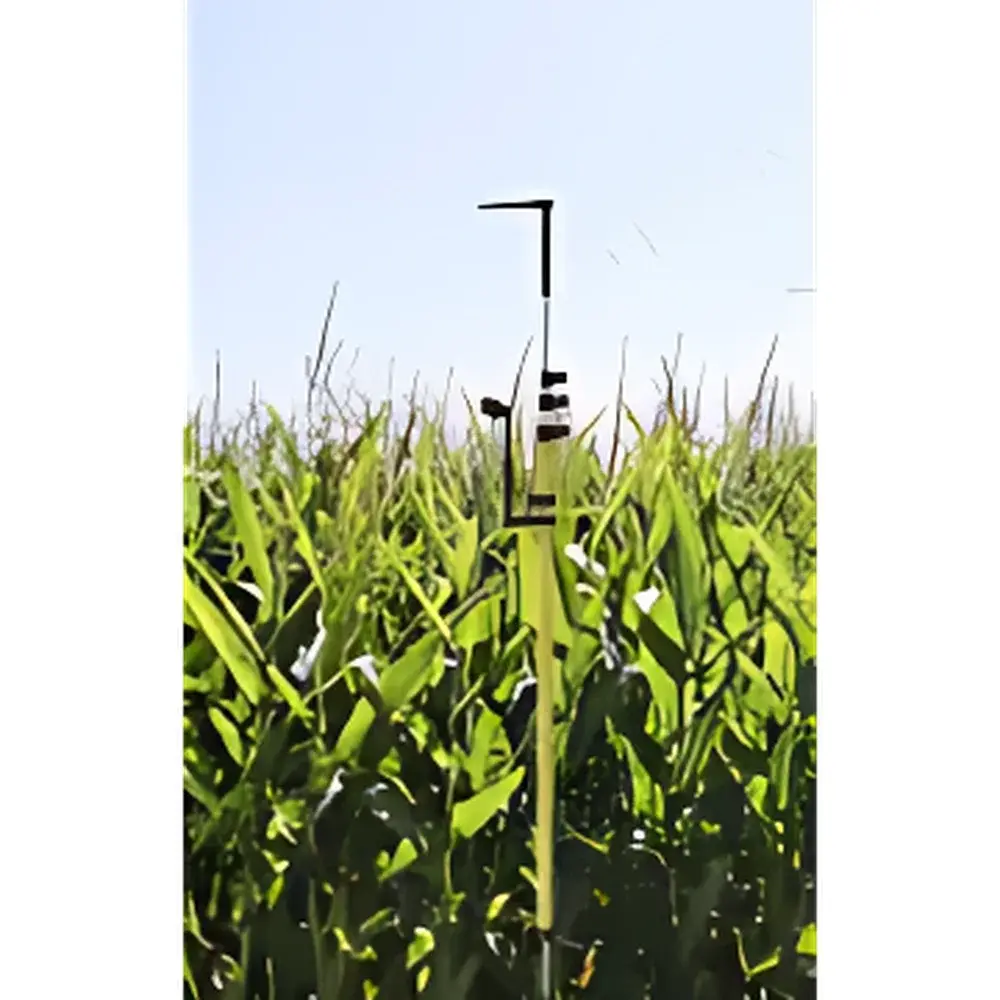
Top Cloud-agri TPYM-G-1 Portable Plant Height Measurement System for Maize Phenotyping
| Brand | Top Cloud-agri |
|---|---|
| Origin | Zhejiang, China |
| Manufacturer Type | Direct Manufacturer |
| Country of Origin | China |
| Model | TPYM-G-1 |
| Pricing | Available Upon Request |
| Height Measurement Range | 300–3800 mm |
| Resolution | 1 mm |
| Accuracy | ±0.5% of reading |
| Response Time | <1 s |
| Onboard Storage Capacity | 200 measurement records |
| Power Supply | Rechargeable Li-ion battery |
| Operating Duration | 3–4 hours continuous use |
| Host Dimensions | 136 × 54 × 90 mm (L×D×H) + 118 × 47 × 80 mm (L×D×H) |
| Extension Pole Length | Adjustable from 1600 to 3800 mm |
| Host Weight | 1.21 kg |
| Display | 3.5-inch full-color LCD |
| Data Export | USB flash drive (Excel .xlsx format) |
| Protection Features | Operational error prevention, user-initiated database backup and reset |
Overview
The Top Cloud-agri TPYM-G-1 Portable Plant Height Measurement System is a field-deployable, vision-based phenotyping instrument engineered for rapid, non-destructive quantification of plant height and ear insertion height (ear height or穗位) in maize and other erect-stemmed crops. It operates on the principle of calibrated monocular computer vision: a high-resolution CMOS camera captures real-time images of a dual-reference scale bar aligned vertically alongside the plant stem; embedded onboard image processing algorithms detect scale bar features and compute pixel-to-millimeter mapping to determine absolute height with sub-millimeter resolution. Unlike manual tape-based methods or time-intensive laser triangulation systems, the TPYM-G-1 delivers repeatable measurements within one second—enabling high-throughput field phenotyping under variable lighting and wind conditions. Designed specifically for breeding programs targeting ideotype development, canopy architecture optimization, and drought-responsive trait screening, the system supports both single-plant and plot-level height profiling without requiring fixed infrastructure or external power sources.
Key Features
- Field-optimized portability: Total system weight is 1.21 kg for the host unit alone; the telescoping carbon-fiber pole (1600–3800 mm adjustable length) enables stable vertical alignment across diverse canopy heights without tripods or ground anchors.
- Dual-parameter measurement mode: Switch seamlessly between plant height (ground-to-apex) and ear height (ground-to-first ear node) via intuitive touchscreen interface—critical for evaluating lodging resistance and harvest index in maize breeding trials.
- Integrated human-machine interface: 3.5-inch sunlight-readable color LCD provides real-time preview, measurement confirmation, and historical record review; audible feedback confirms successful data capture to minimize operator error.
- Self-contained data workflow: All measurements are timestamped, geotagged (optional GPS module integration), and stored locally in non-volatile memory; no Bluetooth pairing or smartphone dependency required for core operation.
- Battery-powered autonomy: High-capacity rechargeable lithium-ion battery supports ≥3.5 hours of continuous field use per charge; USB-C charging compatibility ensures interoperability with standard lab power supplies and portable power banks.
- Robust mechanical architecture: IP54-rated enclosure protects internal optics and electronics against dust ingress and incidental water exposure during rain or dew-laden morning measurements.
Sample Compatibility & Compliance
The TPYM-G-1 accommodates monocot and dicot species with upright growth habits and minimal leaf occlusion at the stem base—including Zea mays (maize), Oryza sativa (rice), Triticum aestivum (wheat), Brassica napus (oilseed rape), Sesamum indicum (sesame), Glycine max (soybean), Sorghum bicolor (sorghum), and Gossypium hirsutum (upland cotton). Its 300–3800 mm operational range covers juvenile seedlings through mature tasseling stages. While not certified to ISO/IEC 17025 for metrological traceability, the system’s ±0.5% accuracy aligns with ASTM E29-23 guidelines for significant digit reporting in agricultural field instrumentation. Data export in native Excel (.xlsx) format facilitates downstream statistical analysis in R, SAS, or JMP environments compliant with GLP documentation standards.
Software & Data Management
Measurements are stored internally as structured CSV metadata files containing plant ID, date/time stamp, GPS coordinates (if enabled), height value (mm), measurement mode flag (height/ear height), and operator ID. The included USB-A flash drive serves as a secure, air-gapped transfer medium—eliminating wireless transmission vulnerabilities and ensuring compatibility with offline laboratory networks subject to IT security policies. Optional cloud synchronization via Top Cloud-agri’s web-based Phenotype Data Hub (accessible via desktop browser or iOS/Android app) supports role-based access control, audit trail logging per FDA 21 CFR Part 11 Annex 11 requirements, and automated backup to encrypted S3 storage. Local database management allows selective record deletion, batch export, and integrity verification via SHA-256 hash checksums.
Applications
- Maize breeding programs assessing ideotype selection criteria including optimal plant height, ear height uniformity, and internode elongation patterns under nitrogen-limited or drought-stressed conditions.
- Phenotypic validation of CRISPR/Cas9-edited lines targeting dwarfing genes (e.g., d8, d9, br2) where sub-centimeter height differentials must be resolved across large segregating populations.
- Multi-location trial coordination: Standardized height acquisition across geographically dispersed sites using identical calibration protocols and firmware versions ensures inter-site data comparability.
- Teaching laboratories in plant science curricula demonstrating quantitative trait locus (QTL) mapping principles through hands-on field measurement and variance component analysis.
- Smart agriculture service providers deploying mobile phenotyping units for contract phenotyping services under ISO 9001-certified quality management systems.
FAQ
What calibration procedures are required before field deployment?
The TPYM-G-1 performs factory calibration using NIST-traceable gauge blocks; users conduct a quick visual verification check using the supplied reference scale before each measurement session—no field recalibration is necessary.
Can the device measure plants with overlapping canopies or dense foliage?
Optimal accuracy requires unobstructed vertical visibility of the stem base and apical meristem; users should gently part leaves or select representative tillers in high-density stands to ensure clear scale bar alignment.
Is firmware upgradable in the field?
Yes—firmware updates are delivered via USB flash drive and installed through the onboard menu; version history and changelogs are published on Top Cloud-agri’s technical support portal.
Does the system support integration with third-party LIMS or breeding management software?
Raw Excel exports are compatible with common BMS platforms (e.g., BreedBase, FieldBook, Agrobase); API-based integration is available under enterprise licensing agreements.
What environmental conditions limit operational reliability?
Performance may degrade under direct midday sun causing lens flare or in sustained rainfall (>10 mm/h); however, the IP54 rating permits continued operation in light drizzle and high-humidity field environments typical of subtropical maize-growing regions.





