
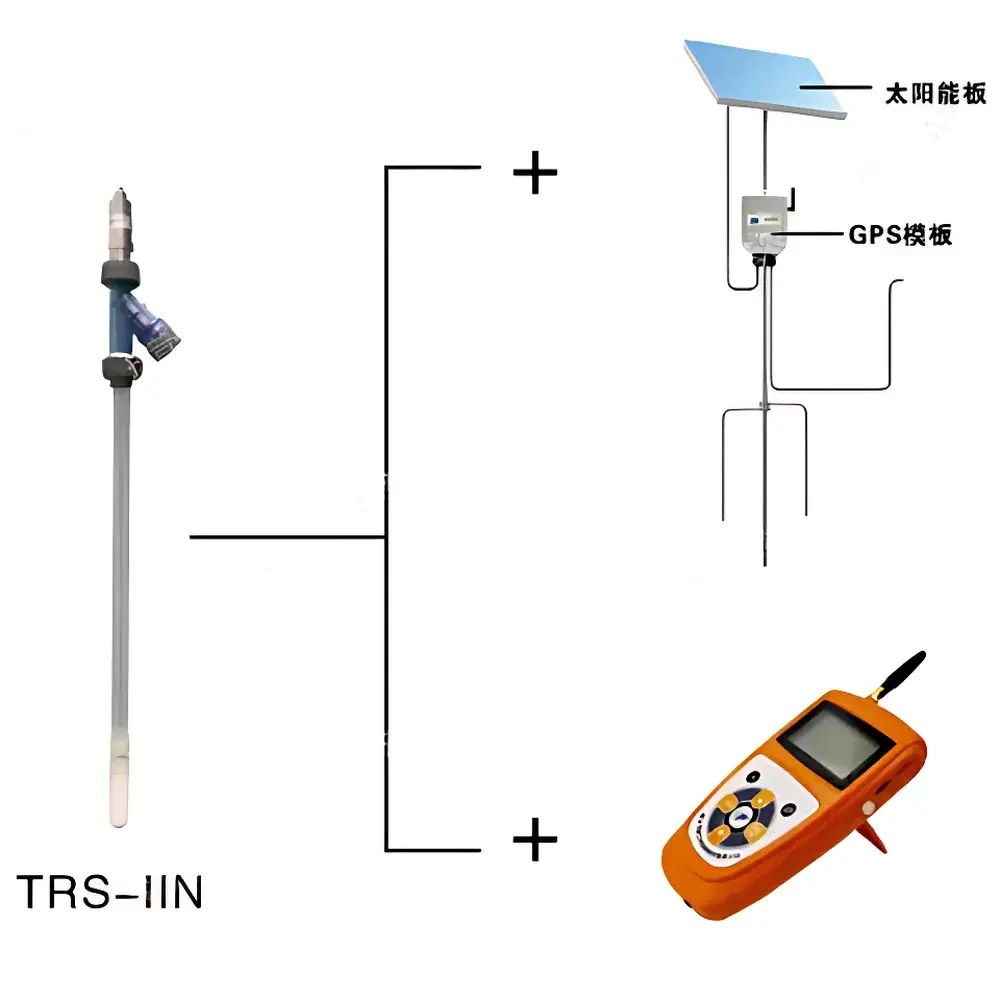
Top Cloud-agri TRS-IIN Soil Water Potential and Temperature Logger
| Brand | Top Cloud-agri |
|---|---|
| Origin | Zhejiang, China |
| Manufacturer Type | Direct Manufacturer |
| Country of Origin | Domestic (China) |
| Model | TRS-IIN |
| Instrument Type | Soil Water Potential & Temperature Analyzer |
| Power Supply | Dual AC/DC with 7.4 V / 2.8 Ah Rechargeable Lithium Battery |
| Data Transmission | Integrated GPRS Module |
| GPS | Built-in GNSS Positioning |
| Storage | 30,000 records in internal Flash + expandable 4 GB microSD card |
| Sampling Interval | 5 min to 99 h |
| Measurement Time per Sample | ≤2 s |
| Water Potential Range | 0 to –100 kPa |
| Water Potential Resolution | 0.01 kPa |
| Water Potential Accuracy | ±0.25 kPa or ±0.5% F.S. (whichever is greater) |
| Response Time (Water Potential) | 30 s |
| Soil Temperature Range | –55 °C to +150 °C |
| Soil Temperature Accuracy | ±0.5 °C |
| Soil Temperature Sensor Length | 20 cm |
| Display | Dot-matrix LCD with full Chinese menu interface |
| Connectivity | 32-channel expandable sensor interface with auto-detection |
| Software Platform | Web- and mobile-compatible cloud management platform (C/S architecture), supports data visualization, export (CSV, PDF), reporting, audit trail, and over-the-air firmware updates |
| Compliance | Designed for long-term unattended field deployment |
Overview
The Top Cloud-agri TRS-IIN Soil Water Potential and Temperature Logger is a fixed-deployment environmental monitoring instrument engineered for continuous, autonomous measurement of two critical soil physical parameters: matric water potential (expressed in kilopascals, kPa) and soil temperature (°C). It operates on the principle of thermocouple psychrometry—where the vapor pressure deficit across a porous ceramic or polymer matrix is quantified via precise thermoelectric sensing—to deliver high-reproducibility water potential readings under variable field conditions. Unlike transient tensiometric methods, the TRS-IIN employs a solid-state, low-drift sensor architecture optimized for long-term stability in heterogeneous soils across agricultural, ecological, and hydrological research applications. Its integrated dual-sensing capability eliminates the need for co-located but independent instruments, reducing spatial uncertainty and installation complexity. Designed for permanent outdoor installation, the device features solar-assisted charging, IP67-rated housing, and embedded GNSS for geotagged data provenance—ensuring traceability required in regulatory monitoring and peer-reviewed field studies.
Key Features
- Simultaneous, synchronized acquisition of soil water potential (0 to –100 kPa) and temperature (–55 °C to +150 °C) with calibrated accuracy of ±0.25 kPa and ±0.5 °C respectively
- Dual power architecture: rechargeable 7.4 V / 2.8 Ah lithium battery with intelligent charge protection, low-voltage warning, and AC adapter compatibility for extended off-grid operation
- On-device data management: 30,000-record internal Flash memory plus user-expandable 4 GB microSD card; supports timestamped, GPS-georeferenced storage with automatic rollover and power-fail resilience
- Real-time GNSS positioning: captures and logs latitude/longitude coordinates at each sampling event, enabling spatial interpolation and GIS integration
- Voice alert system with Mandarin speech synthesis: configurable threshold-based audio alarms for out-of-range water potential or temperature values, including direct numeric readout of measured parameters
- Modular sensor interface: auto-detecting 32-channel expansion port supporting up to six simultaneous soil probes (e.g., one TRS-IIN host with four or six distributed sensors); cross-compatible with other Top Cloud-agri environmental sensors
- Intuitive human-machine interface: backlit dot-matrix LCD with full Chinese menu navigation, real-time clock display, remaining storage count, and battery status indicator
Sample Compatibility & Compliance
The TRS-IIN is validated for use in mineral soils, loams, sandy and clayey textures, and organic-rich substrates—including peat and compost—provided the ceramic or polymer moisture sensor is fully hydrated and in intimate contact with the surrounding matrix. It is not intended for saturated-zone (positive pore-water pressure) or highly saline environments (>10 dS/m EC) without empirical calibration correction. While not certified to ISO/IEC 17025 as a standalone metrological standard, its measurement protocol aligns with ASTM D4318 (Standard Test Methods for Liquid Limit, Plastic Limit, and Plasticity Index of Soils) and FAO’s guidelines for soil water monitoring in irrigation scheduling. The device supports GLP-compliant data handling through immutable time stamps, GPS metadata, and non-volatile local storage—features essential for audit readiness in federally funded agronomic trials and environmental impact assessments.
Software & Data Management
Data from the TRS-IIN is transmitted via embedded GPRS to the Top Cloud-agri Instrument Cloud Platform—a secure, browser-accessible C/S architecture supporting both desktop and mobile clients (iOS and Android). The platform provides role-based access control, customizable dashboards, multi-parameter trend visualization, and automated report generation (PDF/CSV/Excel). All uploaded records retain original timestamps, sensor IDs, and GNSS coordinates. Audit-trail functionality logs user actions, configuration changes, and firmware updates. Data exports include raw time-series tables, annotated graphs, and summary statistics (min/max/mean/std dev). The platform adheres to data sovereignty principles: hosted on ISO 27001-certified infrastructure with optional on-premise deployment for institutional compliance with national data residency regulations. Firmware updates are delivered over-the-air with version-controlled rollback capability.
Applications
- Irrigation scheduling and deficit irrigation optimization in precision agriculture
- Root-zone drought stress monitoring for crop phenotyping and breeding programs
- Soil hydrological modeling input (e.g., HYDRUS, SWAP) requiring high-temporal-resolution matric potential data
- Long-term ecological research (LTER) sites tracking seasonal and interannual soil moisture dynamics
- Landfill cover system performance evaluation and capillary barrier design validation
- Educational field labs requiring robust, student-operable instrumentation with cloud-based data sharing
FAQ
What is the operating principle of the water potential sensor?
The TRS-IIN uses thermocouple psychrometry: a temperature-controlled thermopile measures the differential cooling effect caused by water vapor diffusion across a semi-permeable membrane in equilibrium with soil moisture—converting vapor pressure deficit into kPa.
Can the device be deployed in frozen soils?
Yes—the temperature sensor remains functional down to –55 °C, though water potential measurements below 0 °C require interpretation within the context of unfrozen water content and should be cross-validated with dielectric methods where ice formation dominates.
Is the cloud platform compliant with FDA 21 CFR Part 11 or EU Annex 11?
While the platform implements electronic signature support, audit trails, and data encryption, formal validation for regulated pharmaceutical or clinical trial use requires site-specific IQ/OQ/PQ documentation; it is primarily designed for environmental science and agricultural research workflows.
How is sensor calibration maintained over multi-year deployments?
Factory calibration is traceable to NIST-standard humidity references. Field recalibration is performed using saturated salt solutions (e.g., LiCl, MgCl₂) at known water potentials; the device supports user-initiated offset adjustment via the onboard menu.
Does the system support MQTT or Modbus protocols for integration with SCADA or IoT edge gateways?
Native support is limited to GPRS HTTP(S) POST to the vendor cloud. Custom API access and protocol translation (e.g., MQTT bridge) are available under enterprise licensing agreements with documented RESTful endpoints and JSON schema specifications.







