
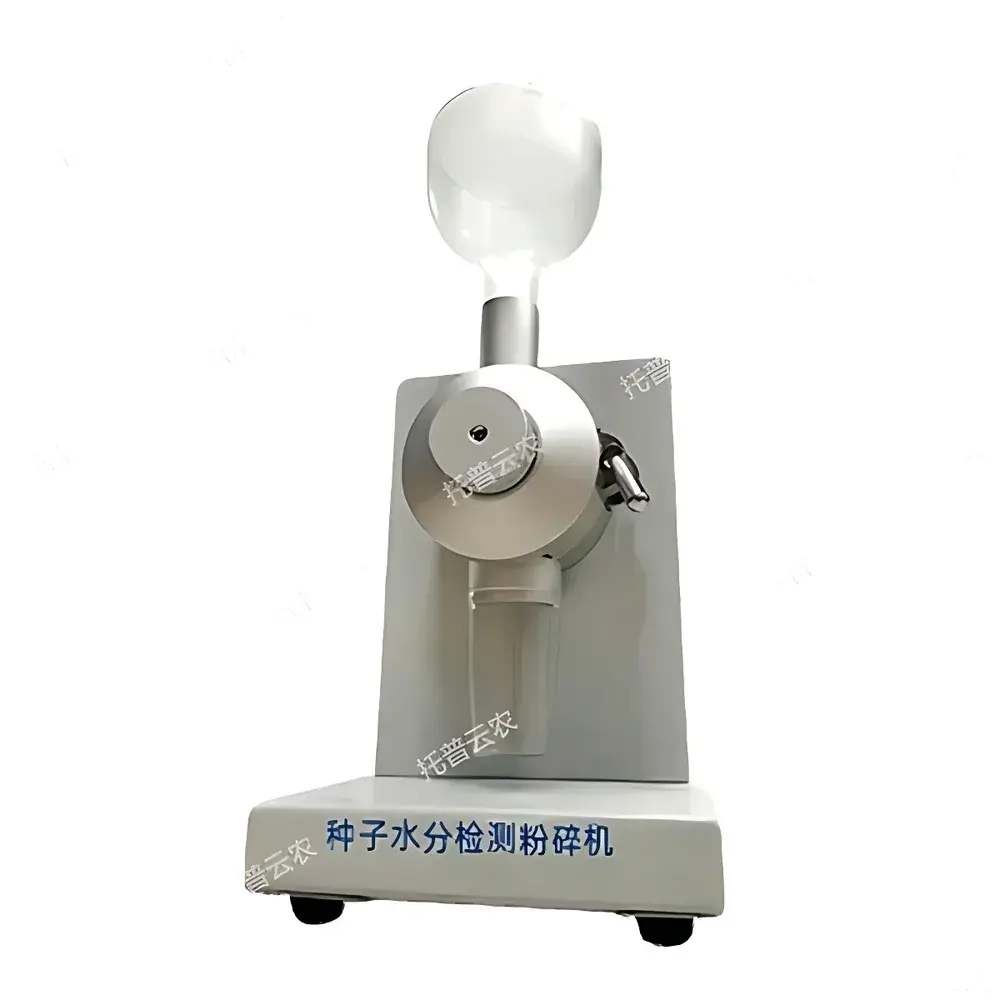
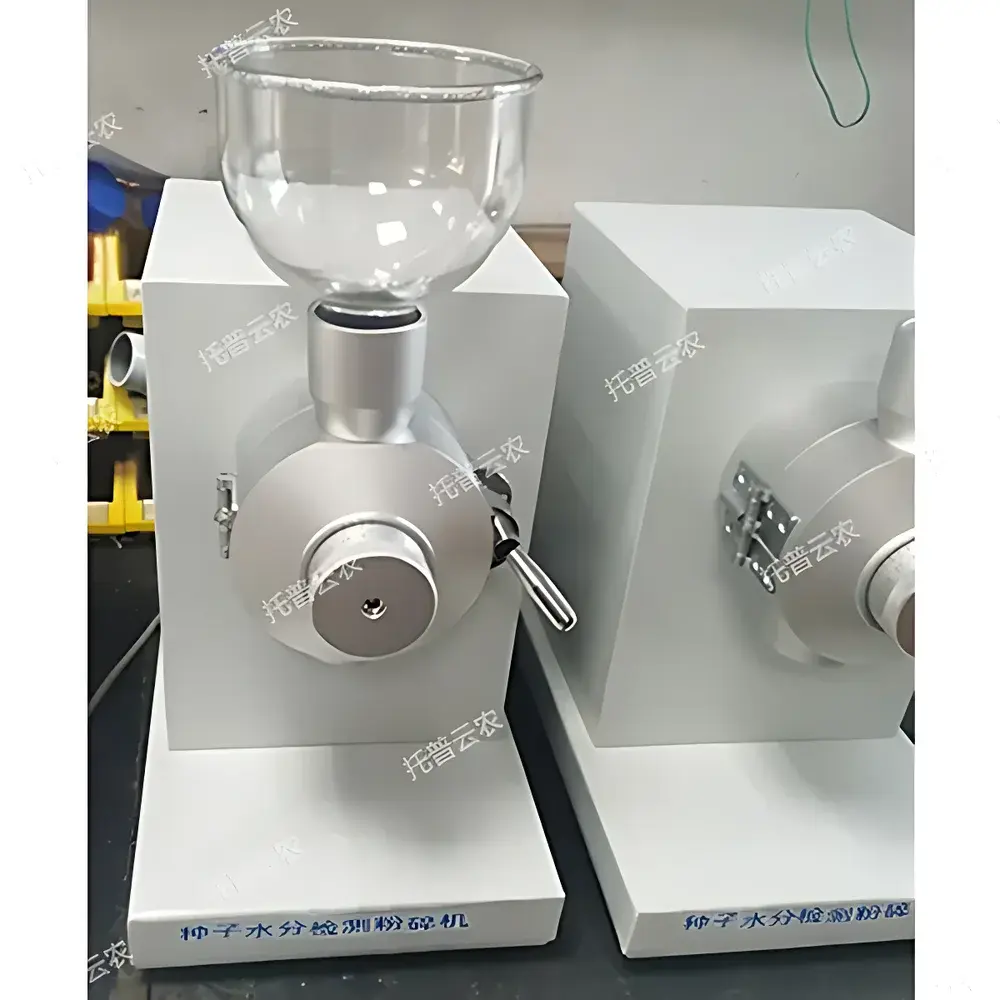
Top Cloud-agri JSFM-II Seed Moisture Grinding Mill
| Brand | Top Cloud-agri |
|---|---|
| Origin | Zhejiang, China |
| Manufacturer Type | Direct Manufacturer |
| Country of Origin | China |
| Model | JSFM-II |
| Price | Upon Request |
| Grinding Disc Diameter | Φ80 mm |
| Throughput Capacity | 300 g/min |
| Operating Noise Level | <68 dB(A) |
| Adjustable Grinding Gap | 20-position precision dial |
| Maximum Sample Moisture Content | ≤17% (w.b.) |
| Collection Cup Capacity | ≥200 g |
| Power Supply | 220 V, 50 Hz |
| Hopper Inlet Diameter | 128 mm |
| Particle Size Distribution | ≥98% passing through 1.0 mm sieve |
Overview
The Top Cloud-agri JSFM-II Seed Moisture Grinding Mill is a purpose-built laboratory grinding instrument engineered specifically for the preparation of homogenous, representative grain and seed samples prior to moisture content determination in accordance with standardized agricultural testing protocols. It operates on a high-precision counter-rotating disc milling principle—utilizing hardened serrated grinding plates—to achieve controlled mechanical size reduction without inducing thermally driven moisture loss. Unlike general-purpose grinders, the JSFM-II integrates thermal management design (low-friction geometry, optimized rotational inertia, and short-duty-cycle operation) to maintain sample integrity during comminution, ensuring that measured moisture values reflect true equilibrium conditions rather than artifactually reduced levels caused by localized heating or prolonged exposure. This makes it an essential pre-analytical tool for accredited seed testing laboratories operating under ISO/IEC 17025, ISTA, AOSA, and national seed quality control frameworks.
Key Features
- Thermally neutral grinding architecture: Engineered to minimize frictional heat generation, preserving native moisture content throughout the entire grinding cycle.
- 20-step micrometer-adjustable grinding gap: Enables precise, repeatable control over particle size distribution—from coarse conditioning to fine milling—without requiring tool changes or recalibration.
- Hermetically sealed grinding chamber and integrated collection cup: Eliminates cross-contamination and residual sample carryover; facilitates rapid, residue-free cleaning between batches.
- High-throughput capability: Consistently delivers ≥300 g/min throughput for cereal grains, oilseeds, legumes, and grass seeds while maintaining compliance with ASTM D4442 and ISO 4851 moisture sampling guidelines.
- Acoustically optimized enclosure: Meets laboratory ambient noise requirements (<68 dB[A]) for continuous use in shared analytical spaces without disrupting adjacent instrumentation or personnel.
- Dual-sieve performance verification: Delivers reproducible particle size profiles—≥98% <1.0 mm, ≥90% <0.5 mm, ≥80% <425 µm—ensuring uniform packing density and consistent drying kinetics during subsequent oven-drying or NIR moisture analysis.
Sample Compatibility & Compliance
The JSFM-II accommodates a broad spectrum of agricultural commodities including but not limited to wheat, rice, maize, soybean, barley, oats, sorghum, sunflower, canola, and alfalfa seeds. Its feed hopper (128 mm diameter) accepts whole, unshelled, or lightly dehulled materials within the specified moisture limit (≤17% w.b.), preventing clogging and ensuring laminar flow into the grinding zone. The instrument conforms to the physical sample preparation requirements outlined in ISO 6540 (Grain—Determination of moisture content—Reference method), ISTA Rules Section 5 (Moisture Content Testing), and GB/T 3543.6–1995 (China National Standard for Seed Testing—Moisture Determination). All contact surfaces are constructed from food-grade stainless steel (AISI 304), meeting hygiene criteria for regulated seed certification workflows.
Software & Data Management
As a standalone mechanical grinding system, the JSFM-II does not incorporate embedded firmware or digital interfaces. However, its deterministic mechanical design ensures full traceability when integrated into GLP-compliant laboratory information management systems (LIMS). Operators record grinding parameters—including gap setting, batch ID, operator code, and timestamp—manually or via barcode-scanned entry into validated electronic notebooks. The 20-position dial provides auditable, non-volatile setting retention, supporting FDA 21 CFR Part 11-compliant audit trails when paired with appropriate documentation practices. Routine preventive maintenance logs (e.g., disc wear inspection, torque calibration, seal integrity checks) are aligned with ISO/IEC 17025 clause 6.4.10.
Applications
- Preparation of test samples for gravimetric moisture analysis (oven-dry method per ISO 6540 or AOAC 950.46).
- Homogenization of heterogeneous seed lots prior to near-infrared (NIR) spectroscopic moisture calibration modeling.
- Standardized milling for germination testing substrates where particle size influences water absorption kinetics.
- Feedstock conditioning for reference material production in inter-laboratory proficiency testing schemes.
- Supporting regulatory submissions to national seed certification agencies (e.g., USDA APHIS, China National Agro-Tech Extension and Service Center).
FAQ
What is the maximum allowable moisture content for samples processed in the JSFM-II?
Samples must not exceed 17% wet-basis moisture content to ensure consistent feeding, avoid disc slippage, and prevent condensation-induced adhesion within the grinding chamber.
Is the grinding gap calibrated to a traceable standard?
Yes—the 20-position adjustment dial corresponds to defined axial displacements verified during factory calibration against NIST-traceable micrometers; calibration certificates are supplied with each unit.
Can the JSFM-II be used for oilseed crushing prior to oil extraction assays?
It is not designed for oil expression; however, it reliably produces uniformly sized particles suitable for Soxhlet or ASE-based lipid extraction protocols where particle morphology affects solvent penetration efficiency.
How often should the grinding discs be replaced?
Under normal use (≤2 hours/day, average grain hardness), disc service life exceeds 1,500 operational hours; visual inspection for serration wear and periodic particle size verification using certified sieves are recommended every 200 hours.
Does the instrument comply with electrical safety standards for international deployment?
It meets IEC 61000-6-3 (EMC Emission) and IEC 61000-6-2 (Immunity), and carries CE marking for EMC Directive 2014/30/EU; voltage compatibility for 220 V / 50 Hz operation is fixed and not auto-switching.






