
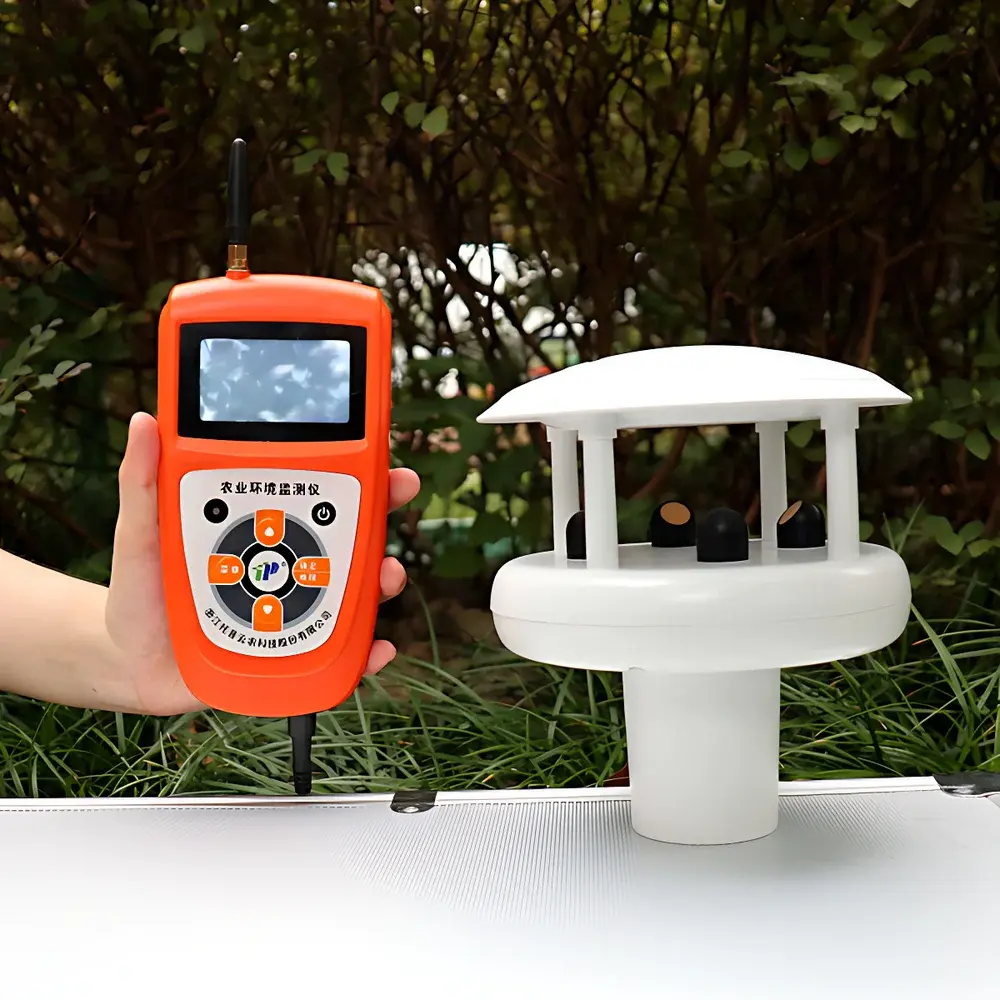
Top Cloud-agri TPJ-30-G Ultrasonic Anemometer & Wind Vane
| Brand | Top Cloud-agri |
|---|---|
| Origin | Zhejiang, China |
| Manufacturer Type | OEM/ODM Manufacturer |
| Country of Origin | China |
| Model | TPJ-30-G |
| Instrument Type | Ultrasonic Anemometer |
| Wind Speed Range | 0–60 m/s |
| Wind Direction Range | 0–360° |
| Wind Speed Accuracy | ±2% of reading (≥1 m/s) |
| Wind Direction Accuracy | ±3° |
| Wind Speed Resolution | 0.1 m/s |
| Wind Direction Resolution | 1° |
| Startup Wind Speed | ≤0.8 m/s |
| Drift Stability | <0.2 m/s per year |
| Data Storage | 30,000 records in internal Flash + optional 4 GB microSD card |
| Communication | 5G/4G cellular uplink |
| Power Supply | 7.4 V / 2.8 Ah Li-ion battery (with charge protection & low-voltage alert) + 8.4 V DC external input (≥1000 mA) |
| Operating Current | 3 mA (standby), variable under active measurement |
| GPS Integration | Built-in GNSS module (GPS+GLONASS) for geotagged data logging |
| Environmental Rating | IP67-rated sensor head and extension cable |
| Expandability | Up to 32 analog/digital sensors via daisy-chained IP67 junction box |
| Software Platform | Cloud-based C/S architecture with web and mobile (iOS/Android) clients |
Overview
The Top Cloud-agri TPJ-30-G Ultrasonic Anemometer & Wind Vane is a compact, field-deployable environmental sensing instrument engineered for continuous, non-mechanical measurement of wind speed and direction using time-of-flight ultrasonic transit-time differential principles. Unlike cup-and-vane or hot-wire anemometers, this device employs four precisely aligned transducer pairs arranged in orthogonal geometry. By measuring the reciprocal propagation times of ultrasonic pulses along two perpendicular axes—accounting for both wind-induced acceleration and deceleration—the system calculates horizontal wind vector components with high temporal resolution and zero moving-part wear. Designed for long-term unattended operation in outdoor environments, it delivers calibrated digital outputs compliant with IEC 61000-6-2 (EMC immunity) and IEC 60529 (IP67 ingress protection for sensor housing). Its integrated GNSS receiver enables automatic georeferencing of every recorded sample, ensuring traceable spatial metadata essential for meteorological validation, microclimate modeling, and regulatory reporting.
Key Features
- Ultrasonic measurement principle eliminating mechanical inertia, bearing degradation, and icing-related failure—ideal for low-wind and sub-zero deployments.
- Dual-mode power architecture: rechargeable 7.4 V / 2.8 Ah lithium-ion battery with intelligent charge management and low-voltage warning; compatible with regulated 8.4 V DC external supply (≥1000 mA).
- Cellular 5G/4G LTE-M connectivity enabling secure, encrypted data transmission to cloud infrastructure without local gateway hardware.
- On-device 30,000-sample Flash memory buffer plus support for removable 4 GB microSD cards for extended offline storage—critical for remote sites with intermittent network coverage.
- Integrated GNSS module (GPS + GLONASS) providing real-time latitude, longitude, altitude, and UTC timestamp synchronized to each wind vector record.
- Expandable sensor ecosystem: supports up to 32 additional environmental sensors—including temperature, humidity, solar radiation, CO₂, and soil moisture—via ruggedized IP67-rated daisy-chain interface.
- Configurable audio feedback: programmable Chinese Mandarin voice prompts for status alerts, measurement confirmation, and user-defined threshold breaches (e.g., wind gust exceedance).
- Intuitive 2.8-inch monochrome LCD display showing real-time wind speed/direction, battery level, GPS fix status, SD card capacity, and accumulated record count.
Sample Compatibility & Compliance
The TPJ-30-G is validated for use across terrestrial boundary-layer monitoring applications where wind dynamics at 2–10 m AGL are critical. It meets functional requirements outlined in WMO Guide to Instruments and Methods of Observation (CIMO Guide, Chapter 12) for Class II portable anemometry. While not certified to ISO 16614-1 (wind turbine site assessment) or IEC 61400-12-1 (power performance testing), its ±2% wind speed accuracy (at ≥1 m/s) and ±3° directional uncertainty align with operational standards for agricultural microclimate networks, forest fire risk modeling, and urban air quality dispersion studies. All firmware and cloud platform operations comply with GDPR-compliant data handling protocols. The embedded software architecture supports audit-ready data provenance, including immutable timestamps, sensor ID binding, and cryptographic signature of transmitted payloads—facilitating alignment with GLP-aligned environmental monitoring workflows.
Software & Data Management
The instrument interfaces natively with the Top Cloud-agri Instrument Cloud Platform—a browser-accessible, role-based C/S system supporting multi-tenant data segregation. Raw sensor streams are ingested via TLS 1.2-secured MQTT or HTTP(S) endpoints and stored in time-series-optimized databases with automatic retention policies. Users access historical and live data through responsive web dashboards or native iOS/Android applications featuring interactive wind rose plots, vector time-series charts, and configurable alarm notifications. Export formats include CSV, Excel (.xlsx), PDF reports, and NetCDF v4 for interoperability with MATLAB, Python (xarray/pandas), and GIS platforms (QGIS, ArcGIS Pro). The platform enforces full audit trails: every configuration change, firmware update, and data export action is logged with user ID, timestamp, and IP address. Over-the-air (OTA) firmware updates ensure continued compliance with evolving cellular carrier certifications and security patch requirements.
Applications
- Agricultural decision support: real-time wind mapping for precision pesticide application timing, frost mitigation fan activation, and evapotranspiration (ET₀) modeling.
- Forestry and wildfire management: early detection of wind shift events preceding fire behavior escalation; integration into incident command systems via API feeds.
- Urban environmental monitoring: deployment on smart city poles to characterize street canyon ventilation efficiency and particulate matter dispersion patterns.
- Educational meteorology labs: robust, low-maintenance instrumentation for undergraduate atmospheric physics experiments requiring vector wind decomposition.
- Renewable energy pre-feasibility: screening-level wind resource assessment in distributed solar-wind hybrid sites where turbine-grade mast installation is impractical.
- Ecological research: long-term phenological correlation studies linking wind-driven pollen dispersal, seed abscission, and avian migration corridors.
FAQ
Does the TPJ-30-G require periodic calibration against a reference standard?
Yes. While ultrasonic transducers exhibit excellent long-term stability (<0.2 m/s/year drift), NIST-traceable recalibration is recommended annually—or after exposure to severe physical impact, lightning proximity, or sustained salt-laden coastal conditions—to maintain stated accuracy specifications.
Can the device operate continuously for more than 30 days on battery alone?
Under default 5-minute sampling intervals and 4G transmission every 15 minutes, typical runtime exceeds 45 days. Actual endurance depends on ambient temperature, signal strength, and frequency of GPS acquisition cycles.
Is raw ultrasonic transit-time data accessible for custom algorithm development?
No. The embedded firmware performs all vector calculations onboard and outputs only calibrated wind speed (m/s) and direction (°) values. However, the cloud API provides access to all processed records with full metadata, including GNSS coordinates and sensor health flags.
What cellular bands does the 4G/5G modem support?
The module complies with global LTE-FDD bands (B1/B3/B5/B7/B8/B20) and 5G NR n1/n3/n28/n41/n78. Carrier-specific firmware variants are available upon request to ensure regional network compatibility.
How is data integrity ensured during network outages?
All measurements are timestamped and stored locally in non-volatile Flash memory prior to transmission. Upon network recovery, the device implements exponential backoff retry logic with packet sequence validation to prevent duplication or gaps in the time series.







