
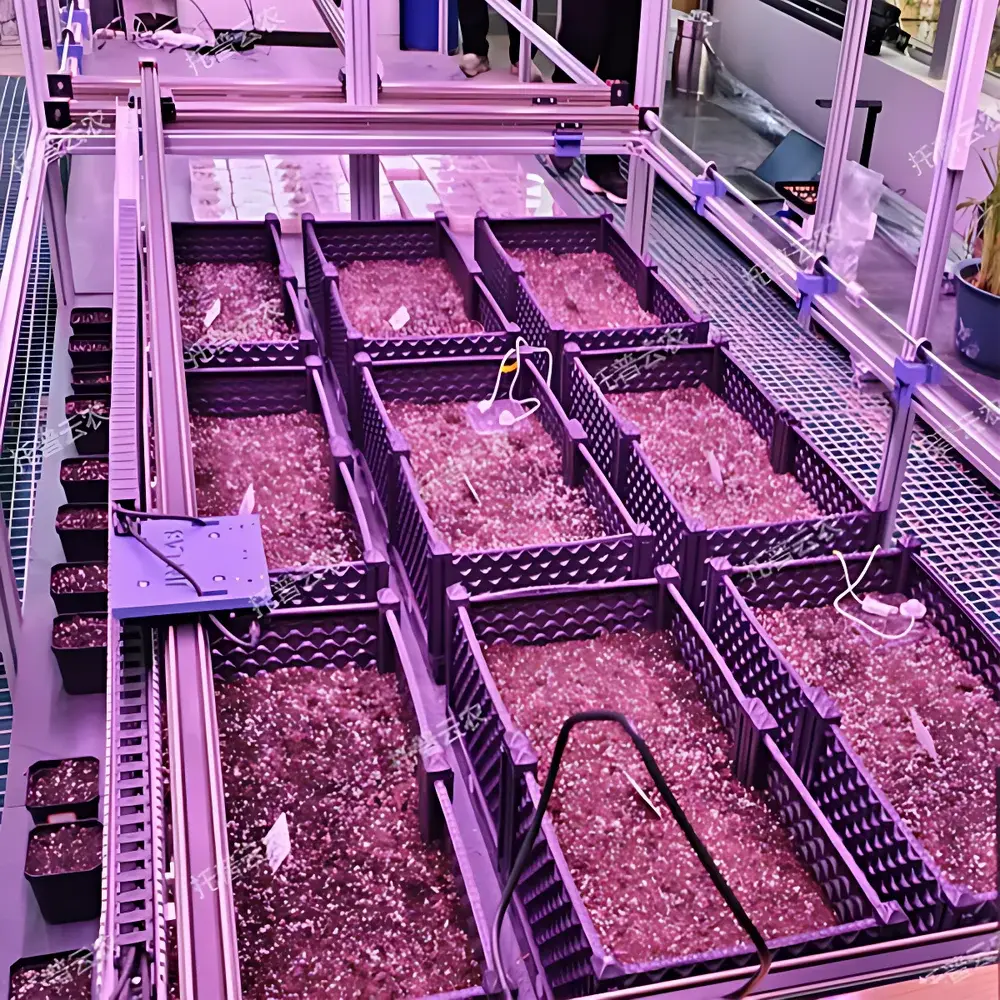
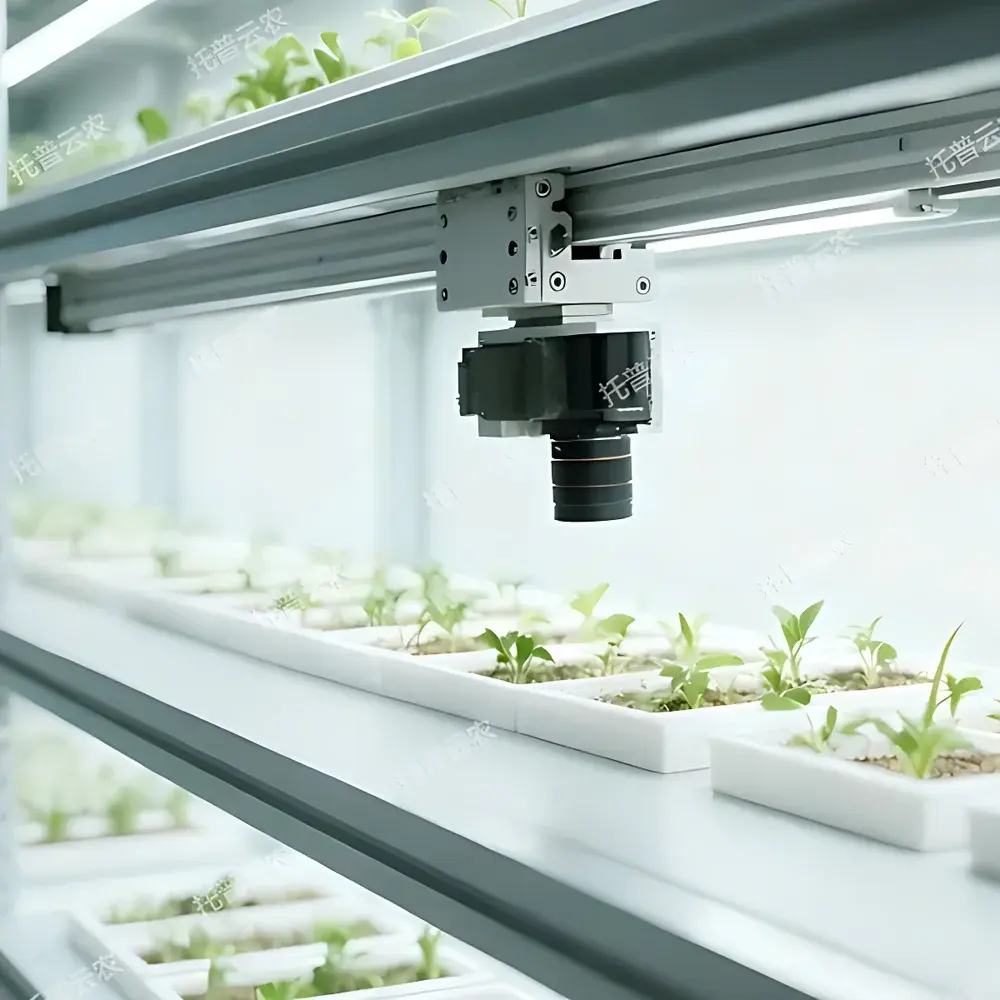
Top Cloud-agri TP-PlantPhy Controlled-Environment Plant Phenotyping System
| Brand | Top Cloud-agri |
|---|---|
| Origin | Zhejiang, China |
| Manufacturer Type | Direct Manufacturer |
| Country of Origin | Domestic (China) |
| Model | TP-PlantPhy |
| Pricing | Available Upon Request |
| Power Supply | AC 220 V, 50 Hz |
| Operating Temperature | 0–40 °C |
| Operating Relative Humidity | 40–90 % RH (non-condensing) |
| Total Power Consumption | ~500 W |
| RGB Imaging Sensor | 48 MP (5312 × 6000), 1 fps |
| Depth Sensor Resolution | 1280 × 720 @ 30 fps |
| RGB Video Resolution (Depth Camera) | 1920 × 1080 @ 30 fps |
| Min/Max Measurement Distance | 300 mm / 3000 mm |
| Depth FOV | 85.2° × 58° × 94° (±3°) |
| RGB FOV (Depth Camera) | 69.4° × 42.5° × 77° (±3°) |
| Illumination | Uniform diffused LED panel light source |
Overview
The Top Cloud-agri TP-PlantPhy Controlled-Environment Plant Phenotyping System is a purpose-built, non-destructive imaging platform engineered for high-resolution, longitudinal phenotypic monitoring of plants within standardized growth chambers or plant factory environments. It integrates synchronized visible-light (RGB) and depth-sensing modalities with calibrated illumination and embedded computational vision to enable quantitative, multi-dimensional trait extraction under controlled abiotic conditions. The system operates on a dual-modality acquisition principle: high-fidelity 2D color imaging captures spectral reflectance and morphological contours, while time-of-flight (ToF) or stereo-based depth sensing provides volumetric structural data—enabling robust 3D reconstruction of plant architecture even under variable lighting backgrounds. By incorporating CCM (Color Correction Matrix) calibration, the system ensures cross-illumination reproducibility, critical for longitudinal studies where lighting conditions may vary across experimental runs or chamber zones. Designed for integration into GLP-compliant breeding pipelines and precision horticulture research, the TP-PlantPhy supports objective, operator-independent phenotyping aligned with FAO and Crop Ontology standards.
Key Features
- Multi-modal sensor fusion: Co-registered 48 MP RGB imaging (5312 × 6000 resolution, 1 fps) and high-speed depth sensing (1280 × 720 @ 30 fps) with synchronized capture timing.
- Uniform, spectrally stable LED illumination: Diffused panel light source eliminates specular highlights and shadow artifacts, ensuring consistent reflectance measurement across canopy layers.
- Automated, calibration-aware image processing pipeline: Integrates morphology-guided segmentation with lightweight convolutional neural networks (CNNs) for seed-point initialization, leaf boundary delineation, and occlusion-resilient organ detection.
- Comprehensive trait quantification engine: Extracts ≥16 morphometric parameters—including plant height, canopy width/length/area, canopy height ratio, compactness, eccentricity, circularity, and leaf curl index—without manual intervention.
- Full-color space analytics: Computes ≥18 chromatic indices (e.g., ExG, ExR, VARI, GNDVI) alongside raw RGB channel intensities and RHS (Royal Horticultural Society) color mapping for pigment-level physiological inference.
- Texture-based phenotyping module: Derives ≥6 textural descriptors—including homogeneity, contrast, entropy, and smoothness—using Gray-Level Co-occurrence Matrix (GLCM) analysis to assess leaf surface integrity and stress-induced microstructural changes.
Sample Compatibility & Compliance
The TP-PlantPhy accommodates a broad range of plant developmental stages—from seed germination and plug-stage seedlings in trays to mature vegetative and early reproductive individuals up to 3 m in height. Its modular gantry design allows flexible mounting above conveyorized growth racks or fixed-position climate chambers. All hardware components meet IEC 61000-6-3 (EMC emission) and IEC 61000-6-2 (immunity) standards. Software workflows support audit-trail generation and user-access logging, enabling alignment with ISO/IEC 17025 requirements for testing laboratories and facilitating documentation for USDA APHIS, OECD, or national variety registration trials. Data export formats include CSV, HDF5, and MIAPPE-compliant JSON-LD for interoperability with BreedBase and Gramene databases.
Software & Data Management
The proprietary PhenotypeStudio™ software suite provides a validated, GUI-driven environment for batch image ingestion, parameter configuration, and automated trait extraction. It implements FDA 21 CFR Part 11–compliant electronic signatures, role-based access control (RBAC), and immutable audit logs for all processing events—including algorithm versioning, threshold adjustments, and manual corrections. Raw and processed datasets are stored in a local PostgreSQL database with optional encrypted network backup to NAS or cloud object storage (AWS S3, Azure Blob). Metadata tagging follows ISA-Tab conventions; time-series trait trajectories can be visualized via interactive dashboards with statistical overlays (ANOVA, PCA, hierarchical clustering). API endpoints support integration with LIMS systems and automated reporting to breeding decision-support platforms.
Applications
- High-throughput screening of germplasm libraries under controlled drought, salinity, or nutrient-stress regimes.
- Dynamic modeling of canopy development kinetics for ideotype optimization in vertical farming systems.
- Validation of QTLs and GWAS hits through precise spatiotemporal trait mapping across RIL or MAGIC populations.
- Non-invasive assessment of biotic stress responses (e.g., powdery mildew progression, aphid infestation) using combined color-texture-morphology anomaly detection.
- Calibration and ground-truthing of proximal and remote sensing algorithms used in field-scale phenotyping.
- Supporting Good Agricultural Practice (GAP) and Good Laboratory Practice (GLP) documentation for regulatory submissions in crop biotechnology dossiers.
FAQ
Does the system require external calibration targets for daily operation?
No—CCM-based illumination normalization and factory-calibrated sensor profiles eliminate routine use of physical color charts. Optional NIST-traceable reference tiles are available for periodic validation.
Can the software process images from third-party cameras or legacy datasets?
Yes—PhenotypeStudio™ accepts TIFF, PNG, and JPEG inputs with embedded EXIF or sidecar JSON metadata. Batch reprocessing is supported with full parameter traceability.
Is the depth sensor suitable for measuring fine root architecture in hydroponic setups?
The current depth module is optimized for aerial canopy imaging at distances ≥300 mm. For sub-canopy or rhizosphere imaging, we recommend pairing with optional macro-lens RGB modules or integrating with complementary X-ray CT or MRI infrastructure.
How is data security enforced during network transmission?
All client-server communication uses TLS 1.3 encryption; local storage employs AES-256 disk encryption with FIPS 140-2 validated modules.
What level of technical support and software update coverage is included?
Standard warranty includes 24-month hardware coverage and lifetime access to minor-version software updates, including algorithm enhancements and compliance patches for evolving ISO/IEC and OECD guidelines.




