Top Cloud-agri TP-PHY-KY High-Throughput Whole-Plant Intelligent Phenotyping System for Rapeseed (Brassica napus)
| Brand | Top Cloud-agri |
|---|---|
| Origin | Zhejiang, China |
| Manufacturer Type | Direct Manufacturer |
| Country of Origin | China |
| Model | TP-PHY-KY |
| Pricing | Upon Request |
| Imaging Unit | 4× 25-MP RGB industrial cameras (5120 × 5120 px, 2.5 µm pixel size) |
| Frame Rate | 1 fps |
| Max Sample Height | 500 mm |
| Max Sample Width (Canopy Span) | 400 mm |
| Max Sample Weight | 22.5 kg |
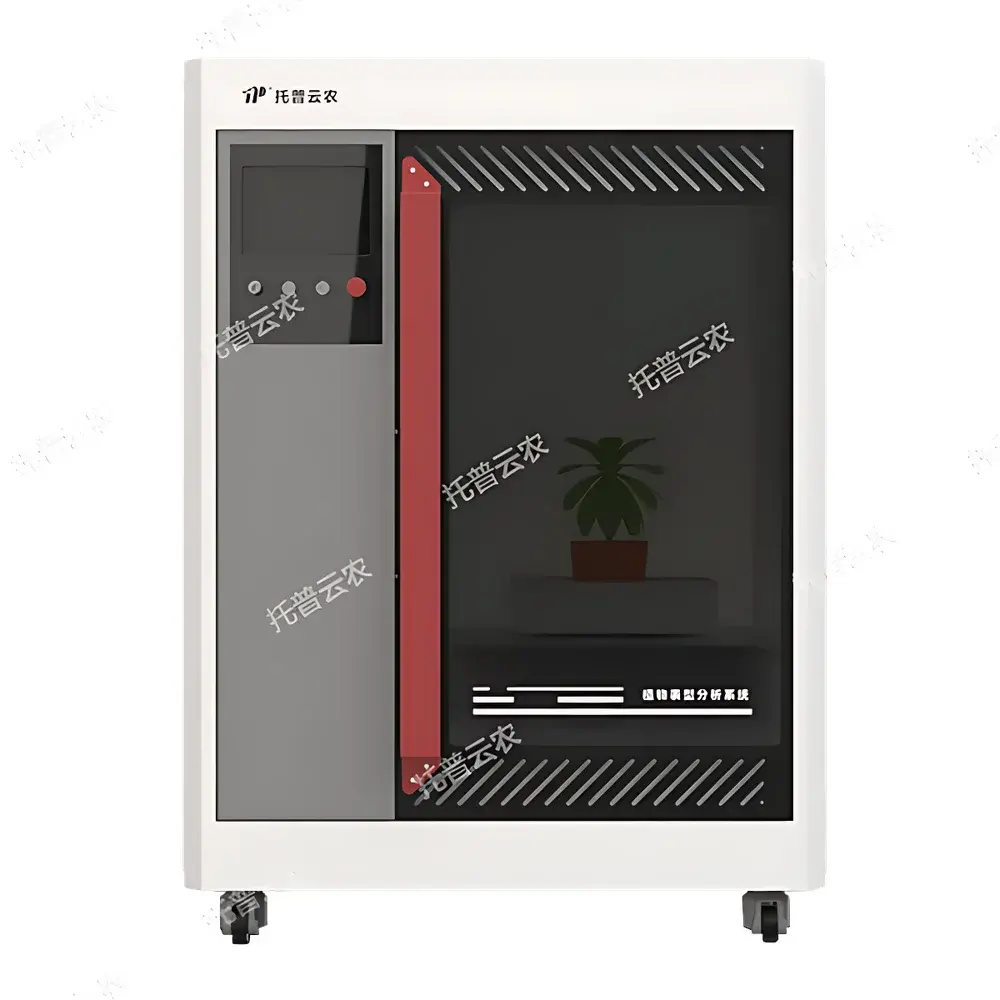
| Enclosure Dimensions | 1400 × 935 × 1840 mm (L × W × H) |
| Power Supply | AC 220 V, 50 Hz |
| Max Power Consumption | <1 kW |
| Operating Temperature | 0–40 °C |
| Relative Humidity | ≤90% RH (non-condensing) |
| IP Rating | IP53 |
| Touch Interface | 10.1-inch full-color LCD touchscreen |
| Lighting | Uniform diffused LED panel illumination |
| Mobility | Equipped with heavy-duty casters (Fuma-type) |
Overview
The Top Cloud-agri TP-PHY-KY High-Throughput Whole-Plant Intelligent Phenotyping System for Rapeseed is a vertically integrated, enclosed phenotyping platform engineered for non-destructive, quantitative assessment of Brassica napus across its entire life cycle—from seedling emergence through bolting, flowering, silique development, and senescence. Built upon visible-light photogrammetry and multi-view stereo reconstruction principles, the system captures high-fidelity RGB image sequences from four synchronized industrial cameras positioned in top-and-side configurations. These images serve as input to an embedded AI-driven reconstruction engine that generates dense 3D point clouds and Gaussian-surface approximations, enabling geometrically accurate volumetric and surface-based trait quantification. Unlike open-field or conveyor-based systems, the TP-PHY-KY’s sealed enclosure ensures strict environmental control—critical for reproducible measurements under standardized light, temperature, and humidity conditions. It is explicitly validated for indoor research environments including growth chambers, climate rooms, phytotrons, and controlled-environment greenhouses, where experimental consistency and operator safety are paramount.
Key Features
- Multi-Angle Visible-Light Imaging: Four calibrated 25-megapixel RGB industrial cameras (5120 × 5120 resolution, 2.5 µm pixel pitch) capture synchronized imagery at 1 frame per second. The turntable supports programmable 360° rotation; default acquisition uses 72 side-view images per plant, with user-defined angular step intervals for optimized throughput vs. resolution trade-offs.
- Automated 3D Reconstruction & Trait Extraction: Proprietary computer vision algorithms perform camera calibration, feature matching, depth map estimation, and mesh generation without manual intervention. Output includes registered 3D point clouds, textured surface models, and Gaussian-splat representations suitable for downstream morphometric analysis.
- Comprehensive Rapeseed-Specific Trait Library: The system computes ≥30 biologically relevant phenotypic descriptors, categorized into: (i) structural metrics (plant height, main stem diameter, canopy width, canopy height ratio, canopy coverage area); (ii) architectural traits (branch number, silique count, internode length, branch insertion height, main inflorescence length); (iii) colorimetric indices (leaf hue, chroma, lightness, greenness index, chlorophyll retention score, senescence progression rate); and (iv) holistic biophysical parameters (plant volume, total surface area, projected leaf area, leaf area index [LAI]).
- Integrated Human-Machine Interface: A 10.1-inch industrial-grade capacitive touchscreen provides real-time monitoring of chamber temperature/humidity, turntable position, lighting intensity, door lock status, and system health. All hardware controls—including LED brightness adjustment, emergency door release, turntable homing, and alarm acknowledgment—are accessible via intuitive graphical widgets.
- Robust Mechanical Architecture: Constructed with reinforced aluminum alloy framing and tempered glass panels, the enclosure meets IP53 ingress protection standards. Heavy-duty Fuma casters enable stable repositioning within laboratory spaces without requiring floor anchoring or permanent installation.
Sample Compatibility & Compliance
The TP-PHY-KY accommodates intact rapeseed plants up to 500 mm in height and 400 mm in maximum canopy span, with a maximum supported mass of 22.5 kg—sufficient for mature, pot-grown specimens under standard cultivation protocols. The system complies with IEC 61000-6-3 (EMC emission limits) and IEC 61000-6-2 (immunity requirements) for laboratory equipment. While not certified to ISO/IEC 17025 or GLP Annex 11 out-of-the-box, its architecture supports audit-ready operation: all image acquisitions and trait calculations are timestamped, logged with operator ID (where configured), and stored with immutable metadata (camera settings, calibration coefficients, reconstruction version). Optional QR-code sample tracking enables full traceability from planting to phenotype report, aligning with FAIR data principles and facilitating integration into LIMS or ELN workflows.
Software & Data Management
The proprietary TP-PHY Analysis Suite operates on Windows 10/11 x64 and offers three operational modes: (i) fully automated batch processing; (ii) semi-automated manual refinement (e.g., ROI masking, outlier rejection); and (iii) interactive 3D model inspection with measurement tools. All raw images, reconstructed models (.ply, .obj), and structured trait tables (.csv, .xlsx) are stored locally on encrypted SSD storage. Backup policies support scheduled network drive synchronization and incremental versioning. Audit trails record every processing event—including parameter changes, user logins, and export actions—in compliance with FDA 21 CFR Part 11 requirements when paired with appropriate identity management and electronic signature modules. Export formats include PNG/JPEG for publication-ready figures, SVG for scalable vector graphics, and JSON-LD for semantic interoperability with MIAPPE-compliant databases.
Applications
This system is routinely deployed in academic and industrial breeding programs focused on rapeseed yield optimization, drought tolerance screening, nitrogen use efficiency (NUE) phenotyping, and post-flowering resilience assessment. Its capacity for longitudinal monitoring enables detection of subtle developmental shifts—such as delayed bolting onset or accelerated silique abscission—under controlled stress treatments (e.g., osmotic stress, heat ramping, nutrient deprivation). In functional genomics studies, it supports high-resolution QTL mapping by correlating time-series trait trajectories with SNP haplotypes. Additionally, the platform serves as a validation reference for field-based remote sensing models, providing ground-truth 3D canopy structure data essential for calibrating UAV-borne multispectral and LiDAR datasets.
FAQ
Is the TP-PHY-KY compatible with other Brassica species beyond rapeseed?
Yes—the core imaging and reconstruction pipeline is species-agnostic. However, trait definitions, segmentation thresholds, and phenotypic ontologies are pre-configured for B. napus. Custom configuration packages can be developed for B. rapa, B. oleracea, or related crops upon request.
Does the system require external calibration targets or daily maintenance routines?
No routine recalibration is needed under stable environmental conditions. The system performs self-diagnostic checks during startup and logs deviations in lens focus, LED output drift, or turntable positional error. A yearly factory recalibration service is recommended for metrological continuity.
Can third-party software access raw image data or intermediate reconstruction files?
Yes—via documented RESTful API endpoints and local file system hooks. Developers may integrate custom ML inference pipelines using exported point clouds or orthomosaic projections.
What level of technical support is provided post-installation?
Top Cloud-agri offers remote diagnostics, firmware updates, and application-specific training sessions. On-site engineering support is available under extended service agreements.
Is cloud-based data hosting or multi-user collaboration supported?
Local deployment is standard. Cloud-hosted instances with role-based access control (RBAC), SSO integration, and HIPAA/GDPR-compliant encryption are available as enterprise add-ons.