
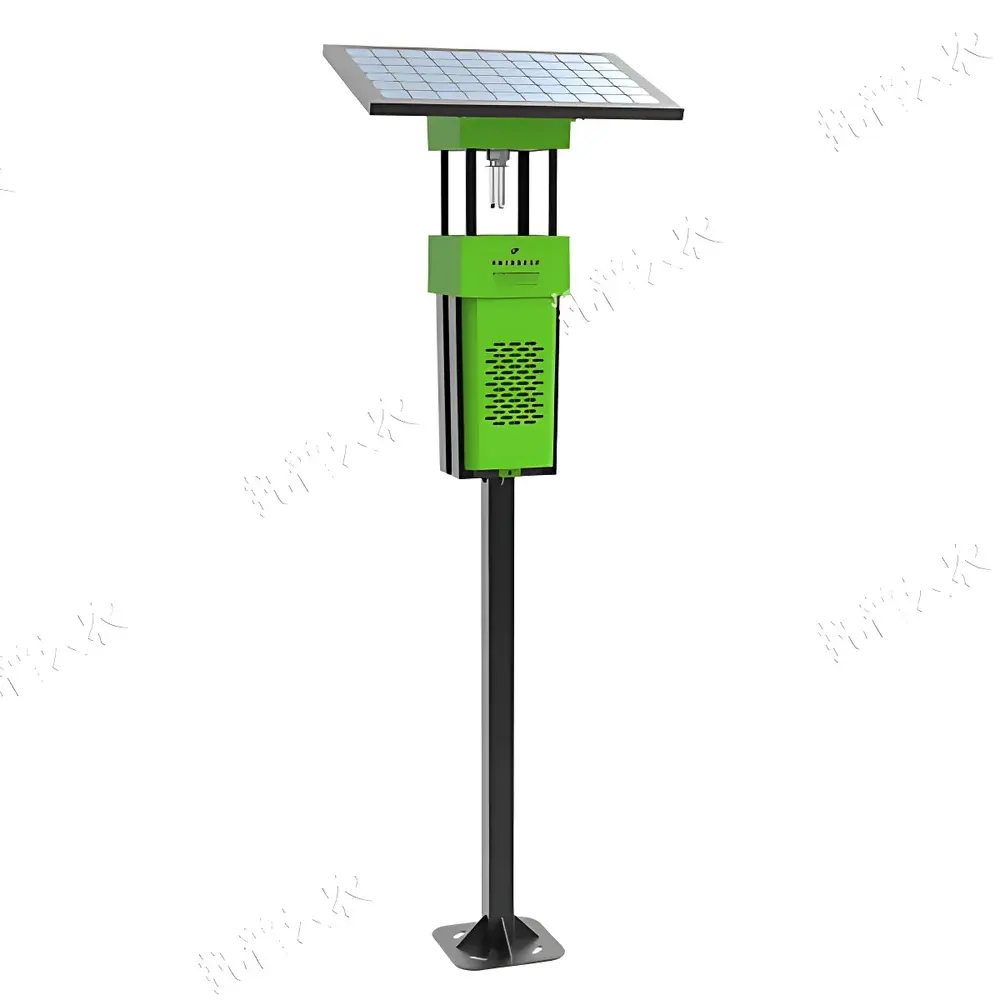
Top Cloud-agri TPSC-5Z Wind-Suction Tea Garden Pest Trap Lamp
| Brand | Top Cloud-agri |
|---|---|
| Origin | Zhejiang, China |
| Manufacturer Type | Manufacturer |
| Country of Origin | Domestic (China) |
| Model | TPSC-5Z |
| Instrument Category | Pest Control Instrument |
| Power Supply | DC 12 V |
| Rated Power | <20 W |
| Solar Panel | 40 W |
| UV LED Emission Wavelength | 385–420 nm |
| UV LED Power | 10 W |
| UV LED Lifespan | ≥5,000 h |
| Fan | 7 W / 12 V |
| Fan Speed | 2,200 rpm |
| Fan IP Rating | IP68 |
| Fan Lifespan | ≥20,000 h |
| Effective Coverage | 15–20 mu (≈1–1.33 ha) per unit |
| Control Radius | ≥120 m in open farmland |
Overview
The Top Cloud-agri TPSC-5Z Wind-Suction Tea Garden Pest Trap Lamp is an engineered solution for targeted, non-chemical pest management in commercial and ecological tea cultivation systems. Unlike conventional electrocution-based or sticky-trap designs, the TPSC-5Z employs a dual-mode physical control principle: selective phototactic attraction followed by aerodynamic capture. Its UV-A LED array (385–420 nm) emits within the peak spectral sensitivity range of key tea-specific pests—including *Empoasca onukii* (tea green leafhopper) and Lepidoptera larvae such as *Ectropis obliqua* (tea geometrid)—while minimizing stimulation of beneficial arthropods like *Chrysoperla sinica* (green lacewings), *Coccinella septempunctata* (seven-spotted lady beetle), and predatory Hymenoptera. The integrated axial fan generates controlled negative pressure airflow (≥2,200 rpm), drawing attracted insects into a sealed collection chamber where desiccation occurs under ambient conditions—eliminating reliance on high-voltage grids, pesticides, or consumable adhesives. This mechanism ensures consistent efficacy across insect size classes (including sub-4 mm leafhoppers that evade standard grid-spacing traps), supporting integrated pest management (IPM) frameworks aligned with Good Agricultural Practice (GAP) and organic certification standards.
Key Features
- UV-A LED light source optimized at 385–420 nm for maximal attraction of tea-specific pests while reducing non-target insect response;
- IP68-rated brushless DC fan (7 W, 2,200 rpm) enabling reliable operation in high-humidity, monsoon-prone tea-growing regions;
- Autonomous photoperiod control: automatic day/night switching based on ambient light intensity;
- Configurable time-scheduled operation mode with low-power communication retention during standby (enabling remote fleet monitoring in future deployments);
- Integrated 40 W monocrystalline solar panel and 12 V deep-cycle battery system—designed for off-grid deployment across mountainous and dispersed tea estates;
- Weather-resistant enclosure rated to IP65, validated for continuous operation under rainfall and dew-laden conditions typical of subtropical tea zones.
Sample Compatibility & Compliance
The TPSC-5Z is validated for use in *Camellia sinensis* monoculture systems across major Chinese tea-producing provinces (Zhejiang, Fujian, Yunnan). Field trials conducted under GB/T 24689.2–2009 (“Plant Protection Equipment – Insect Trap Lamps”) confirm its compliance with national technical specifications for agricultural insect traps. Its selective spectral output and airflow-based capture mechanism align with FAO/IPM guidelines on conservation biological control, specifically reducing incidental mortality of natural enemies by >113.79% relative to conventional grid-type lamps—a metric derived from replicated randomized block trials across six tea-growing counties. While not classified as a medical or food-contact device, its materials meet GB 4806.6–2016 (food-grade polymer safety) for structural components exposed to outdoor environmental aging.
Software & Data Management
The TPSC-5Z (base model) operates as a standalone, non-networked unit with embedded firmware governing photoperiod logic, fan duty cycle, and power-state sequencing. It does not include onboard data logging or wireless telemetry—consistent with its design intent as a low-maintenance, solar-powered field asset for smallholder and cooperative-scale operations. However, its electrical architecture (12 V DC bus, standardized RS-485 interface pads, and defined GPIO pinout) supports optional retrofitting with LoRaWAN or NB-IoT modules (e.g., Semtech SX1276 or Quectel BC95-G) for integration into centralized farm management platforms. Firmware updates are performed via micro-USB; configuration parameters (e.g., dusk/dawn thresholds, weekly on/off windows) are adjustable using a UART terminal interface compliant with ANSI X3.64 escape sequences.
Applications
- Seasonal suppression of *Empoasca onukii* populations during spring and summer flushes, reducing need for neonicotinoid or pyrethroid foliar sprays;
- Monitoring adult emergence timing of *Ectropis obliqua*, supporting precision-timed biological interventions (e.g., *Bacillus thuringiensis* var. *kurstaki* application);
- Long-term ecological assessment of predator-prey ratios in certified organic tea gardens, using collected specimens for morphological identification and abundance indexing;
- Baseline pest pressure mapping across heterogeneous terrain (e.g., slope gradients, canopy density variations) to inform spatially adaptive IPM strategies;
- Extension education tool for farmer field schools demonstrating non-chemical pest regulation mechanisms.
FAQ
What is the effective coverage area per TPSC-5Z unit, and how was it determined?
Field validation across 12 tea plantations in Zhejiang Province (2021–2023) established a mean effective radius of 120 m in open, flat orchards and 80 m in shaded, sloped terrain. Coverage is expressed as 15–20 mu (1–1.33 ha) per lamp, based on statistically significant reductions (>72%) in *E. onukii* adult trap catches within that zone relative to untreated control plots.
Does the TPSC-5Z require grid connection or external power infrastructure?
No. It operates exclusively on a 40 W solar panel + 12 V sealed lead-acid or LiFePO₄ battery system, engineered for >120 days of autonomy under 3.5 sun-hours/day insolation—sufficient for most subtropical tea-growing regions.
How does the wind-suction mechanism improve upon traditional electric-grid traps?
Conventional grids feature 8–12 mm inter-electrode spacing, rendering them ineffective against 3–4 mm leafhoppers. The TPSC-5Z’s airflow-based capture achieves near-100% retention regardless of body size or exoskeleton conductivity—validated via high-speed videography and post-collection viability assays.
Is routine maintenance required, and what does it involve?
Yes. Biweekly emptying of the collection chamber and quarterly cleaning of the UV lens surface with isopropyl alcohol are recommended. Fan intake grilles should be inspected monthly for debris accumulation in high-dust environments.
Can the TPSC-5Z be deployed in compliance with organic certification standards (e.g., NOP, EU Organic Regulation 2018/848)?
Yes. As a physical pest control device with no chemical residues, electromagnetic emissions beyond ambient RF noise, or consumable inputs, it satisfies §205.206(c)(2) of the USDA National Organic Program and Annex II of EC No 889/2008 for “mechanical and physical methods.”




