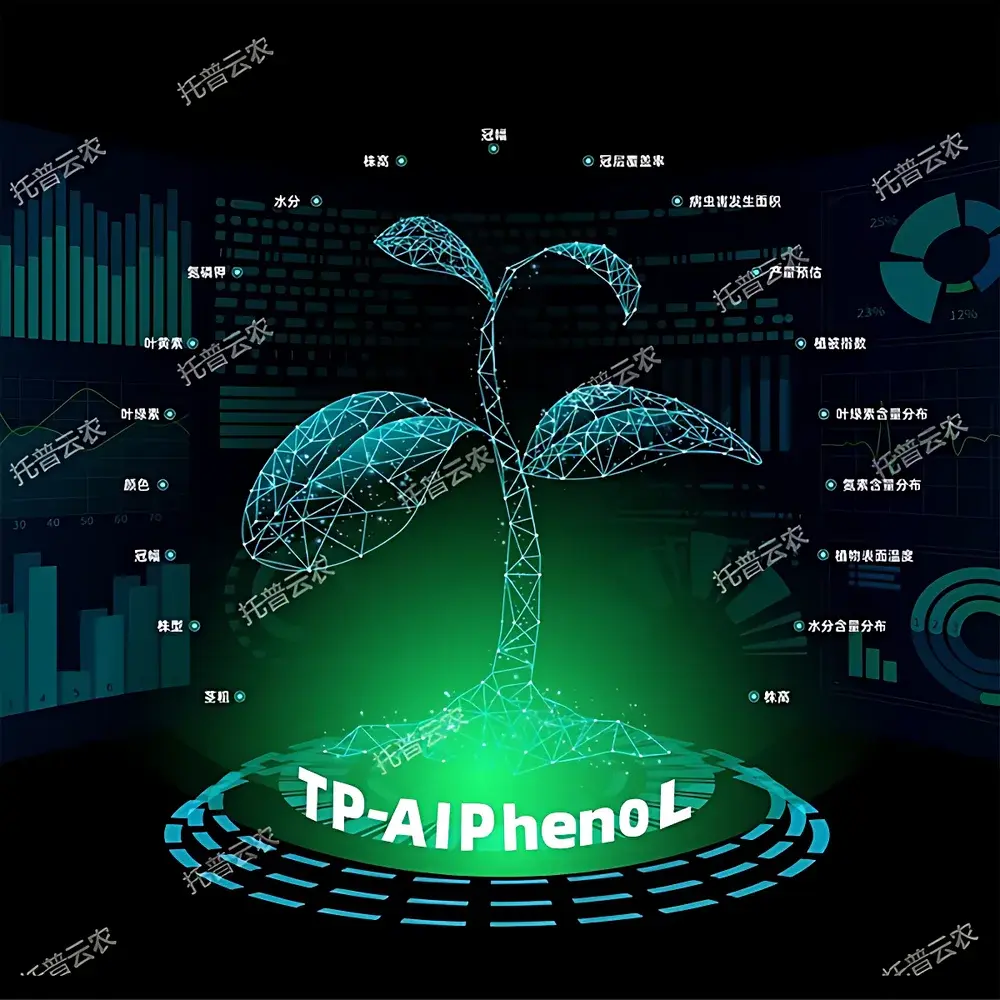
Top Cloud-agri TP-AI Pheno L Plant Phenotyping Analysis Software (Client Application)
| Brand | Top Cloud-agri |
|---|---|
| Origin | Zhejiang, China |
| Manufacturer Type | OEM/ODM Producer |
| Country of Origin | China |
| Model | TP-AI Pheno L |
| Pricing | Available upon Request |
Overview
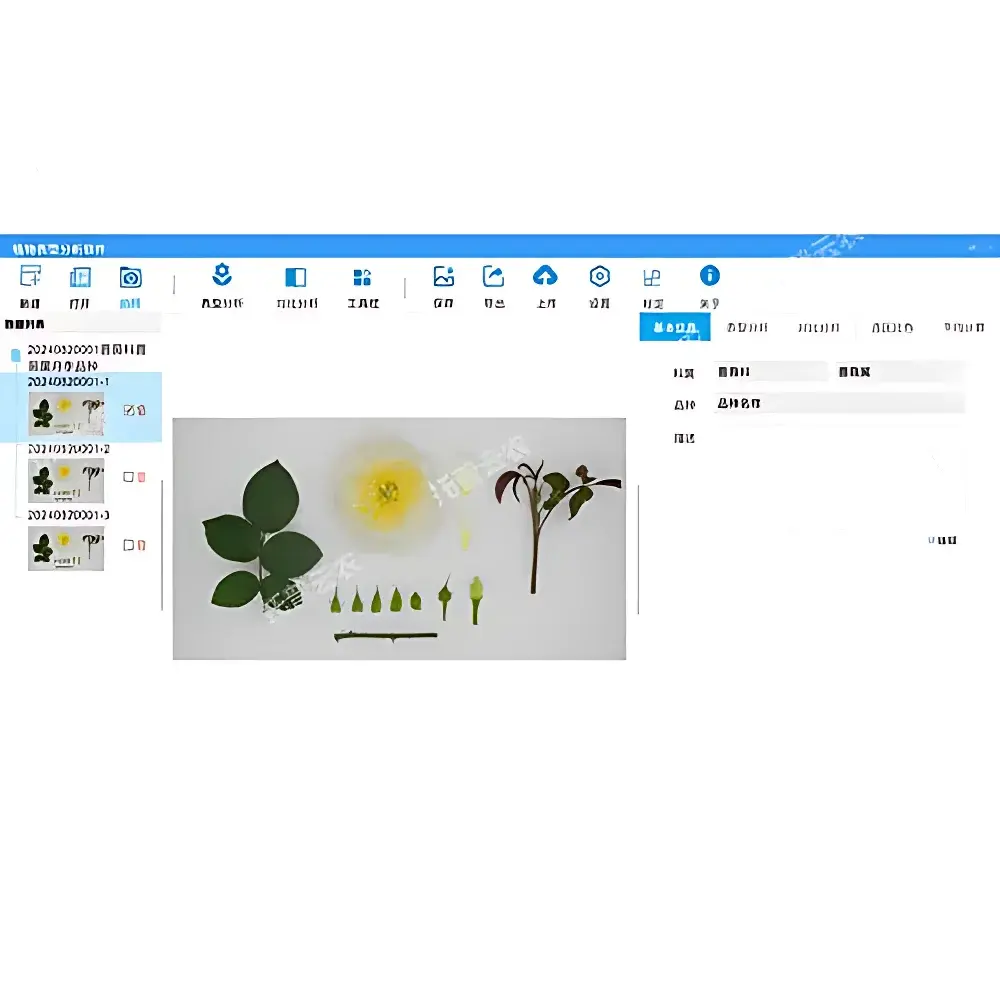
Top Cloud-agri TP-AI Pheno L is a client-based plant phenotyping analysis software engineered for high-throughput, non-destructive quantitative trait extraction from digital plant imagery. Built on a modular computer vision architecture, it implements multi-scale image segmentation, adaptive thresholding, and deep learning–assisted organ classification to enable robust identification and measurement of morphological, colorimetric, and textural features across heterogeneous plant tissues. The software operates independently of proprietary hardware, supporting standardized image inputs from flatbed scanners, DSLR cameras, industrial machine vision systems, smartphone captures, and hyperspectral or RGB-D acquisition platforms. Its core analytical pipeline conforms to FAIR data principles—Findable, Accessible, Interoperable, Reusable—ensuring compatibility with downstream statistical modeling (e.g., GWAS, QTL mapping) and integration into larger phenomics workflows compliant with MIAPPE (Minimum Information About a Plant Phenotyping Experiment) metadata standards.
Key Features
- Multi-organ recognition engine: Simultaneously segments and quantifies seeds, leaves, flowers, fruits, stems, and fungal colonies within a single image—without manual pre-sorting or region-of-interest (ROI) definition.
- 30+ standardized phenotypic descriptors: Includes geometric metrics (area, perimeter, length, width, circularity, solidity), color space parameters (RGB, HSV, CIELAB, RHS color chart matching), and texture statistics (contrast, homogeneity, entropy, correlation) derived from Gray-Level Co-occurrence Matrix (GLCM) analysis.
- Batch processing framework: Supports concurrent analysis of thousands of images via configurable job queues; maintains consistent calibration across sessions using embedded reference targets and auto-white balance correction.
- Statistical aggregation module: Computes descriptive statistics—including mean, median, standard deviation, coefficient of variation, min/max, and confidence intervals—for each measured trait across user-defined sample groups.
- Cloud synchronization protocol: Integrates with Top Cloud-agri’s secure cloud platform via TLS 1.2 encrypted RESTful API; enables role-based access control (RBAC), versioned dataset storage, and audit-trail logging for GLP/GMP-aligned environments.
- Extensible plugin architecture: Provides documented Python SDK and JSON-based configuration schema for custom metric development, algorithm substitution (e.g., replacing default segmentation with U-Net or Mask R-CNN models), and third-party database connectors (e.g., PostgreSQL, MySQL).
Sample Compatibility & Compliance
The TP-AI Pheno L software accepts lossless (TIFF, PNG) and compressed (JPEG, JPEG2000) image formats at resolutions up to 100 MP, accommodating both macro-scale field-captured images and micro-scale lab-scanned specimens. It has been validated for use with common botanical imaging protocols defined in ASTM E2924-22 (Standard Guide for Digital Imaging in Plant Phenotyping) and ISO 20675:2020 (Plant phenotyping—Requirements for image acquisition and processing). While not FDA-cleared, its data export structure supports 21 CFR Part 11-compliant electronic records when deployed with appropriate system validation documentation and user access controls.
Software & Data Management
Data management follows hierarchical project organization: Projects → Experiments → Image Sets → Individual Images. Each image retains full EXIF metadata and user-annotated contextual fields (genotype, treatment, timepoint, growth chamber ID). Export options include CSV (tabular trait values), GeoJSON (spatial annotations), PDF reports (with embedded visualizations), and HDF5 (for large-scale tensor storage). Audit logs record all user actions—including parameter changes, ROI edits, and export events—with timestamps and authenticated user IDs. All local databases utilize SQLite with WAL journaling for ACID compliance; cloud sync employs end-to-end encryption and differential upload to minimize bandwidth usage.
Applications
- High-throughput screening of mutant populations under controlled environment or field trials
- Time-series analysis of developmental dynamics (e.g., leaf expansion rate, senescence progression, floral transition timing)
- Abiotic stress response profiling (drought, salinity, heat) via color shift detection and necrosis quantification
- Seed quality assessment including viability prediction, dormancy classification, and varietal purity testing
- Phytopathology studies involving lesion area measurement, sporulation density estimation, and disease severity indexing (e.g., AUDPC calculation)
- Support for breeding programs requiring objective, operator-independent trait scoring aligned with CIMMYT and IRRI phenotyping guidelines
FAQ
Does TP-AI Pheno L require dedicated hardware or proprietary imaging stations?
No—it is hardware-agnostic and designed to process images acquired from off-the-shelf devices, including consumer-grade cameras and flatbed scanners calibrated with NIST-traceable color charts.
Can the software be validated for regulated research environments (e.g., GLP or GMP)?
Yes—while the base software is not pre-validated, its deterministic algorithms, full audit trail, and configurable user permissions allow laboratories to perform IQ/OQ/PQ qualification per ISO/IEC 17025 and internal SOPs.
Is source code or API documentation available for integration with LIMS or ELN systems?
Yes—Top Cloud-agri provides a comprehensive REST API specification, Python client library, and example integrations with LabArchives and Benchling via OAuth 2.0 authentication.
What image preprocessing steps are applied by default?
Automatic illumination normalization, background subtraction using rolling-ball algorithm, noise reduction via non-local means filtering, and perspective correction for oblique-angle captures.
How does the software handle overlapping or occluded organs?
It applies watershed-based separation combined with shape prior constraints (e.g., convex hull refinement and aspect-ratio filtering) to resolve partial overlaps while preserving biological plausibility of segmented regions.