
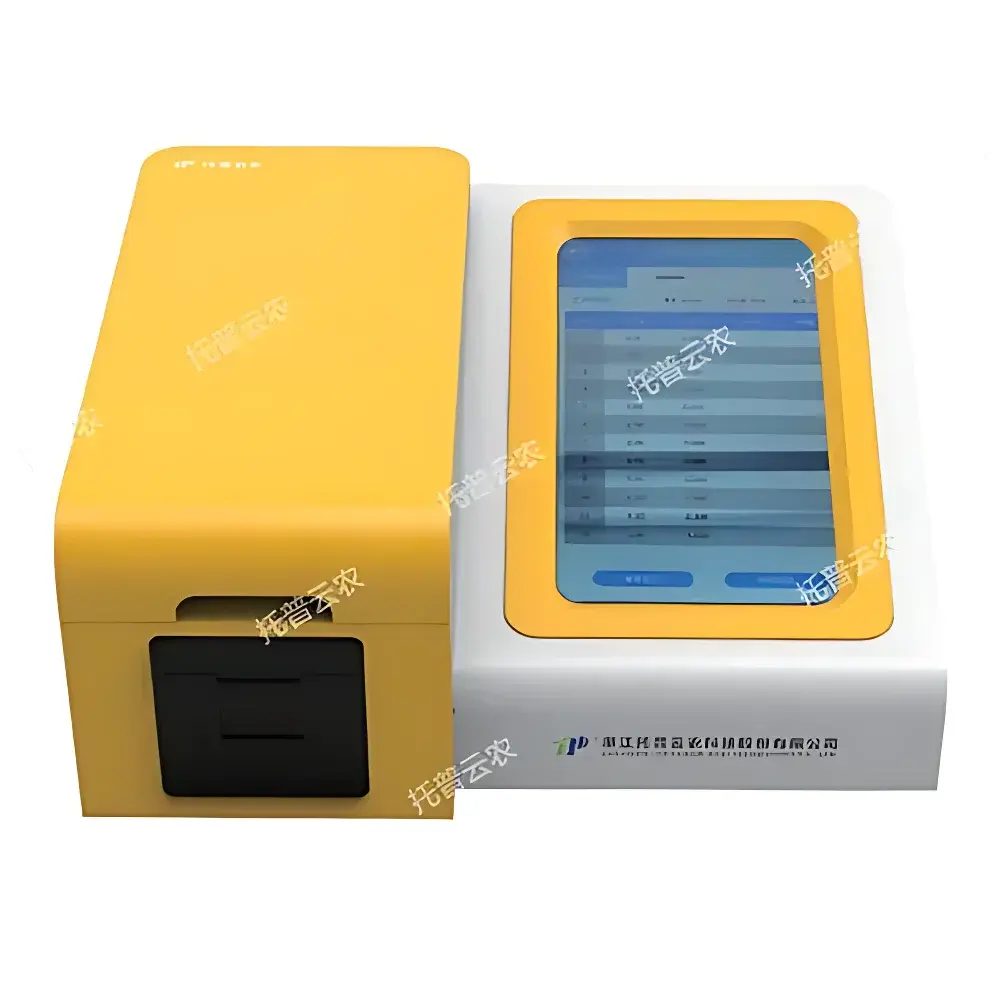
Top Cloud-agri TPSP-10D Food Safety Rapid Detection Analyzer
| Brand | Top Cloud-agri |
|---|---|
| Origin | Zhejiang, China |
| Manufacturer Type | Manufacturer |
| Country of Origin | Domestic (China) |
| Model | TPSP-10D |
| Price | ¥56,000 |
| Function Type | Multi-analyte (120+ configurable tests) |
| Sample Compatibility | Universal for solid, liquid, and semi-solid food matrices |
| Wavelength Range | 410–630 nm (discrete wavelengths: 410 nm, 412 nm, 465 nm, 518 nm, 630 nm) |
| Detection Time | ≤3 minutes per assay |
| Optical Channels | 12 photometric channels (expandable to 16) |
| Colloidal Gold Immunoassay Channels | 3 (expandable to 10) |
| Photometric Accuracy | ±2.0% transmittance |
| Photometric Repeatability | ≤0.2% |
| 3-Minute Baseline Stability | ≤0.2% |
| Operating System | Android-based embedded platform |
| Display | 10.1″ capacitive touchscreen |
| Connectivity | Dual USB 2.0, Bluetooth 4.2, Wi-Fi 802.11 b/g/n, RJ45 Ethernet, optional 4G/5G module, GPS/AGPS |
| Data Output | Thermal printer (embedded micro-thermal), USB export, cloud upload, third-party LIMS/platform integration |
| Power Supply | 220 V ±10%, 50 Hz |
Overview
The Top Cloud-agri TPSP-10D Food Safety Rapid Detection Analyzer is a dual-mode, benchtop analytical instrument engineered for high-throughput, field-deployable screening of chemical and biological hazards in food matrices. It integrates two complementary detection principles: quantitative reflectance/absorbance photometry (based on Beer–Lambert law compliance at discrete visible wavelengths) and qualitative/semi-quantitative lateral flow immunoassay (colloidal gold strip interpretation). Designed for regulatory surveillance and quality assurance laboratories, the system delivers actionable results within three minutes—enabling real-time decision-making without reliance on centralized reference labs. Its architecture supports both routine compliance testing (e.g., pesticide residues in produce, sulfite adulteration in dried fruits, aflatoxin B1 in grains) and emergency response scenarios (e.g., melamine in dairy, clenbuterol in meat, chloramphenicol in aquaculture products). The device operates under ambient conditions (10–35°C, ≤85% RH), requires no external calibration gases or consumable reagents beyond certified test kits, and meets foundational metrological requirements for rapid screening tools as outlined in ISO/IEC 17025:2017 Annex A.3 (screening method validation).
Key Features
- Dual-detection modality: 12 independent photometric channels (410–630 nm, with fixed-bandpass filters at 410 nm, 412 nm, 465 nm, 518 nm, and 630 nm) and 3 dedicated colloidal gold strip readers—each with auto-focused CMOS imaging and dynamic threshold adjustment for batch-specific signal normalization.
- Modular scalability: Photometric channel count expandable to 16; colloidal gold readers upgradable to 10 units via firmware-enabled hardware arbitration—supporting parallel processing of heterogeneous sample sets across regulatory priorities.
- Embedded Android 9.0 platform with 10.1″ full-HD capacitive touchscreen: Enables intuitive workflow navigation, multilingual UI (English/Chinese), handwriting recognition, voice-assisted sample annotation, and embedded video tutorials compliant with ISO/IEC 17025 training documentation requirements.
- Comprehensive data governance: Local storage for ≥100,000 test records (including sample ID, producer name, test date/time, raw absorbance values, calculated concentration, pass/fail flag per analyte, operator ID, and instrument serial number); audit-trail enabled for GLP/GMP-aligned environments.
- Integrated thermal printer and multi-protocol connectivity: On-device printing of QC-passed reports; simultaneous data transmission via USB mass storage, Wi-Fi (WPA2-Enterprise compatible), Ethernet (RJ45), and optional LTE/5G modules—ensuring interoperability with national food safety traceability platforms (e.g., China’s NIFDC E-Surveillance System).
Sample Compatibility & Compliance
The TPSP-10D accepts homogenized extracts from diverse food categories—including fresh produce, cereals, meat, dairy, seafood, spices, and processed condiments—without matrix-specific hardware modification. Sample preparation follows AOAC Official Method guidelines for extraction (e.g., QuEChERS for pesticides, immunoaffinity cleanup for mycotoxins) and adheres to ISO 22000:2018 clause 8.4.2 (validation of sampling procedures). Photometric measurements comply with ISO 6497:2002 (feed analysis—general principles) and GB/T 5009 series standards (Chinese national food testing methods). Colloidal gold assays are validated against manufacturer-provided cut-off concentrations per CLSI EP12-A2 protocol. Instrument firmware includes built-in calibration verification using NIST-traceable neutral density filters, satisfying internal QA requirements under FDA 21 CFR Part 11 (electronic records/signatures) when paired with password-protected user roles and time-stamped audit logs.
Software & Data Management
The embedded software suite provides role-based access control (administrator, analyst, reviewer), automated limit comparison against Codex Alimentarius, GB 2760–2024 (food additive limits), GB 2761–2023 (mycotoxin thresholds), and EU Commission Regulation (EC) No 396/2005. Data export supports CSV, PDF, and XML formats—structured to align with HL7 FHIR R4 Laboratory Report resources for seamless ingestion into public health surveillance systems. Remote management capabilities include over-the-air firmware updates, diagnostic telemetry streaming, and screen-sharing-assisted troubleshooting—all encrypted via TLS 1.2. All data transmissions employ AES-256 encryption; local database integrity is enforced through SQLite WAL journaling with periodic SHA-256 hash verification.
Applications
- Routine monitoring of pesticide residues (organophosphates, carbamates, neonicotinoids) in leafy vegetables and fruits using enzyme inhibition assays.
- Quantification of illegal additives (e.g., Sudan dyes, rhodamine B, borax) in sauces, chili powders, and preserved foods via colorimetric reaction kinetics.
- Semi-quantitative detection of veterinary drug residues (tetracyclines, fluoroquinolones, β-agonists) in animal tissues using lateral flow strips with digital readout.
- Screening for mycotoxins (aflatoxin B1, deoxynivalenol, zearalenone) in cereal grains and oilseeds through competitive immunoassays.
- Verification of food authenticity (e.g., honey adulteration with C4-sugar syrups) via refractive index correlation with spectral absorbance profiles.
- Field deployment in mobile food safety inspection vehicles, border quarantine stations, and decentralized agro-processing hubs where infrastructure constraints preclude HPLC-MS access.
FAQ
Does the TPSP-10D require external PC software for operation or data analysis?
No—the instrument functions autonomously with its onboard Android OS, eliminating dependency on external computers for testing, reporting, or basic statistical review.
Can third-party lateral flow test strips be used with the colloidal gold module?
Yes, provided they conform to standard 3.5 mm strip width and exhibit detectable signal intensity within the 400–700 nm spectral response range of the CMOS sensor.
How is measurement traceability maintained for photometric channels?
Each unit ships with factory-applied calibration certificates referencing NIST SRM 2036 (neutral density filters); users may perform daily verification using supplied reference standards before initiating regulated testing.
Is the device suitable for ISO/IEC 17025-accredited laboratories?
Yes—when operated under documented SOPs, with regular inter-laboratory verification studies, and with audit trails enabled, it satisfies Clause 7.2.2 (method validation) and Clause 7.7 (result reporting) requirements for screening methods.
What is the expected service life of the optical components under continuous use?
LED light sources are rated for ≥50,000 hours; filter assemblies retain spectral fidelity for ≥3 years under typical environmental conditions (per IEC 60068-2-68 humidity cycling tests).



