
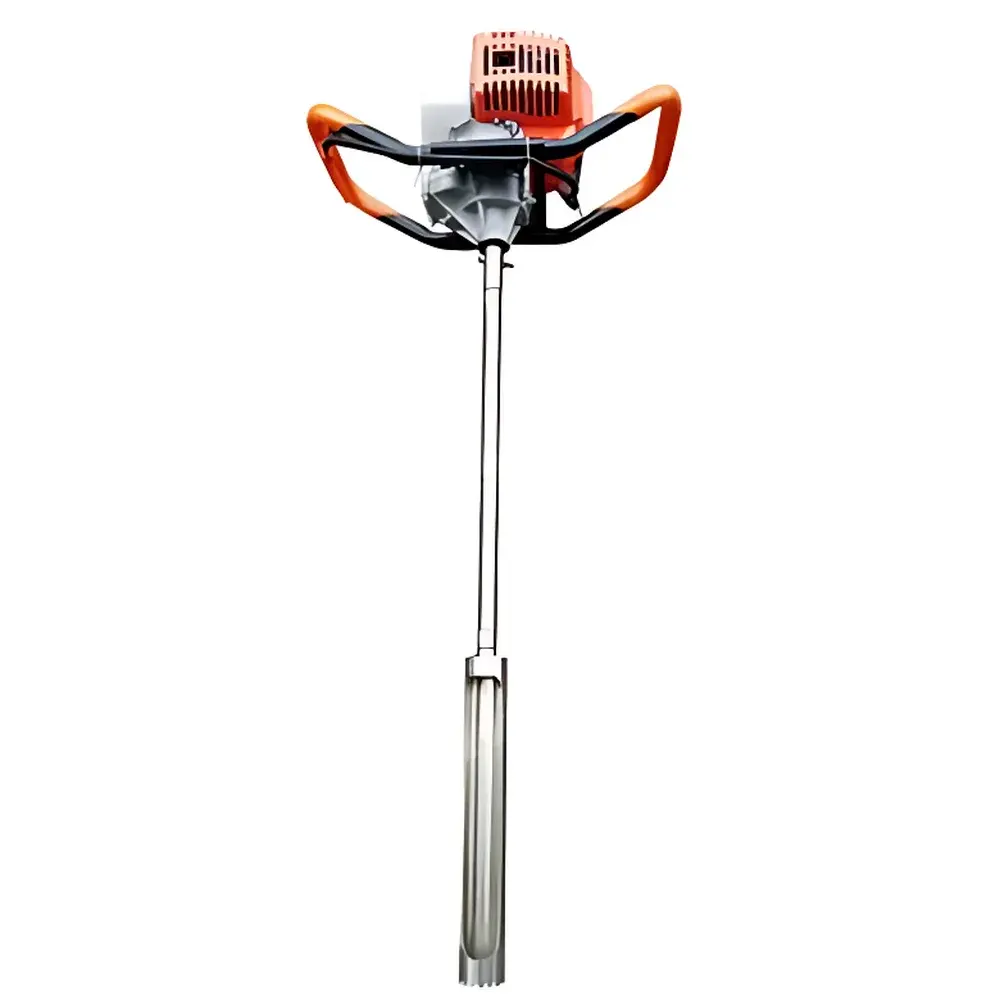
Top Cloud-agri TPLQ-Q Gasoline-Powered Soil Sampler
| Brand | Top Cloud-agri |
|---|---|
| Origin | Zhejiang, China |
| Manufacturer Type | Direct Manufacturer |
| Country of Origin | China |
| Model | TPLQ-Q |
| Automation Level | Semi-Automatic |
| Engine Type | Air-Cooled, Single-Cylinder, Two-Stroke |
| Displacement | 62 cm³ |
| Rated Power | 1.9 kW @ 7000 rpm |
| Gearbox | Two-Stage Reduction Gearbox with Precision Bearings |
| Transmission | Gear-Driven Reduction |
| Starting Method | Recoil Starter with Auto-Return Rope |
| Fuel Mix Ratio | 25:1 (93 RON Gasoline : Two-Stroke Oil) |
| Fuel Tank Capacity | 1200 mL |
| Gear Reduction Ratio | 41:1 |
| Compatible Auger Diameters | 80 / 100 / 150 / 200 / 250 / 300 mm |
| Standard Auger | 304 Stainless Steel, OD 54 mm, ID 50 mm, Length 350 mm, Surface-Hardened |
| Extension Rod | 500 mm, 304 Stainless Steel |
Overview
The Top Cloud-agri TPLQ-Q Gasoline-Powered Soil Sampler is a field-deployable, semi-automatic soil coring device engineered for high-efficiency, depth-consistent sampling in heterogeneous terrestrial environments. It operates on a proven two-stroke combustion principle—delivering reliable mechanical torque through an air-cooled, single-cylinder engine coupled to a precision two-stage reduction gearbox. Unlike electric or manual samplers, the TPLQ-Q maintains consistent rotational speed and penetration force across variable soil matrices—including loam, clay, gravelly subsoils, and compacted till—without requiring external power infrastructure. Its design complies with internationally recognized field sampling protocols for environmental site assessments (e.g., ASTM D1586, ISO 22475-1), ensuring representative core recovery for subsequent laboratory analysis of physical, chemical, and biological soil parameters. As a designated instrument for China’s National Soil Three-Survey (Soil Three-Inventory) initiative, the TPLQ-Q supports standardized collection of undisturbed samples for pH, organic matter, heavy metal, nutrient, and texture analysis per GB/T 35821–2018 and NY/T 1121 series standards.
Key Features
- Robust air-cooled two-stroke engine (62 cm³, 1.9 kW @ 7000 rpm) optimized for low-vibration operation and fuel economy—typical consumption ≤ 380 g/kW·h under nominal load
- Two-stage planetary gear reduction (41:1 ratio) delivering high-torque, low-RPM output ideal for controlled auger advancement and minimal sample disturbance
- Modular auger system compatible with six standard diameters (80–300 mm), enabling stratified sampling from surface litter to ≥1.5 m depth depending on configuration
- Corrosion-resistant 304 stainless steel auger (OD 54 mm, ID 50 mm, L 350 mm) with surface-hardened cutting edges to extend service life in abrasive soils
- Ergonomic recoil starter with auto-return rope mechanism—tested for >10,000 cycles without degradation in pull-force consistency
- Integrated 1200 mL translucent fuel tank with calibrated sight window and anti-spill venting for precise 25:1 gasoline–oil mixing verification
- Quick-release coupling system between engine head and auger shaft—enabling tool-free disassembly in <90 seconds for transport or maintenance
Sample Compatibility & Compliance
The TPLQ-Q accommodates both disturbed and minimally disturbed sampling strategies. With appropriate auger selection (e.g., 100 mm diameter for agricultural profiling; 200 mm for geotechnical borehole lining), it achieves ≥92% core recovery in cohesive soils (plasticity index PI > 12) and ≥85% in granular media (ASTM D1586 classification). All structural components meet RoHS Directive 2011/65/EU restrictions on hazardous substances. The fuel system conforms to EPA Tier 2 emission equivalency for small off-road engines. For regulatory reporting, raw field data—including GPS-tagged location, depth increment, auger ID, and operator ID—can be manually logged to support GLP-compliant chain-of-custody documentation required by ISO/IEC 17025-accredited labs.
Software & Data Management
While the TPLQ-Q operates as a standalone mechanical system, its modular architecture integrates seamlessly into digital field workflows. Auger-specific calibration profiles (torque vs. depth, RPM stability thresholds) are documented in manufacturer-provided PDF technical annexes compliant with ISO 9001:2015 Clause 7.5. Users may pair the sampler with third-party GNSS-enabled tablets (e.g., Trimble R1, Emlid Reach RS3) to geotag sampling points in real time using open-format CSV or Shapefile exports. Firmware-upgradable Bluetooth modules (optional accessory) enable wireless transmission of engine runtime logs and thermal event alerts to cloud-based asset management platforms such as ArcGIS Field Maps or QField—supporting audit-ready traceability per FDA 21 CFR Part 11 when used in regulated environmental monitoring programs.
Applications
- Agricultural land evaluation: Stratified sampling for soil organic carbon (SOC), cation exchange capacity (CEC), and phosphorus saturation ratios per FAO Global Soil Laboratory Network guidelines
- Environmental site investigations: Depth-resolved contaminant screening (e.g., PAHs, PCBs, petroleum hydrocarbons) in brownfield redevelopment projects aligned with EPA Method 5035A
- Geotechnical engineering: In-situ sampling for Atterberg limits, compaction testing (Proctor), and shear strength parameter estimation per ASTM D2487 and D2488
- Coastal and wetland studies: Low-impact coring in saturated peat and silty sediments—auger geometry minimizes smearing and core shortening
- Forestry and ecological surveys: Root-zone sampling for mycorrhizal diversity assessment and soil respiration modeling
- National-scale soil inventories: Standardized deployment across provincial survey teams under China’s Ministry of Agriculture and Rural Affairs (MARA) Soil Three-Survey framework
FAQ
What engine oil specification is required for optimal performance?
Use API TC–certified synthetic two-stroke oil mixed at 25:1 with 93 RON unleaded gasoline. Mineral oils are not recommended due to higher ash content and reduced lubricity at elevated cylinder temperatures.
Can the TPLQ-Q be used in frozen or highly compacted soils?
Pre-drilling with a pilot rod or localized thawing (e.g., steam lance) is advised for soils with penetration resistance >2.5 MPa (equivalent to ASTM D2488 “very stiff” classification). Auger tip geometry is not optimized for ice or bedrock.
Is the 304 stainless steel auger suitable for saline or acidic soils?
Yes—the passivated surface layer provides resistance to chloride-induced pitting up to 5000 ppm NaCl and pH ≥3.5. For long-term exposure below pH 3.0, optional 316L augers are available.
How often should the gearbox lubricant be replaced?
Every 100 operational hours or annually—whichever occurs first—using ISO VG 68 gear oil meeting DIN 51517-3 specifications. Drain plug access requires only two M6 hex bolts.
Does the TPLQ-Q meet EU CE marking requirements for portable motorized equipment?
It is supplied with a Declaration of Conformity referencing EN 60745-1:2010+A11:2013 (safety of motor-operated electric tools) and EN 60745-2-1:2010 (particular requirements for drills). Note: CE marking applies to mechanical safety only—not emissions or radio interference.







