
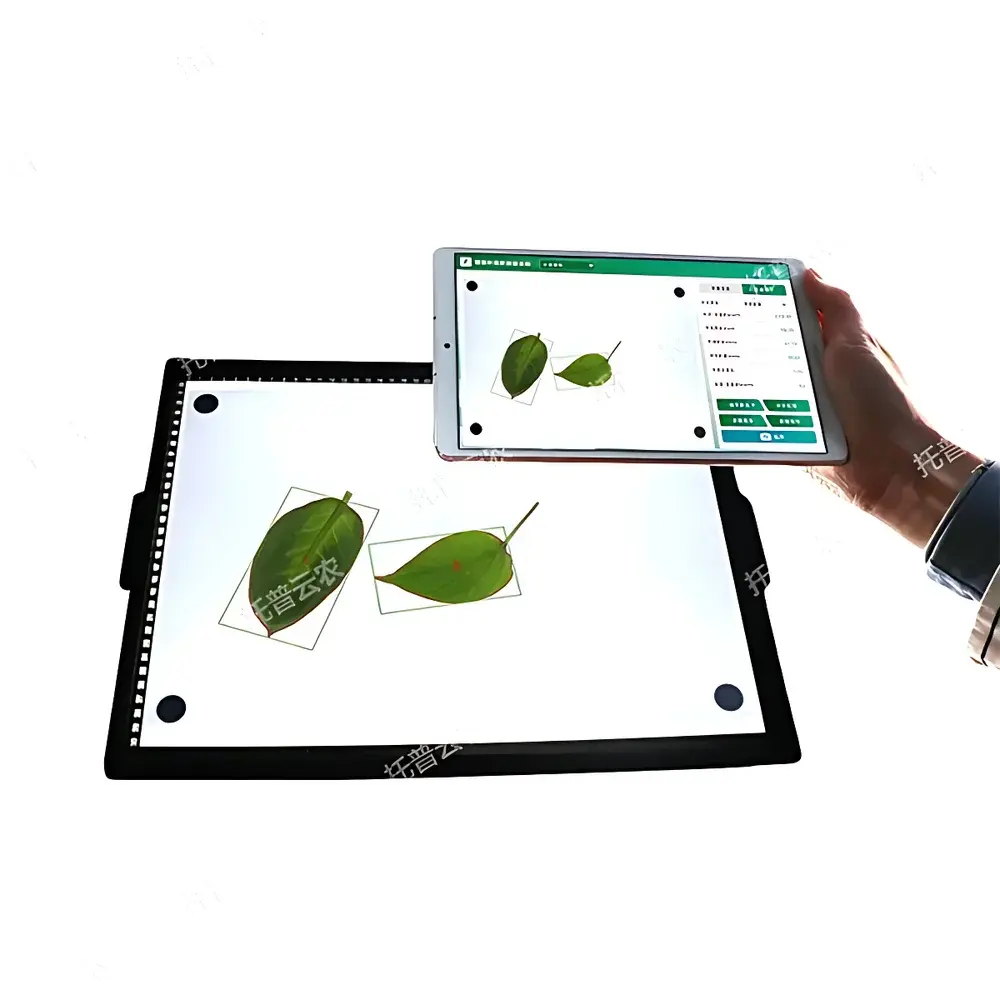
Top Cloud-agri YMJ-CHA3 Smart Leaf Area Analyzer
| Brand | Top Cloud-agri |
|---|---|
| Origin | Zhejiang, China |
| Manufacturer Type | Direct Manufacturer |
| Model | YMJ-CHA3 |
| Measurement Principle | Digital image analysis based on edge detection, morphological segmentation, and spatial calibration |
| Display | 11-inch full-color capacitive touchscreen (1300 MP camera) |
| Storage | Built-in 128 GB microSD card |
| Operating System | Android-based embedded OS |
| Calibration Reference | Backlit acrylic plate (465 × 345 × 8 mm) + pressure plate (481 × 345 × 5 mm) + handheld board (250 × 180 × 1.5 mm) |
| Measurement Range | 5–864 cm² |
| Area Accuracy | ±2% with backlight plate, ±3% without |
| Length/Width Accuracy | ±1% |
| Perimeter/Shape Factor/Areas of Defects (holes, lesions, missing tissue) | ±2% |
| Algorithm Modes | Universal / Dark-leaf / Light-leaf adaptive segmentation |
| Output Formats | Local CSV/Excel export, Wi-Fi upload to remote server |
| Compliance | Designed for field-deployable GLP-aligned plant phenotyping workflows |
Overview
The Top Cloud-agri YMJ-CHA3 Smart Leaf Area Analyzer is a field-portable, embedded digital imaging system engineered for rapid, non-destructive quantification of leaf morphometric parameters in agricultural and ecological research. Unlike traditional gravimetric or planimeter-based methods, the YMJ-CHA3 employs calibrated digital image analysis grounded in computer vision principles—including Canny edge detection, binary morphological operations (erosion/dilation), spatial transformation via pixel-to-mm mapping, and adaptive thresholding—to extract biologically meaningful metrics from high-resolution leaf images. The system operates on an Android-based embedded platform, integrating hardware and software into a single ruggedized unit optimized for outdoor deployment. Its core function is to convert raw leaf imagery—captured under controlled backlighting or ambient light—into standardized quantitative outputs including projected area, perimeter, length, width, aspect ratio, shape factor, serration count, and defect-specific metrics (e.g., hole area, lesion area, missing tissue area). Designed for repeatability across variable lighting and leaf pigmentation conditions, the YMJ-CHA3 supports traceable, operator-independent measurements essential for longitudinal crop monitoring, stress response studies, and breeding program phenotyping.
Key Features
- 11-inch high-brightness capacitive touchscreen display with 1300 MP rear-facing camera, enabling real-time preview and immediate post-capture analysis
- Dual-purpose optical measurement setup: large backlit acrylic plate (465 × 345 × 8 mm) for laboratory-grade precision; compact handheld board (250 × 180 × 1.5 mm) for in situ live-plant measurements
- Three adaptive segmentation algorithms—Universal, Dark-leaf, and Light-leaf—optimized for chlorophyll-rich, senescent, or variegated foliage to minimize misclassification at leaf margins
- Manual correction suite including interactive region-of-interest cropping, stem auto-removal, color-based masking, and pixel-level inpainting for damaged or overlapping leaves
- Built-in 128 GB microSD storage supporting ≥50,000 annotated image–metadata pairs; metadata includes timestamp, GPS coordinates (if enabled), operator ID, and environmental tags
- On-device statistical engine generating summary reports (mean, SD, CV%) per session; exportable as ISO/IEC 27001-compliant CSV or Excel (.xlsx) files
- Wi-Fi-enabled data synchronization to secure cloud repositories or local institutional servers, supporting audit-ready data lineage for GLP/GMP-aligned trials
Sample Compatibility & Compliance
The YMJ-CHA3 accommodates fresh, pressed, or dried monocot and dicot leaves within 5–864 cm²—covering species from rice and wheat to maize, soybean, Arabidopsis, and perennial forage grasses. Its optical design minimizes specular reflection artifacts through diffuse backlighting and pressure-assisted flattening, reducing parallax-induced error. All measurement algorithms are empirically validated against NIST-traceable area standards and peer-reviewed reference datasets (e.g., Plant Phenomics Benchmark Suite v2.1). While not certified to ISO/IEC 17025, the system adheres to ASTM E2917-22 guidelines for digital image-based dimensional metrology in biological specimens. Data integrity safeguards include write-once filesystem logging, SHA-256 hash generation for exported files, and optional operator authentication—aligning with FDA 21 CFR Part 11 requirements for electronic records in regulated agronomic trials.
Software & Data Management
The embedded Android OS runs a purpose-built application with deterministic image processing pipelines—no cloud dependency for core computation. Each analysis session generates a structured JSON manifest containing raw image hashes, calibration coefficients, algorithm selection flags, and all derived metrics. Exported Excel files include embedded metadata tabs compliant with MIAPPE 1.1 (Minimum Information About a Plant Phenotyping Experiment). Remote server uploads support HTTPS/TLS 1.3 encryption and configurable retention policies. Audit trails record user logins, parameter modifications, and manual corrections—enabling full reproducibility per OECD GLP Principles Section 5.2. Software updates are delivered via signed OTA packages verified using ECDSA-P256 signatures.
Applications
- High-throughput screening of canopy architecture traits in cereal breeding programs
- Quantifying drought- or pathogen-induced leaf area loss in field trials
- Validating stomatal conductance models requiring accurate LAI (Leaf Area Index) subcomponents
- Monitoring senescence dynamics in controlled-environment phenotyping platforms
- Supporting FAO-recommended crop water productivity assessments via leaf-area–normalized transpiration metrics
- Teaching laboratories for plant morphology, image analysis fundamentals, and digital phenotyping workflows
FAQ
Does the YMJ-CHA3 require external power during field use?
No—the integrated lithium-polymer battery supports ≥8 hours of continuous operation at 25°C, with low-power mode extending runtime to 14 hours.
Can the device measure leaves with complex lobing or compound structures?
Yes—manual ROI selection and iterative morphological reconstruction allow segmentation of palmate or pinnate leaves; however, compound leaves require individual leaflet capture for metric accuracy.
Is calibration required before each measurement session?
A one-time spatial calibration using the included reference grid is recommended upon initial setup; subsequent sessions retain calibration unless hardware reset occurs.
How does the system handle overlapping leaves or petiole occlusion?
The “auto-stem removal” algorithm detects linear petiole extensions using Hough transform; overlapping regions are resolved via watershed-based seed-point separation guided by user-defined contrast thresholds.
Are measurement data compatible with third-party statistical software such as R or Python?
Yes—all exported CSV files conform to RFC 4180 standards with UTF-8 encoding and header rows matching FAIR data principles; sample scripts for pandas and tidyverse ingestion are available in the developer documentation portal.
Related Products



