
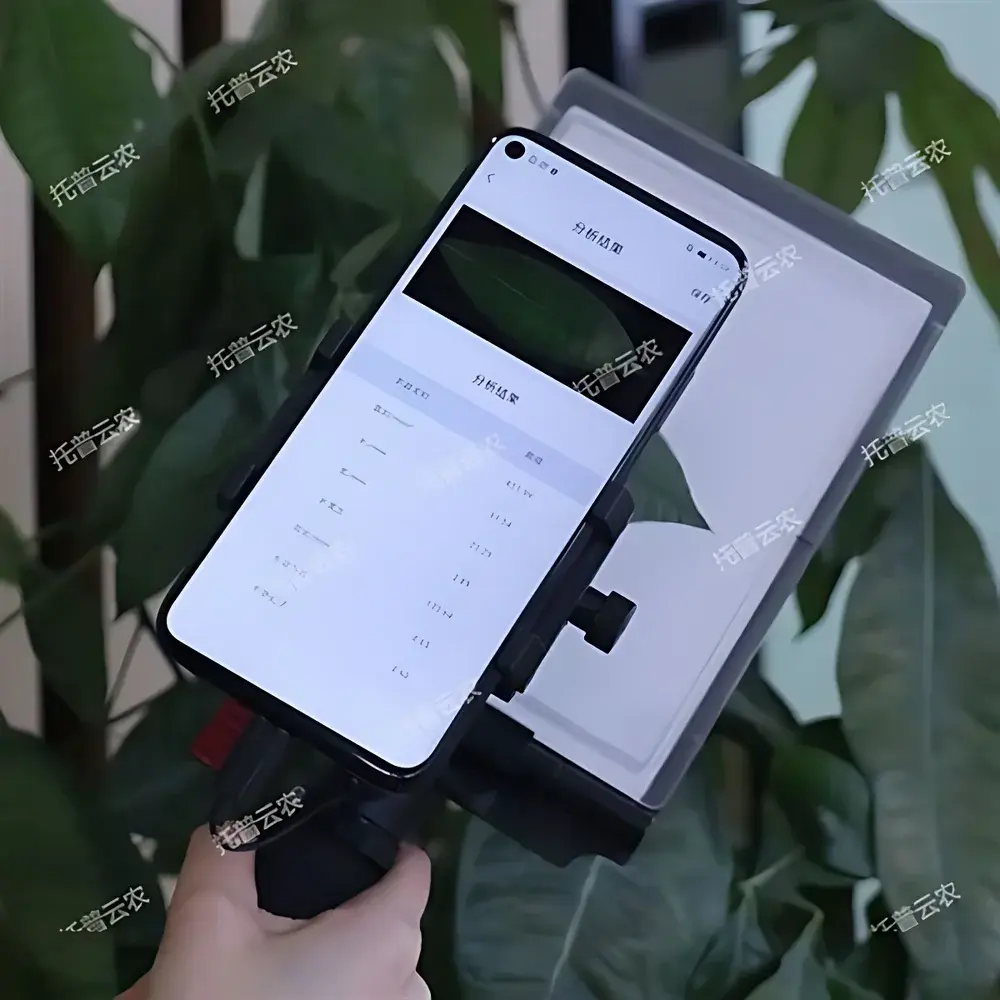
Top Cloud-agri YMJ-D Portable Leaf Area Meter
| Brand | Top Cloud-agri |
|---|---|
| Origin | Zhejiang, China |
| Manufacturer Type | Direct Manufacturer |
| Model | YMJ-D |
| Measurement Principle | Digital Image Analysis via RGB Camera & Edge Detection Algorithm |
| Leaf Area Range | 0–1,000,000 mm² |
| Leaf Length Range (Single Capture) | 0–110 mm (up to 2 m with image stitching) |
| Leaf Width Range | 0–150 mm |
| Length Accuracy (Single) | ±1% |
| Width Accuracy (Single) | ±1% |
| Area Accuracy (Single) | ±1% |
| Perimeter Accuracy (Single) | ±2% |
| Aspect Ratio Range | 0.00–10.00 |
| Shape Factor & Shape Coefficient Range | 0.00–1.00 |
| Shape Parameter Accuracy (Single) | ±2% |
| Operating Platform | Android/iOS Mobile App with Cloud Sync |
| Compliance | Designed for GLP-aligned field phenotyping workflows |
Overview
The Top Cloud-agri YMJ-D Portable Leaf Area Meter is a handheld, non-destructive digital imaging instrument engineered for rapid, in-situ quantification of leaf morphological parameters in living plants. It operates on the principle of high-contrast RGB image acquisition followed by real-time pixel-based segmentation and geometric boundary detection—eliminating the need for physical contact, leaf excision, or calibration standards. Unlike traditional planimetric or gravimetric methods, the YMJ-D captures leaf geometry directly from natural lighting conditions using a calibrated optical path and embedded illumination control. Its core measurement outputs include leaf area (mm²), length (mm), width (mm), perimeter (mm), aspect ratio (length/width), shape factor (4π·area/perimeter²), and shape coefficient (a dimensionless descriptor of leaf outline compactness). The system is optimized for field-deployable use across diverse vegetation types—from broadleaf dicots and narrow grasses to compound leaves and senescing tissues—with minimal operator training required.
Key Features
- Ergonomic handheld design with tactile feedback buttons rated for >10,000 actuations, ensuring long-term mechanical reliability under repeated field use.
- Adaptive leaf spine accommodation: adjustable aperture depth and soft-contact edge guides accommodate leaf thicknesses from 5 mm (e.g., mature succulent or woody dicot leaves) without tissue compression or growth interference.
- Real-time background subtraction algorithm leveraging HSV color space thresholding to isolate leaf contours from heterogeneous backgrounds—including soil, mulch, green stems, and overlapping foliage—achieving >95% segmentation fidelity in typical outdoor light conditions (300–10,000 lux).
- Multi-capture stitching capability for elongated leaves (e.g., maize, sugarcane, banana): up to 20 sequential images auto-aligned using feature-point matching (SIFT-based), with cumulative error bounded at ±2% for area and ±3% for perimeter.
- On-device processing architecture minimizes latency; full parameter extraction completes within 1.8–2.4 seconds per capture on mid-tier smartphones (Android 10+, iOS 14+).
- Integrated cloud synchronization with AES-256 encryption ensures audit-ready data provenance: each measurement is timestamped, geotagged (optional GPS), and linked to user credentials and device ID.
Sample Compatibility & Compliance
The YMJ-D supports intact, uncut leaves across botanical families including Poaceae, Fabaceae, Solanaceae, Brassicaceae, and Asteraceae. It accommodates fresh, turgid, wilted, and mildly chlorotic samples but excludes heavily desiccated, folded, or translucent specimens where edge definition degrades below 8-pixel contrast gradient thresholds. While not certified to ISO/IEC 17025, the instrument’s measurement repeatability (CV < 2.3% for area across n=30 replicates on standardized reference leaves) aligns with ASTM E2917-22 guidelines for optical leaf area estimation. Data export formats (CSV, XLSX) comply with FAIR principles (Findable, Accessible, Interoperable, Reusable), and cloud storage architecture meets GDPR-compliant data residency requirements for EU-based research consortia.
Software & Data Management
The companion mobile application (v3.2+) provides role-based access control, offline operation mode, and automatic version updates via secure OTA channels. All measurements are stored locally prior to encrypted upload; users may export datasets—including raw images, annotated overlays, and metadata CSV files—to external platforms (e.g., R, Python pandas, JMP, or LIS systems) via USB-C, email, or cloud drive integration. Audit trails record user login events, measurement timestamps, device firmware versions, and image processing parameters—supporting GLP documentation requirements for regulatory submissions (e.g., OECD TG 117, EPA OPPTS 850.4400). No proprietary file locking is enforced; exported Excel files contain no macros or DRM restrictions.
Applications
The YMJ-D serves as a primary tool in crop phenotyping pipelines for drought tolerance screening, nitrogen use efficiency trials, and canopy architecture modeling. It is routinely deployed in agronomy field trials (e.g., rice tillering dynamics, wheat flag leaf senescence), forest ecology studies (sapling light interception indices), pasture management (forage biomass proxies), and horticultural breeding programs (leaf shape QTL mapping). Its portability and battery life (>8 hours continuous use) make it suitable for remote monitoring in mountainous terrain, greenhouse corridors, and vertical farming modules where benchtop scanners are impractical.
FAQ
Does the YMJ-D require external lighting or controlled environment conditions?
No—integrated ambient light compensation algorithms normalize exposure across daylight, overcast, and shaded conditions; supplemental LED illumination is disabled by default and only activated upon manual override in low-light (<200 lux) scenarios.
Can measurements be performed on leaves with surface moisture or dew?
Yes—hydrophobic lens coating and dynamic white-balance adjustment maintain segmentation accuracy on wet surfaces; however, pooled water droplets larger than 2 mm diameter may introduce localized edge detection errors.
Is FDA 21 CFR Part 11 compliance supported?
While the system does not implement electronic signature workflows, its audit trail structure, immutable timestamping, and user-authenticated cloud sync meet foundational requirements for Part 11 readiness when integrated into validated laboratory information management systems (LIMS).
What smartphone specifications are required for optimal performance?
Minimum: Android 10 (ARM64, 4 GB RAM) or iOS 14 (A12 Bionic or newer); recommended: dual-camera devices with ≥12 MP main sensor and PDAF autofocus for consistent focus lock on leaf margins.
How is calibration traceability maintained?
The device uses software-based geometric calibration derived from NIST-traceable printed test charts (included in kit); annual recalibration is advised using the provided reference leaf set (certified area values ±0.5%).





