
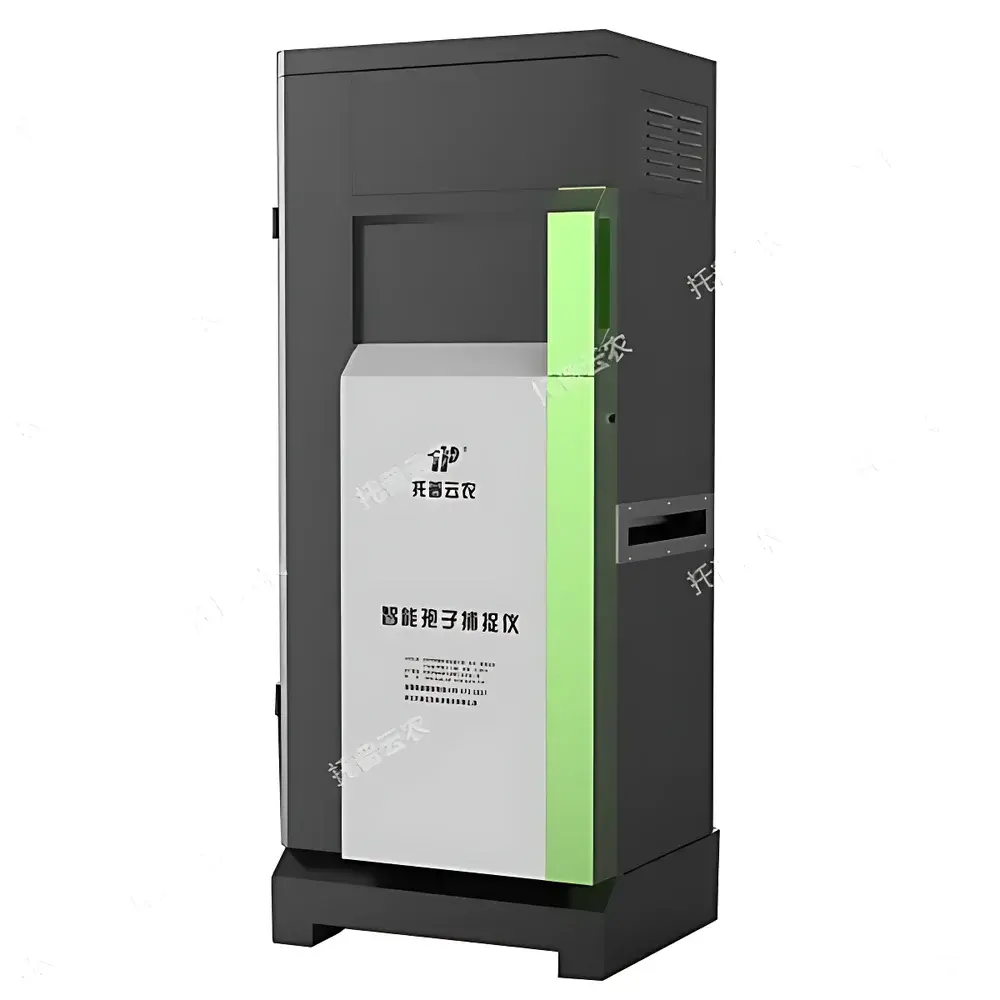
Top Cloud-agri TPSQ-BZ Intelligent Spore Trap with Remote Imaging and Automated Analysis System
| Brand | Top Cloud-agri |
|---|---|
| Origin | Zhejiang, China |
| Manufacturer Type | Direct Manufacturer |
| Country of Origin | China |
| Model | TPSQ-BZ |
| Instrument Category | Plant Pathogen Detection Instrument |
| Power Supply | AC 220V±10% or DC 12V (solar-compatible) |
| Max Power Consumption | 65 W |
| Standby Power (fan on) | 20 W |
| Standby Power (fan off) | 2 W |
| Camera | 5 MP, 20× optical zoom |
| Display | 10.4-inch touchscreen |
| Dimensions | 760 × 660 × 1850 mm |
| Operating Temperature | −30 °C to +70 °C |
| Operating Humidity | ≤98% RH |
| Air Sampling Flow Rate | 120 L/min |
| Sampling Duration Range | 60–1200 min |
| Capture Area per Slide | 50 × 8 mm |
| Image Capture Frequency | 1–100 images per cycle |
| Slide Cartridge Lifespan | 365 days (3 images/day) |
Overview
The Top Cloud-agri TPSQ-BZ Intelligent Spore Trap is an integrated environmental monitoring instrument engineered for continuous, unattended surveillance of airborne fungal spores in agricultural ecosystems. It operates on the principle of volumetric air sampling combined with high-resolution digital microscopy, enabling quantitative capture and morphological documentation of viable and inert spores across defined time intervals. Unlike passive traps or manual slide collection methods, the TPSQ-BZ employs active aspiration at a calibrated flow rate of 120 L/min, drawing ambient air through a standardized adhesive-coated glass tape (50 × 8 mm capture zone). Captured particles are imaged in situ using a 5-megapixel camera with 20× optical magnification and depth-fusion enhancement—delivering pseudo-3D clarity essential for taxonomic differentiation among morphologically similar genera (e.g., Puccinia, Blumeria, Alternaria). All imaging, metadata logging, and environmental telemetry (temperature, relative humidity, GPS coordinates) are synchronized and transmitted via cellular or Ethernet connectivity to a secure cloud-based analytics platform. Designed for deployment in orchards, vineyards, cereal fields, and greenhouse perimeters, the system supports predictive modeling of disease onset windows under evolving climatic conditions.
Key Features
- 24/7 autonomous operation with dual power options: AC 220 V ±10% or DC 12 V (compatible with 300 W solar panel + battery backup)
- Intelligent image curation algorithm that selects only in-focus, artifact-free spore images for upload—reducing bandwidth usage and analyst workload
- Real-time remote configuration via web interface: adjustable sampling duration (60–1200 min), image count per cycle (1–100), and daily schedule (24-hour clock)
- Integrated GPS module with geofence-triggered alerts for unauthorized relocation or physical tampering
- Onboard environmental sensor suite continuously monitors internal temperature and humidity to ensure optical stability and adhesive integrity of sampling tapes
- Automated slide usage tracking with low-tape warning and estimated replacement date—enabling proactive maintenance planning over full 365-day operational cycles
- 10.4-inch industrial-grade touchscreen for local diagnostics, manual triggering, and firmware updates without external hardware
Sample Compatibility & Compliance
The TPSQ-BZ is optimized for capturing and imaging dry, airborne propagules from obligate and facultative phytopathogenic fungi—including but not limited to Ustilago maydis, Phytophthora infestans sporangia, Fusarium graminearum macroconidia, and ascospores of Venturia inaequalis. Its standardized 50 × 8 mm adhesive tape format aligns with ISO 21527-1:2008 (microbiological methods for cereals and cereal products) and supports semi-quantitative enumeration protocols referenced in EPPO PM 7/106 (spore trapping guidelines for early warning systems). While not certified for regulatory submission under FDA 21 CFR Part 11, the system’s audit trail functionality—including timestamped image logs, user-access records, and configuration change history—meets GLP-aligned data integrity requirements for field research and extension service reporting.
Software & Data Management
Data acquisition and visualization occur through Top Cloud-agri’s proprietary AgriSporeCloud™ platform—a browser-accessible SaaS environment supporting role-based access control (RBAC), multi-site dashboard aggregation, and API-driven integration with third-party decision support systems (e.g., DSSAT, APSIM). Each uploaded image is tagged with EXIF metadata (GPS, UTC timestamp, exposure settings), environmental context (chamber temp/RH), and user-defined location tags. Manual annotation tools allow plant pathologists to classify spores by morphology, size range, and suspected host association. Statistical outputs include daily spore load trends, cumulative weekly totals, and comparative heatmaps across networked trap locations. All raw image archives and processed reports are retained for ≥24 months with optional cold-storage tiering compliant with ISO/IEC 27001 information security standards.
Applications
- Early detection of wheat leaf rust (Puccinia triticina) and stripe rust (P. striiformis) in national surveillance networks
- Monitoring Botrytis cinerea spore pressure in protected horticulture to optimize fungicide application timing
- Validating efficacy of biocontrol agents (e.g., Trichoderma spp.) by quantifying reductions in target pathogen spore counts
- Supporting climate-resilience studies on spore dispersal dynamics under elevated temperature and humidity regimes
- Enabling participatory epidemiology through farmer-accessible dashboards linked to regional advisory services
FAQ
How does the TPSQ-BZ differentiate between spore types without AI-based classification?
The system does not perform automated taxonomic identification. It delivers high-fidelity micrographs suitable for expert morphological analysis—retaining critical diagnostic features such as ornamentation, septation, germination pore position, and appendage structure.
Can the device operate reliably during extended rain or dust storms?
Yes. The enclosure meets IP65 ingress protection rating; internal desiccant and fan-assisted airflow prevent condensation buildup. Adhesive tape formulation resists hydrolysis and particulate masking under high-humidity (>95% RH) and airborne dust loads.
Is the sampling tape compatible with downstream molecular analysis (e.g., qPCR)?
The standard tape is optimized for optical imaging. For nucleic acid extraction, users may request optional sterile polyester-backed tapes validated for DNA recovery—subject to protocol adaptation and validation per ISO/IEC 17025 laboratory requirements.
What cybersecurity measures protect data transmission?
All communications use TLS 1.2+ encryption; device authentication employs X.509 certificates; and firmware updates are cryptographically signed and verified prior to installation.
Does the system support integration with national pest forecasting platforms like NAPIS or EuroBlight?
AgriSporeCloud™ provides RESTful APIs and CSV/GeoJSON export formats compatible with interoperability frameworks specified by EFSA and FAO for transnational disease monitoring initiatives.




