
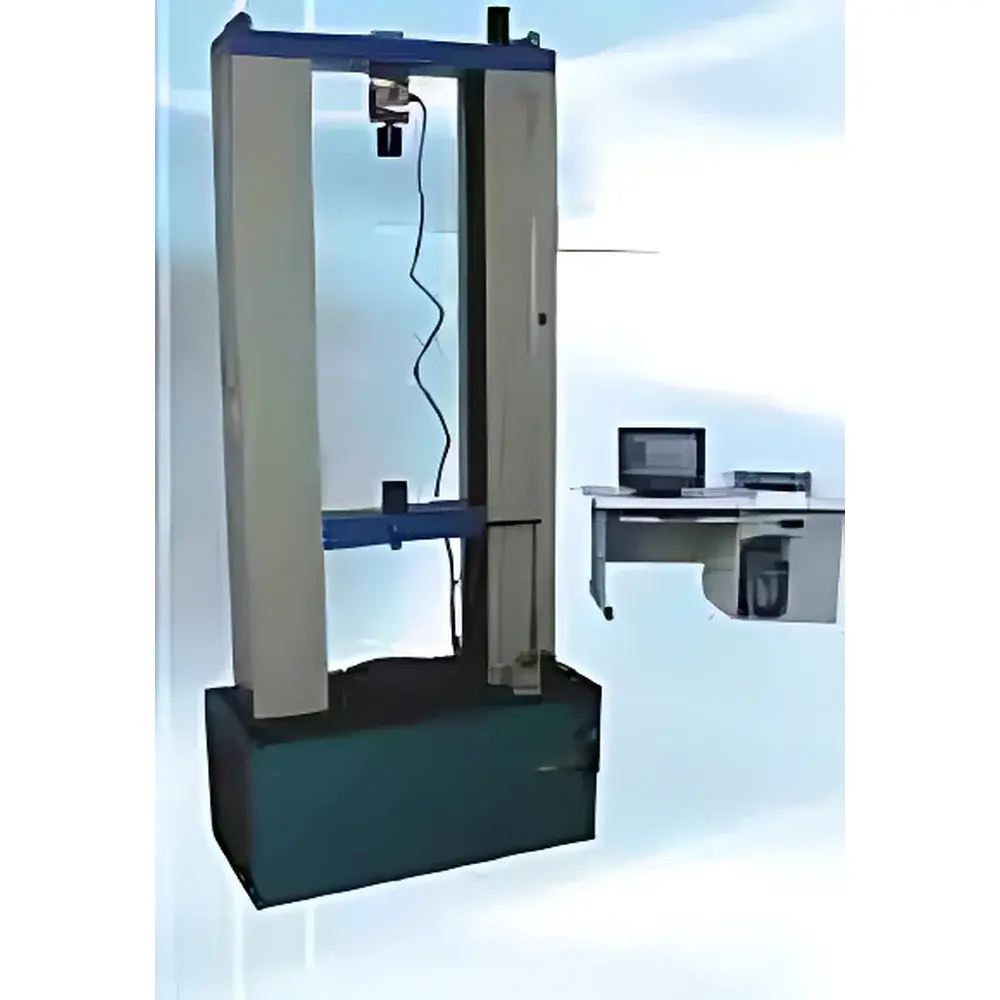
JB-124 Universal Testing Machine (UTM) – Tensile, Compression, Three-Point Bending & Shear Tester
| Brand | JByq |
|---|---|
| Origin | Taiwan |
| Model | JB-124 |
| Load Capacity | 0–20 kN (user-selectable) |
| Load Cell | High-Precision Load Cell (USA-made) |
| Load Accuracy | ±0.5% of full scale |
| Effective Test Width | 380 mm |
| Max. Tensile Travel | 1000 mm |
| Drive System | Servo Motor (Japan-made) |
| Mechanical Transmission | Precision Ball Screw (Taiwan-made) |
| Test Speed Range | 0.001–500 mm/min (infinitely variable, constant-rate mode) |
| Displacement Resolution | ±0.005% |
| Force Resolution | 1/200,000 full scale |
| Safety Features | Upper/Lower Limit Switches, Emergency Stop Button |
| Display | Dual-mode — PC-based software interface + Embedded microcomputer display |
| Power Supply | 220 V, 50 Hz |
| Net Weight | 1080 kg |
| Dimensions (W×D×H) | 900 × 600 × 1800 mm |
| Unit Options | g, kg, N, kN, lb, lbf |
Overview
The JB-124 Universal Testing Machine (UTM) is a floor-standing electromechanical testing system engineered for high-reproducibility mechanical property evaluation of metallic materials and structural components under uniaxial loading conditions. Based on the principle of controlled displacement-driven force measurement, the system applies precisely regulated tensile, compressive, bending, or shear loads to standardized or custom specimens while continuously recording load-displacement data in real time. Its modular architecture integrates a high-stiffness load frame, precision ball-screw actuation, and traceable load cell technology compliant with ISO 7500-1 Class 1 and ASTM E4 calibration standards. Designed for routine QC/QA laboratories and R&D environments, the JB-124 supports static mechanical characterization per ASTM E8/E21 (tensile), ASTM E9 (compression), ASTM C293/C78 (flexure), and ISO 6892-1/15630-1 test protocols.
Key Features
- Robust dual-display control architecture: synchronized operation via embedded microcomputer panel and Windows-based PC software — enabling both standalone bench operation and networked lab integration.
- Infinitely variable speed control from 0.001 to 500 mm/min, with programmable ramp-hold-step profiles suitable for quasi-static and low-speed dynamic testing.
- High-resolution force measurement (1/200,000 full-scale resolution) using a certified USA-manufactured load cell, calibrated to ±0.5% accuracy across the selected 0–20 kN range.
- Mechanically optimized frame with hardened steel crosshead, guided linear motion system, and precision-ground ball screw transmission (Taiwan-sourced) ensuring minimal axial play and long-term repeatability.
- Comprehensive safety suite including dual-position mechanical limit switches, hardware-triggered emergency stop circuitry, and overload protection logic integrated into the servo drive firmware.
- Modular fixture compatibility — standard single-set grip assembly included; optional accessories include extensometers (two-point or clip-on), compression platens, three-point bend fixtures, and shear adapters.
Sample Compatibility & Compliance
The JB-124 accommodates metallic specimens conforming to common international geometry standards: flat tensile bars (ASTM E8, ISO 6892-1), round rods (up to Ø25 mm), sheet coupons (0.1–6 mm thickness), and rectangular flexural beams (e.g., 10 × 10 × 80 mm per ASTM C293). Its 380 mm effective test width and 1000 mm vertical travel support ASTM D695-compliant compression testing of cast metals and sintered alloys. All hardware and firmware comply with CE Machinery Directive 2006/42/EC, and the load cell meets ISO 376 verification requirements. The system supports audit-ready documentation workflows aligned with GLP and ISO/IEC 17025 laboratory accreditation criteria.
Software & Data Management
The proprietary UTMControl software provides full test sequence programming, real-time curve visualization (load vs. displacement, stress vs. strain), and automated report generation in PDF/Excel formats. It includes built-in compliance modules for ASTM, ISO, and GB/T test methods, allowing users to pre-configure specimen geometry, test rate, failure criteria, and pass/fail thresholds. Raw data export supports CSV and ASCII formats for post-processing in MATLAB, Python (NumPy/Pandas), or third-party statistical analysis tools. Audit trail functionality logs all user actions, parameter changes, and calibration events — satisfying FDA 21 CFR Part 11 requirements when deployed with electronic signature validation.
Applications
- Tensile property quantification: yield strength (Rp0.2), ultimate tensile strength (Rm), elongation at break (A%), and Young’s modulus (E) of aluminum alloys, stainless steels, copper foils, and titanium grades.
- Compression testing of ductile cast iron, powder metallurgy compacts, and heat-treated bearing steels under controlled strain rates.
- Three-point bending evaluation of welded joints, extruded profiles, and thin-walled tubing — determining flexural strength (σf) and modulus (Ef) per ISO 178.
- Shear strength assessment of riveted lap joints, brazed interfaces, and adhesive bonds using custom shear fixtures.
- Quality conformance verification for automotive fasteners, aerospace sheet metal components, and medical device substrates prior to sterilization or coating processes.
FAQ
What load capacity options are available for the JB-124 series?
The JB-124 is factory-configured for a maximum capacity of 20 kN (≈2040 kgf); users may select lower sub-ranges (e.g., 5 kN, 10 kN) during setup to optimize resolution and accuracy for lightweight specimens.
Is the system compatible with external extensometers?
Yes — the machine features analog and digital input channels supporting industry-standard clip-on, video, or laser extensometers (e.g., Zwick Roell, MTS, or Tinius Olsen models) for true strain measurement.
Can test data be exported to LIMS or ERP systems?
Raw data files (CSV/ASCII) and structured reports (XML-based templates) can be automatically routed to network folders or integrated via OPC UA or REST API extensions upon request.
Does the system meet ISO/IEC 17025 traceability requirements?
When paired with an accredited calibration certificate (NIST-traceable load cell and displacement transducer), the JB-124 satisfies metrological traceability clauses of ISO/IEC 17025:2017 Section 6.4.
What maintenance intervals are recommended?
Lubrication of ball screws and guideways every 500 operational hours; annual recalibration of load cell and position encoder; biannual verification of emergency stop response time and limit switch actuation thresholds.



