
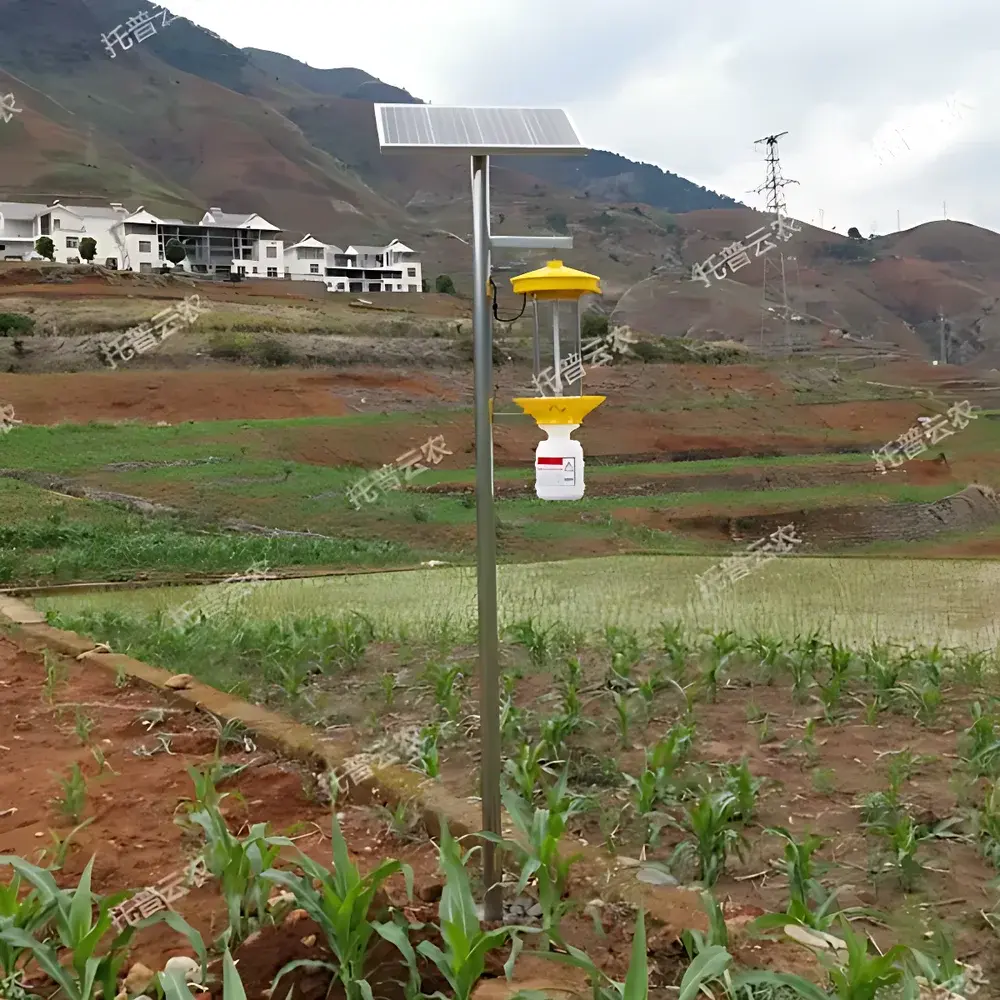
Solar-Powered Frequency-Vibration Insect Trap Lamp TPSC3 Series
| Brand | Top Cloud-agri |
|---|---|
| Origin | Zhejiang, China |
| Manufacturer Type | Direct Manufacturer |
| Product Origin | Domestic (China) |
| Model | TPSC3 Series |
| Instrument Category | Pest Monitoring and Forecasting Device |
| Key Features | Frequency-vibration phototactic trapping, solar-rechargeable DC power system, multi-mode automatic control (photocell, timer, rain sensor), stainless-steel high-voltage grid (Φ2 mm 304 SS), adjustable-height pole, eco-friendly pest suppression with 1:97.6 benefit-to-harm ratio |
| Technical Specifications | Power Supply: Sealed lead-acid battery, DC 12 V |
| Solar Panel Output | ≥40 W |
| Grid Voltage | 5000 V ± 500 V |
| Impact Area | ≥0.25 m² |
| Rated Power Consumption | ≤18 W |
| Standby Power | ≤0.5 W |
| UV-Visible Light Source Wavelength | 320–680 nm |
| Effective Coverage | 30–50 mu (≈2–3.3 ha) |
| Service Life | 3–5 years |
Overview
The Solar-Powered Frequency-Vibration Insect Trap Lamp TPSC3 Series is an autonomous, off-grid pest monitoring and suppression instrument engineered for long-term deployment in agricultural, horticultural, forestry, and peri-urban environments where grid electricity is unavailable or unreliable. Unlike conventional AC-powered traps, the TPSC3 Series integrates photovoltaic energy harvesting with frequency-modulated optical stimulation to achieve sustained, low-maintenance operation. Its core principle relies on phototaxis—exploiting the innate attraction of nocturnal flying insects to specific spectral bands (320–680 nm)—combined with mechanical disruption via a high-voltage electrocuting grid. This dual-mode approach enables continuous, real-time pest pressure assessment while delivering scalable physical control. Designed for integration into integrated pest management (IPM) frameworks, the device supports ecological stewardship by preserving beneficial arthropods—demonstrated by a documented benefit-to-harm ratio of 1:97.6 under field conditions.
Key Features
- Frequency-vibration phototactic stimulation: Emits pulsed broad-spectrum visible and near-UV light (320–680 nm) optimized for Lepidoptera, Coleoptera, Diptera, and Hemiptera attraction without reliance on chemical lures.
- Triple-mode intelligent control system: Automatically switches between photocell-triggered (dusk-to-dawn), programmable time-based, and rain-activated shutdown modes to conserve battery and extend component life.
- Corrosion-resistant high-voltage grid: Constructed from precision-welded 304 stainless steel wire (Φ2 mm), rated at 5000 V ± 500 V, ensuring stable performance in humid, saline, or acidic field environments.
- Modular, height-adjustable support structure: Pole options include hot-dip galvanized steel (TPSC3-1) or full stainless-steel (TPSC3-3), enabling optimal placement across orchards, tea plantations, vegetable plots, and forest edges.
- Energy-autonomous architecture: 40 W monocrystalline solar panel charges a sealed 12 V lead-acid battery; system draws ≤18 W during operation and only ≤0.5 W in standby—supporting >15 days of continuous operation under overcast conditions.
Sample Compatibility & Compliance
The TPSC3 Series is validated for consistent capture efficacy across major agricultural pest taxa, including Plutella xylostella, Chilo suppressalis, Athetis lepigone, Anomala corpulenta, and Bactrocera dorsalis. It complies with national standards for agricultural pest monitoring equipment (NY/T 2147–2012, People’s Republic of China). While not classified as a medical or laboratory diagnostic device, its data output supports GLP-aligned field trial documentation when used within structured IPM protocols. No hazardous substances are emitted during operation; all materials meet RoHS Directive 2011/65/EU restrictions on lead, cadmium, mercury, and hexavalent chromium.
Software & Data Management
The TPSC3 Series operates as a standalone hardware platform without embedded firmware or cloud connectivity. However, it is fully compatible with third-party digital pest surveillance systems—including Top Cloud-agri’s proprietary AgriVision™ ecosystem—via manual daily/weekly catch count logging. Collected specimens can be geotagged and annotated using standard mobile applications (e.g., iNaturalist, AgriLog) for trend analysis. For regulatory reporting, trap catch records align with FAO Pest Risk Analysis (PRA) templates and support traceability requirements under ISO 22000-compliant food safety management systems.
Applications
- Large-scale crop protection: Deployment across rice paddies, cotton fields, and fruit orchards for early detection and suppression of migratory moth populations.
- Specialty horticulture: Targeted use in tea gardens and greenhouse perimeters to monitor Adoxophyes honmai and other leafroller species without disrupting pollinator activity.
- Urban green infrastructure: Installation along park borders and municipal greenways to reduce nuisance Diptera and mosquito vectors in compliance with WHO Integrated Vector Management (IVM) guidelines.
- Ecological research: Quantitative sampling for biodiversity baseline studies, phenology tracking, and climate-driven pest range shift modeling.
- Extension service toolkits: Used by agricultural cooperatives and county-level plant protection stations for participatory pest forecasting and farmer field school demonstrations.
FAQ
Is the TPSC3 Series certified for export to the EU or North America?
The unit meets CE marking prerequisites for low-voltage directive (LVD 2014/35/EU) and electromagnetic compatibility (EMC 2014/30/EU); however, formal CE certification requires end-user country-specific notified body validation. It is not FDA-registered, as it falls outside the scope of medical or food-contact devices.
Can trap catch data be exported in CSV or JSON format?
Raw catch counts are manually recorded; digital export requires integration with external platforms such as Top Cloud-agri’s AgriVision™ API or open-source tools like QGIS + KoboToolbox for structured data ingestion.
What maintenance intervals are recommended for field deployment?
Grid cleaning every 7–10 days in high-dust environments; battery replacement every 2–3 years; solar panel surface inspection quarterly; stainless-steel pole integrity check annually per ISO 12944 corrosion classification C3/C4.
Does the device comply with IPM certification requirements?
Yes—it satisfies Criterion 4.2 (Monitoring Tools) of the GLOBALG.A.P. Integrated Farm Assurance Standard v6.0 and supports documentation for USDA-NOP Organic System Plans requiring non-chemical pest surveillance methods.






