
Top Cloud-agri TP-GTL-WGS High-Throughput Potted Fruit Tree Phenotyping System
| Brand | Top Cloud-agri |
|---|---|
| Origin | Zhejiang, China |
| Manufacturer Type | OEM/ODM Manufacturer |
| Region of Origin | Domestic (China) |
| Model | TP-GTL-WGS |
| Pricing | Upon Request |
Overview
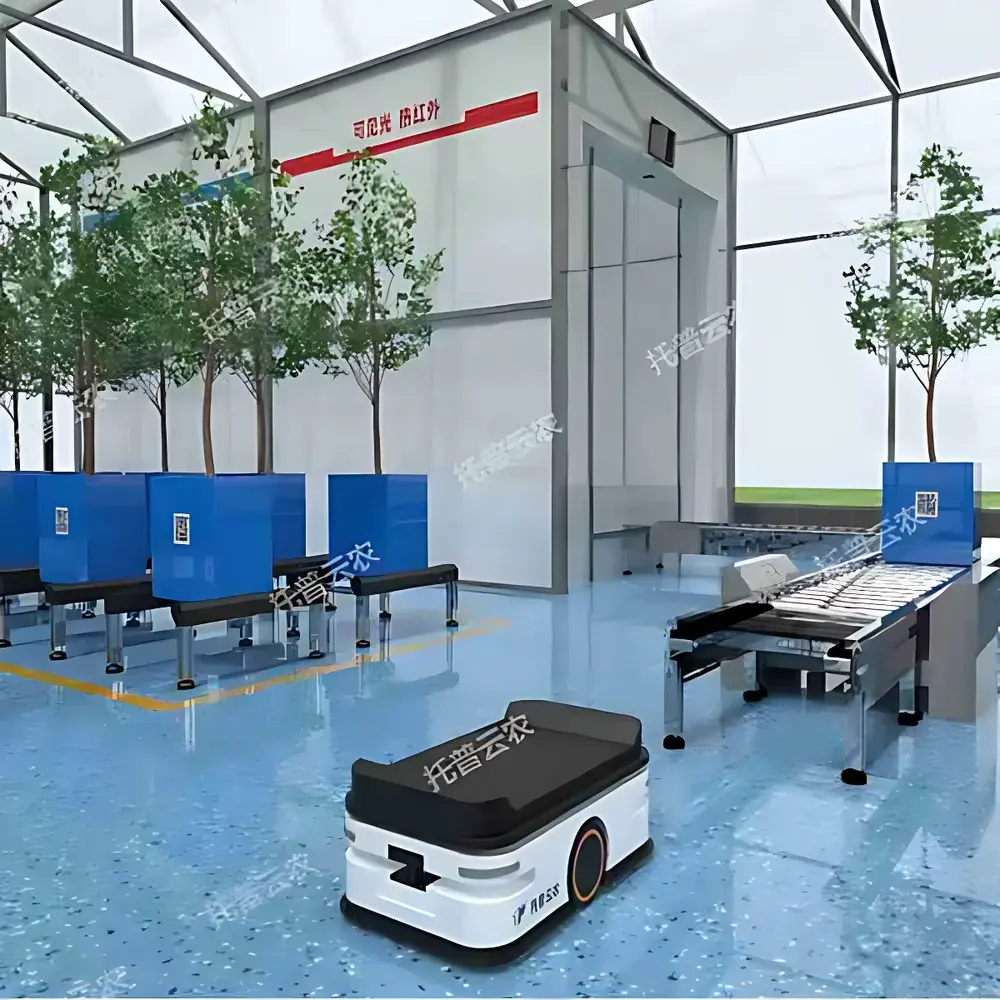
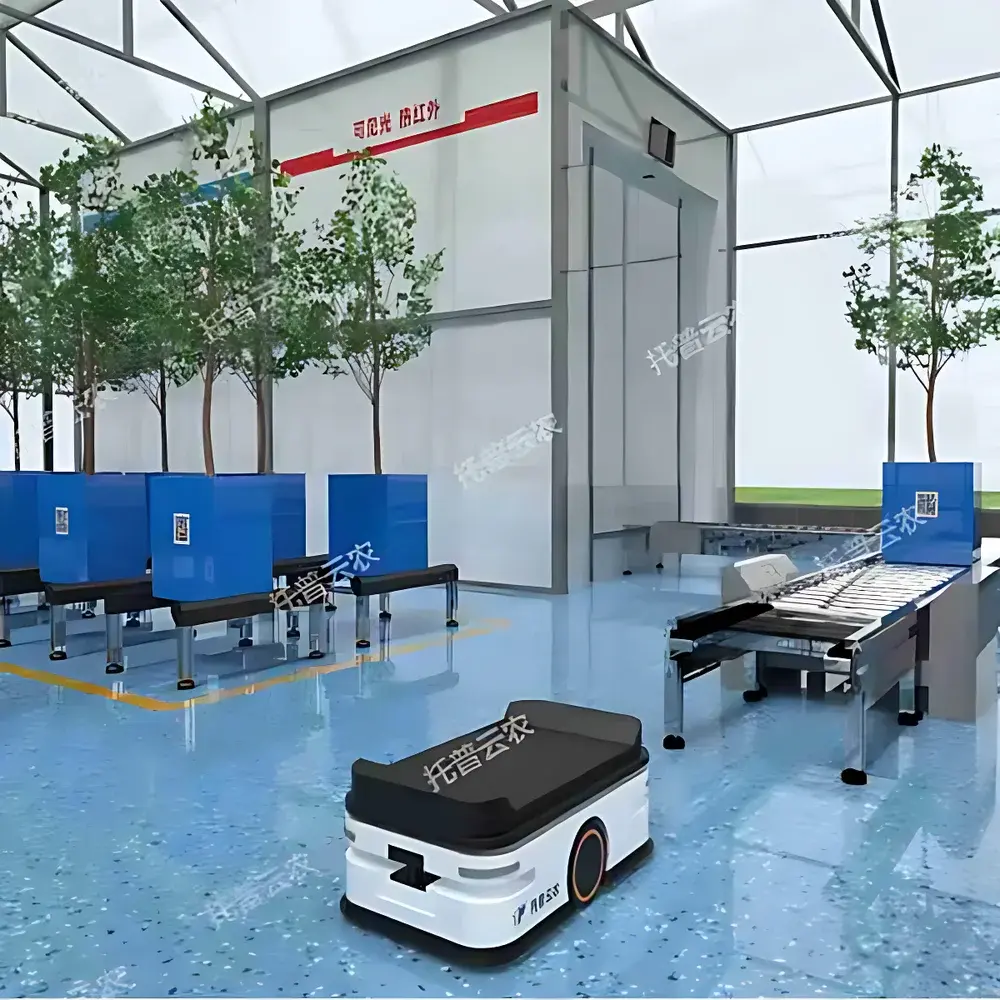
The Top Cloud-agri TP-GTL-WGS High-Throughput Potted Fruit Tree Phenotyping System is an integrated, single-chamber phenomics platform engineered for controlled-environment research in greenhouses and growth chambers. It employs a multi-modal imaging architecture—combining high-resolution visible-light 2D/3D imaging and push-broom hyperspectral acquisition—to enable non-invasive, quantitative, and repeatable measurement of morphological, structural, physiological, and biochemical traits in potted fruit trees and other horticultural crops. The system operates on the principle of automated spatial-temporal phenotyping: plants are conveyed through a precisely controlled dark chamber where synchronized sensor triggers acquire co-registered image stacks under standardized illumination conditions. This ensures high reproducibility across time-series experiments—critical for longitudinal studies of growth dynamics, abiotic stress response (e.g., drought, salinity), biotic stress progression (e.g., fungal infection, viral symptoms), and genotype-by-environment (G×E) interaction analysis.
Key Features
- Modular Conveyor-Based Workflow: A motorized, adjustable-speed conveyor belt (0–13 m/min, ±2 mm positional accuracy) transports standardized plant trays into a light-isolated imaging chamber. Each tray accommodates up to 10 potted specimens (max. height: 2 m; max. canopy diameter: 1 m; max. tray load: 100 kg).
- RFID-Enabled Sample Traceability: Integrated RFID readers automatically detect plant-specific identifiers upon entry, binding all acquired images and derived metrics to unique digital plant IDs—enabling full experimental auditability and GLP-compliant data lineage.
- Multi-Sensor Synchronization: All imaging modalities (RGB 2D, RGB 3D, hyperspectral) are hardware-triggered and time-aligned, ensuring pixel-level registration across datasets for cross-modal feature fusion and validation.
- Embedded AI-Powered Phenotype Analytics: Pre-trained deep learning models perform real-time image segmentation, plant region extraction, and trait quantification without manual intervention—supporting rapid batch processing of hundreds of plants per day.
- Expandable Sensor Ecosystem: Optional modules—including high-precision weighing sensors (for biomass trajectory tracking), environmental monitoring nodes (temperature, RH, PAR), and custom spectral band filters—allow functional extension per experimental protocol.
Sample Compatibility & Compliance
The TP-GTL-WGS is optimized for potted woody and herbaceous fruit species including Malus domestica, Pyrus communis, Citrus sinensis, Prunus persica, and Vitis vinifera, as well as model perennials and ornamental shrubs. Its mechanical design conforms to IEC 61000-6-2 (EMC immunity) and ISO 13857 (safety distances). The software architecture supports ALCOA+ principles (Attributable, Legible, Contemporaneous, Original, Accurate, Complete, Consistent, Enduring, Available) and enables configuration for 21 CFR Part 11 compliance via optional electronic signature and audit trail modules. Data storage adheres to ISO/IEC 27001-aligned encryption protocols during local transfer and archival.
Software & Data Management
The unified Phenotrack™ Control Suite provides end-to-end workflow orchestration—from device calibration and imaging task scheduling to batch analysis and report generation. All raw images and metadata are stored in vendor-agnostic HDF5 containers with embedded EXIF and sidecar JSON descriptors. Users can execute retrospective queries by plant ID, treatment group, acquisition timestamp, or phenotypic threshold (e.g., “all samples with NDVI < 0.45 on Day 14”). Export formats include CSV, PNG/TIFF (with georeferenced overlays), STL (for 3D mesh visualization), and NetCDF (for hyperspectral cube interoperability with ENVI, Python’s scikit-image, or R’s hyperSpec). QR code generation and printing tools integrate directly with LIMS-compatible sample registration workflows.
Applications
- Longitudinal monitoring of canopy architecture development in breeding nurseries
- Quantitative assessment of drought-induced leaf rolling, chlorosis, and senescence kinetics
- High-resolution mapping of pathogen-induced necrotic lesion expansion and spectral shift patterns
- Correlation modeling between hyperspectral vegetation indices (e.g., MCARI, PRI, SIPI) and destructive biochemical assays (chlorophyll, anthocyanin, nitrogen)
- Validation of QTL-associated morphological markers under controlled stress gradients
- Training and benchmarking of crop-specific CNN architectures using ground-truthed, multi-year phenomic datasets
FAQ
What is the maximum throughput capacity per hour?
Typical throughput ranges from 60–120 potted plants/hour depending on imaging modality selection, resolution settings, and post-acquisition analysis depth.
Can the system operate in ambient greenhouse lighting?
No—the integrated dark chamber eliminates ambient light interference; all imaging occurs under calibrated LED or halogen illumination to ensure spectral and radiometric consistency.
Is third-party algorithm integration supported?
Yes—via documented RESTful API and Python SDK, users may deploy custom PyTorch/TensorFlow models for trait extraction or extend the analysis pipeline with domain-specific spectral unmixing routines.
Does the system comply with FAIR data principles?
Yes—metadata follows ISA-Tab conventions; raw data files include mandatory provenance fields (instrument ID, operator, calibration date, environmental log); export functions support schema-mapped deposition to repositories such as Phenome Network or EGA.
What maintenance intervals are recommended for optical components?
Annual recalibration of camera intrinsics and spectral response curves is advised; LED source output stability is monitored continuously and logged with each acquisition session.






